Formtastic 6.0: A Rails Form Builder That Puts Semantics Before Speed
GitHub describes it as A Rails form builder plugin with semantically rich and accessible markup.. The repository metadata lists Ruby as its primary language. The metadata lists the MIT license. This article stays within the project description and details documented in the GitHub repository README.
At a glance
- What is it?
- Formtastic is a mature Rails form builder DSL that generates accessible, class-heavy HTML. The new 6.0 release raises the Rails floor to 7.2, but its ActiveRecord focus and extra markup are trade-offs you should weigh before adopting.
- Who is it for?
- Adopt Formtastic if you want a Rails form DSL that emits structured fieldsets, lists, and class hooks for styling and accessibility, and you are already on Rails 7.2 with Ruby 3.1. Skip it if you need to support older Rails versions, work with non-ActiveRecord ORMs without patching, or prefer lean, minimal HTML output.
- Can I use it commercially?
- Yes. MIT is a permissive licence: you can use, modify and sell software built on it, as long as you keep its copyright and licence notices.
- Is it still maintained?
- Activity is slowing. The repository last received commits 7 months ago.
- What is it written in?
- Mainly Ruby, according to GitHub's language statistics.
Answers come from the project's GitHub data, last synced on October 22, 2026, and from our analysis. They are not legal advice.
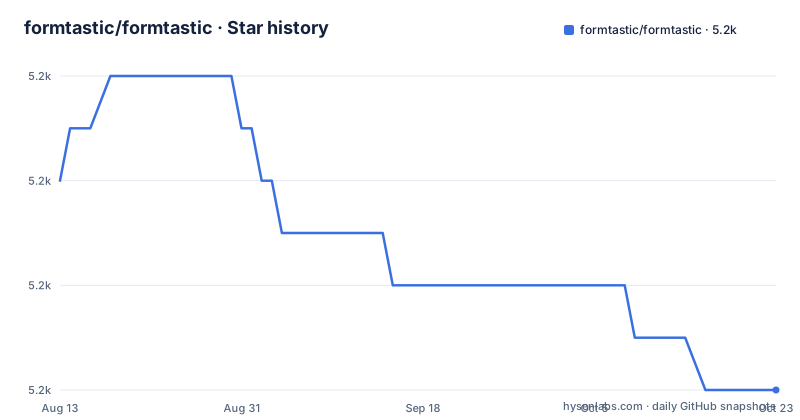
Star history
- formtastic/formtastic5,210 ★ · -4
| Repository | 2026-08-13 | 2026-10-22 |
|---|---|---|
| formtastic/formtastic | 5.2k | 5.2k |
-4 Stars in the last 70 days, measured from the daily GitHub snapshot. Compare with other projects
Editorial analysis
What Formtastic Solves and Who It Targets
Formtastic addresses a specific annoyance: writing Rails forms by hand produces repetitive, inconsistent markup that is hard to style and hard to make accessible. The library offers a DSL that hides the boilerplate and emits a predictable structure of fieldsets, lists, labels, and inputs. The target user is a Rails developer who cares about CSS hooks and semantic HTML, not just functional forms. The README's story is explicit: the author wanted a DSL that generates 'semantically rich, syntactically awesome, readily stylable and wonderfully accessible' output. That is a strong claim. The library is not for everyone. If you are happy with Rails' default form helpers and just want a submit button, Formtastic adds a layer of abstraction you may not need. It is aimed at projects where forms are a significant part of the UI and where consistency across many fields matters more than minimal output.
How the DSL Works: From Model to Markup
The core mechanism is a custom form builder that overrides Rails' form_for. You call semantic_form_for with a model, then use f.inputs and f.input to declare fields. The builder inspects the model's columns and associations to infer input types. For a belongs_to association, it renders a select or radio group with choices from the parent model. For has_many or has_and_belongs_to_many, it renders a multi-select. The README shows that f.inputs with no arguments produces an input for most database columns and each belongs_to association. That is a fast way to scaffold a form, but the README explicitly warns it is not for production. The DSL supports explicit control via the :as option to force an input type, and you can pass :label, :hint, and :required to fine-tune each field. The output is not just a flat set of inputs. It wraps fields in fieldsets and lists, which gives CSS authors a stable structure to target. That structure is the heart of the library's value. It trades a bit of verbosity in your view for a lot of consistency in the HTML.
Getting Started: Commands and Configuration
Installation is straightforward. Add the gem to your Gemfile with a version constraint, then run the generator. The README shows gem 'formtastic', '~> 5.0', but the current release is 6.0.0, so you would use a 6.x constraint. After bundling, run rails generate formtastic:install. That generator likely copies an initializer and maybe locale files, though the README does not detail what it creates. There is also an optional stylesheet generator: rails generate formtastic:stylesheet. That installs a proof-of-concept stylesheet, which the README calls 'optional'. You can skip it if you have your own CSS. The usage examples show that the DSL works inside ERB templates. You write <%= semantic_form_for @user do |f| %> and then use f.inputs and f.actions. The f.actions block renders default submit and cancel buttons, and you can customize them with :as => :button or :as => :link. There is no mention of a JavaScript component or a build step; this is server-rendered HTML.
Compatibility and the Rails 7.2 Floor
The 6.0 release, dated 2026-02-20, sets a hard floor: Formtastic 6.x requires Rails 7.2 and Ruby 3.1 minimum, matching Rails' own minimum supported versions. That is a significant jump from the 5.x line, which required Rails 6.0 and Ruby 2.6. If you are on Rails 7.1 or earlier, you cannot upgrade to Formtastic 6.0 without also upgrading Rails. The README also states that Formtastic is 'very ActiveRecord-centric'. It works with other ActiveModel-like ORMs such as Mongoid or DataMapper, but the project does not guarantee full compatibility. That is a real constraint. If your project uses a non-ActiveRecord ORM, you may need to patch or test extensively. The README invites patches, which is a sign that the core team does not treat those ORMs as first-class. For a library that promises accessibility and rich markup, the compatibility constraint is a practical gate. You should check your Rails version before adding this gem.
Real Limitations: Markup Volume and the Lazy Path
Formtastic deliberately generates more markup than Rails' default helpers. The README's opinions section says 'Sometimes more mark-up is better.' That is a design philosophy, but it has a cost. The extra fieldsets, lists, and class attributes make the HTML heavier and can complicate debugging. If you are on a team that prefers minimal DOM, this library will fight you. Another limitation is the 'lazy' path: calling f.inputs with no arguments infers fields from the database schema. The README warns it is 'not recommended for production' and calls it scaffolding. That is a clear failure mode. If you use that shortcut in a real app, you will expose fields you did not intend, and you will have no control over ordering. The library pushes you toward explicit field lists, which is good, but the easy path is a trap. The README also mentions HTML5 support is 'growing', not complete. You can use new input types like email and phone, but not every HTML5 feature is guaranteed.
Alternatives: Rails Default Helpers and Simple Form
The most direct alternative is Rails' built-in form helpers, form_with and form_for. They give you minimal markup and full control, but you write more code and you lose the automatic association handling and the semantic structure. Formtastic's value is that it saves you from writing that boilerplate. Another alternative is Simple Form, a popular Rails form builder that also provides a DSL. Simple Form focuses on configuration and integration with CSS frameworks like Bootstrap, whereas Formtastic emphasizes semantic markup and accessibility. The difference in approach is clear: Simple Form gives you a configuration file to define default input types and wrappers, while Formtastic hard-codes its fieldset-and-list structure. If you want to customize the wrapper HTML heavily, Simple Form may be easier. If you want a consistent, accessible structure out of the box, Formtastic's opinionated output is the point. Neither library is a drop-in replacement; you would have to rewrite your views if you switch.
Maintenance, License, and Upgrade Cost
Formtastic is an MIT-licensed open source project with an active release history. The 6.0.0 release came on the same day as a 6.0.0.alpha, which suggests a rapid finalization after a period of development. The repository is not archived, and the last push is the release date, so maintenance appears ongoing. The upgrade cost from 5.x to 6.x is tied directly to your Rails version. Since 6.x requires Rails 7.2, you must upgrade Rails first, which is a major undertaking for many apps. The README does not provide a changelog or migration guide in the supplied material, so you should check the GitHub releases or wiki for breaking changes. The license is MIT, which is permissive and allows commercial use without copyleft obligations, but that is not legal advice. The project's test coverage is described as 'absolutely awesome', which is a subjective claim, but it suggests a maintained test suite. For a library that generates HTML, you should also budget time to update any CSS that depends on the exact class names and structure, as those may change between major versions.
Editorial conclusion
Adopt Formtastic if you want a Rails form DSL that emits structured fieldsets, lists, and class hooks for styling and accessibility, and you are already on Rails 7.2 with Ruby 3.1. Skip it if you need to support older Rails versions, work with non-ActiveRecord ORMs without patching, or prefer lean, minimal HTML output. Before committing, verify that your model associations and custom inputs behave as expected under the new 6.0 release, and test the generated markup against your accessibility requirements, since the library's promise of 'accessible' markup is not formally certified.
Frequently asked questions
What is Formtastic?
A Rails form builder plugin expressed as a DSL, aimed at semantically rich and accessible markup. It infers inputs from a model's columns and its belongs-to associations, emits multi-selects for the has-many and join associations, and lets you override the label, the hint text, the required flag, the input type and the fieldset layout for any field.
How do I install Formtastic?
Add the gem to your Gemfile and run the install generator, which writes the initial configuration. A second generator writes an optional proof-of-concept stylesheet. Note that the readme's Gemfile line pins the previous major version while the newest release raises the minimum for both the framework and the language.
Does Formtastic work with recent Rails versions?
The compatibility section says the 6.x line requires a framework release and a language release as minimums, described as matching what the framework itself supports, and that the 5.x line required the previous pair. A bullet elsewhere in the readme still names two much older major versions of the framework, which appears to be left over from an earlier era.
Does Formtastic work with MongoDB or with other object mappers?
The readme says the library is very tied to the default mapper, and that many people are successfully using it with other ActiveModel-like mappers and objects, naming several document store mappers and authentication libraries. It then says full compatibility is not guaranteed at this stage and that patches are welcome, which is the sentence to quote if you are not on the default mapper.
Can I use Formtastic's inferred inputs in production?
The readme describes the bare helper, which renders an input for most columns plus one per belongs-to association followed by a submit action, as the fastest way to get something working, then compares it to scaffolding and says it is not recommended for production. The documented path is to keep the inference and override the fields it got wrong.
Official sources
Add this badge to your README
If you maintain this project, the badge below links readers to this analysis and shows its maintenance status from the daily GitHub snapshot. Paste the markdown into your README; add ?metric=license or ?metric=stars to the image URL for a different field.

[](https://hysenlabs.com/projects/formtastic-formtastic)Star history chart for your README
[](https://hysenlabs.com/projects/formtastic-formtastic)