HKUDS OpenSpace: the skill layer under AgentPilot, a policy that picks your agent's next trial
"OpenSpace: The Skill Management Layer for AI Agents" -- https://open-space.cloud/
At a glance
- What is it?
- The HKUDS/OpenSpace repository started as a skill management layer for AI agents and now ships AgentPilot on top of it: a Python decision layer that tells agents such as Codex and Claude Code what to try next. This piece covers how the two parts fit, how installation works, and what you need before running it.
- Who is it for?
- OpenSpace with AgentPilot suits people who run long, trial-heavy agent loops, such as algorithm search or deep research, and want a policy to decide what to try next and where to spend the trial budget. It is a poor fit if you want a small, well-understood dependency, since AgentPilot v1.0.0 was only tagged on 1 November 2026 and the install path is an instruction your agent carries out.
- Can I use it commercially?
- Yes. MIT is a permissive licence: you can use, modify and sell software built on it, as long as you keep its copyright and licence notices.
- Is it still maintained?
- Yes. The repository last received commits 2 days ago.
- What is it written in?
- Mainly Python, according to GitHub's language statistics.
Answers come from the project's GitHub data, last synced on November 14, 2026, and from our analysis. They are not legal advice.
Star history
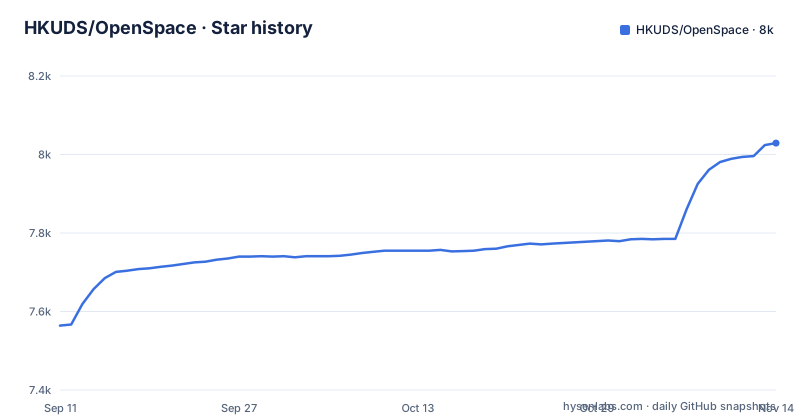
- HKUDS/OpenSpace8,029 ★ · +465
| Repository | 2026-09-11 | 2026-11-14 |
|---|---|---|
| HKUDS/OpenSpace | 7.6k | 8k |
465 Stars in the last 64 days, measured from the daily GitHub snapshot. Compare with other projects
Editorial analysis
The OpenSpace repository now leads with AgentPilot
HKUDS/OpenSpace is still described on GitHub as OpenSpace: The Skill Management Layer for AI Agents, and its v2.0.0 release from 17 July 2026 carries that name. The README you land on today, however, is about AgentPilot, tagged as agentpilot-v1.0.0 on 1 November 2026. The top-level layout reflects both: an openspace/ package, an agentpilot/ package, an arena/ directory, a plugins/ directory and an install.py.
The relationship is stated plainly: AgentPilot guides the next move, and OpenSpace manages the skills that make it work. If you arrived looking for the July OpenSpace release, expect the documentation to frame it as a component rather than the main product. Links and tutorials written for v2.0.0 may describe a repository that no longer looks the same.
OpenSpace retrieves, evaluates, evolves and shares skills
The skill layer does four things. It retrieves relevant skills for each task. It evaluates skills through real execution outcomes rather than by description. It evolves skills with feedback and validated updates. And it shares proven workflows across tasks and across agents.
The point of this loop is that a skill is not a static prompt file. A skill that keeps failing in execution gets refined, and one that works is offered to the next task and to other agents connected to the same workspace. For a team, that means one agent's successful workflow can become another agent's starting point, which is the claim behind every trial building on past experience.
Online policy learning picks the next trial and splits the budget
AgentPilot's premise is that agents can execute but struggle to decide what is worth trying next, so they waste tokens repeating mistakes and chasing dead ends. Its online policy learning component addresses that in four steps: choose where to start instead of starting from scratch, decide what to try by testing ideas through small, low-cost experiments, allocate the budget by giving more trials to what works and dropping what does not, and learn from every trial so later decisions improve.
The project targets three kinds of work: algorithm development, where it explores algorithms, architectures and implementation choices; deep research, where it decides which questions and directions get effort; and computer use, where it learns action sequences and recovers from failures. Supported agents named in the README are Codex, Claude Code, Hermes, nanobot, DeepSeek Harness, WorkBuddy and Grok Bot. Your agent still does the execution; AgentPilot only decides.
Agent workspaces keep execution data on your own infrastructure
The second component is the agent workspace, a real execution environment where agents run tasks and record what happens. Outcomes are used to identify what worked and what failed, proven workflows are carried into future tasks and other agents, and workflows are refined with execution feedback and validated before reuse.
The workspace is designed to run on your own infrastructure, with execution data and workflows kept under your control and sharing left as your choice. One workspace can serve several agents, letting them retrieve and reuse each other's workflows and past experience. That is useful if you run Codex and Claude Code side by side, but it also means the workspace becomes shared state that every connected agent reads from, so a bad workflow promoted there reaches all of them.
RSI Arena scores how fast a system learns, not one run
RSI Arena, documented in arena/README.md, is the project's evaluation harness. Most benchmarks score what an AI can do on a fixed task set; RSI Arena asks whether a system learns from feedback and makes better decisions over time, and how fast it improves given the same number of trials and the same budget.
This framing matches the rest of AgentPilot: the product claim is about improvement across trials, so the benchmark measures improvement across trials. The README also includes sections on learning beyond task performance and on stronger learning with a 9B proposer. Treat those as the authors' own evaluation. Whether the policy saves tokens on your workload is something to measure on your own tasks with a fixed budget, the same way RSI Arena frames it.
Installation is a prompt you hand to your agent
The quick start does not lead with shell commands. It asks you to paste a block of text into an agent with terminal and file access, such as Codex or Claude Code, and let the agent do the installation. The block begins:
Install AgentPilot as a skill for this agent.
Repository: https://github.com/HKUDS/AgentPilot
For Codex desktop, also install the local plugin for @ selection.
Note that the repository named in that prompt is HKUDS/AgentPilot, not HKUDS/OpenSpace. The approach has a real cost for anyone careful about what runs on their machine. You are delegating installation to an agent with shell access, so the exact steps depend on how that agent interprets the instruction. If you need a reproducible setup, read install.py in the repository and review each action your agent proposes before approving it, rather than running it unattended.
It needs OpenRouter credentials before anything runs
The .env.example file at the repository root defines two variables, OPENROUTER_API_KEY and OPENROUTER_MANAGEMENT_KEY. In practice that means an OpenRouter account is part of the setup, and any usage billed there comes on top of whatever your coding agent already spends with its own provider. Two OpenRouter credentials will sit in a local .env file, so keep that file out of version control and out of any workspace you share with other agents or people.
The project is a Python codebase under the MIT license, last pushed on 1 November 2026, the same day AgentPilot v1.0.0 was tagged. A first major release that new has no track record yet. Budget time for breaking changes, and pin the tag you test against.
Editorial conclusion
OpenSpace with AgentPilot suits people who run long, trial-heavy agent loops, such as algorithm search or deep research, and want a policy to decide what to try next and where to spend the trial budget. It is a poor fit if you want a small, well-understood dependency, since AgentPilot v1.0.0 was only tagged on 1 November 2026 and the install path is an instruction your agent carries out. Before installing, read install.py, prepare OpenRouter keys, and measure token use on your own tasks rather than relying on the project's goals.
Frequently asked questions
What does OpenSpace do?
OpenSpace is a skill management layer for AI agents. It retrieves relevant skills for each task, evaluates them through real execution outcomes, evolves them with validated feedback, and shares proven workflows across agents.
How do you install OpenSpace?
The quick start installs AgentPilot, which is powered by OpenSpace, by pasting an instruction block into an agent with terminal access such as Codex or Claude Code. The repository also contains an install.py, and .env.example expects OpenRouter keys.
What is OpenSpace AI?
OpenSpace is an MIT-licensed Python project from HKUDS that manages skills for AI agents. In the current repository it serves as the skill layer under AgentPilot, which decides what an agent should try next.
Official sources
Add this badge to your README
If you maintain this project, the badge below links readers to this analysis and shows its maintenance status from the daily GitHub snapshot. Paste the markdown into your README; add ?metric=license or ?metric=stars to the image URL for a different field.

[](https://hysenlabs.com/projects/hkuds-openspace)Star history chart for your README
[](https://hysenlabs.com/projects/hkuds-openspace)Was this useful?