HQBase: a shared email workspace that runs inside your Cloudflare account
AI native email workspace for teams. In your Cloudflare account.
At a glance
- What is it?
- HQBase is an AGPL-3.0 shared inbox for teams, deployed as Workers and D1 in the customer's own Cloudflare account. The design trades managed convenience for credential custody, and the local development path is documented well enough to judge it before you deploy.
- Who is it for?
- Adopt HQBase if your team already runs on Cloudflare and you want shared mailboxes, audit history and an MCP endpoint under credentials you hold rather than a vendor's. Do not adopt it if you need a provider-neutral deployment, because the entire runtime is Workers, D1 and Cloudflare OAuth.
- Can I use it commercially?
- Yes, with strict conditions. AGPL-3.0 is a network copyleft licence: if people use a modified version over a network, for example as a hosted service, you must offer them its source code under the same licence.
- Is it still maintained?
- Yes. The repository last received commits 44 days ago.
- What is it written in?
- Mainly TypeScript, according to GitHub's language statistics.
Answers come from the project's GitHub data, last synced on November 25, 2026, and from our analysis. They are not legal advice.
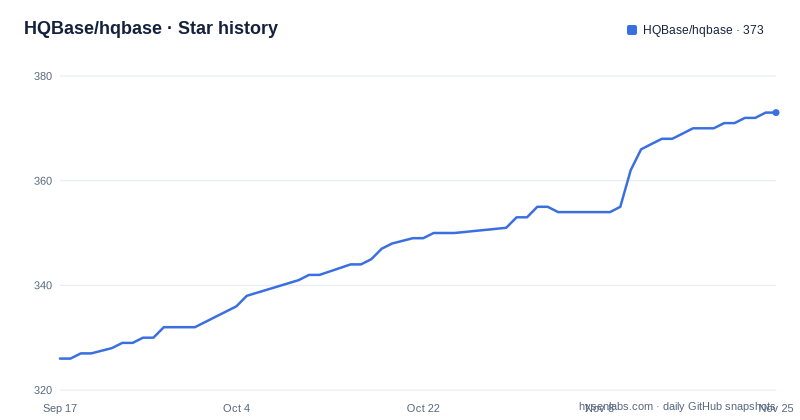
Star history
- HQBase/hqbase373 ★ · +47
| Repository | 2026-09-17 | 2026-11-25 |
|---|---|---|
| HQBase/hqbase | 326 | 373 |
47 Stars in the last 69 days, measured from the daily GitHub snapshot. Compare with other projects
Editorial analysis
The problem HQBase solves, and the team it assumes
Shared mailboxes are usually the least owned part of a company's software. A support address, a billing address and a sales address end up in a provider's web console, with credentials that belong to whoever set it up and an audit trail that stops at the provider's boundary. HQBase's answer is to move the workspace itself: the README describes it as an open-source shared email workspace that runs in your Cloudflare account and keeps mail and credentials in infrastructure you control.
That framing sets the audience precisely. This is for teams that already treat Cloudflare as infrastructure rather than as a CDN in front of something else. The feature list is short and operational: shared mailboxes with team access controls, multi-domain setup, drafts, audit history, installation and recovery operations, and an OAuth-protected remote MCP server. The MCP endpoint is the tell. It assumes you want an assistant or an agent to reach the mailbox through an authenticated interface rather than through IMAP credentials pasted into a config file.
The repository topics confirm the positioning: agpl, cloudflare-workers, email, self-hosted, shared-inbox. If your team has no Cloudflare account and no intention of having one, the product's central claim, that mail and credentials stay in infrastructure you control, has no meaning for you.
Workers, D1 and a signed release path: how the pieces fit
The runtime shape is visible in the repository layout rather than in prose. There is a worker/ directory next to app/ and api/, a wrangler.jsonc at the root, a migrations/ directory and a separate migrations-after-deploy/ directory, and a worker-configuration.d.ts generated from the Wrangler configuration. The API surface is published as artifacts: the package scripts reference api/hqbase-mail-api-v1.openapi.json and api/hqbase-mail-api-v2.openapi.json, each with a matching Postman collection and environment. So the mail API is versioned and generated, not hand-documented.
The release process is the part worth reading twice. The README states that pushes to main run the same quality gate and deployment dry-run, that deployed staging is manual and runs inside the signed release workflow, and that a release stays in draft until the previous stable version upgrades to the exact signed candidate and passes its checks. Customer installations and updates verify the signed manifest and artifact digest before deployment. That is an upgrade chain with a verification step at the customer end, which is unusual for a project at this stage and is the strongest signal in the README about how the maintainers think about operators.
What the README does not describe is the mail ingestion path itself: how a message arrives from a mail provider into the Worker, or what happens to a message when the Worker is unavailable. The documentation site is named as the source for architecture, so that question has to be answered there rather than from the repository.
Running HQBase locally with pnpm and Wrangler
The README gives a local development path that does not require a Cloudflare account for the seeded case. Install dependencies and prepare the local D1 database:
pnpm install
pnpm db:migrate:local
pnpm db:seed:local
pnpm dev
Before the seed command runs, two values must be present in `.dev.vars`: `BETTER_AUTH_SECRET`, and `HQBASE_LOCAL_SEED_PASSWORD` with 8 to 128 characters. The `.env.example` file carries both as commented lines and states that HQBase generates `BETTER_AUTH_SECRET` during installation, so the local value is yours to invent. The seed command writes only to local D1 and, per the README, does not contact Cloudflare OAuth.
After `pnpm dev`, open `http://127.0.0.1:5173/` and sign in as `[email protected]` with the password you set. Vite serves the frontend with live reload on port 5173 and proxies API requests to the Wrangler Worker on port 8787. If you want to see the first-run setup flow instead of the seeded workspace, omit the seed command and open `http://localhost:5173/setup`.
To throw the local database away and start over:
pnpm db:reset:local
pnpm db:seed:local
The README is explicit that the reset command is destructive and local only, and does not change a deployed database. Two other preview commands exist for interface work: `pnpm dev:setup-ui` opens the onboarding screens at `http://127.0.0.1:5173/__ui/setup`, and `pnpm dev:ui` opens a component gallery at `http://127.0.0.1:5173/__ui/design` that uses deterministic fixtures and does not call product APIs. For changes that touch `wrangler.jsonc`, run `pnpm cf:typegen`; the full gate is `pnpm check` followed by `pnpm deploy:dry-run`.
Where HQBase is the wrong tool
The dependency on Cloudflare is not incidental, it is the product. Mail and credentials live in the customer's Cloudflare account, and the first-run setup flow is described as contacting Cloudflare OAuth. A team that needs to run the same workspace on AWS, on a Kubernetes cluster, or on a VPS has no path here, and no amount of configuration will produce one. That is a legitimate reason to stop reading.
The second limitation is less obvious and more consequential for evaluation. The README does not document rollback. It documents backup and recovery operations as a feature, and it documents that updates verify a signed manifest and artifact digest before deploying, but it does not say what an operator does when a verified update deploys and then misbehaves. For a system holding a team's shared mailbox, that gap matters more than any missing integration.
The third is licence shape. HQBase is AGPL-3.0-only, and the README's own framing is self-hosted infrastructure. Anyone planning to offer HQBase as a service to third parties should read the licence text rather than this article; the network clause is the reason the licence was chosen, and it is not a formality.
Herald and the client question
The README's community section names one independent client: Herald, described as a native macOS email client for HQBase. HQBase has tested Herald for compatibility, and the README is careful to state that Herald is made and maintained by independent community developers, so its releases, support and behavior remain in their care. That sentence is doing real work. A shared inbox is only as good as the clients that can reach it, and the project is telling you that the client ecosystem is not something it controls.
The difference in approach between the two is worth stating plainly. HQBase is the workspace: shared mailboxes, access controls, audit history, and an OAuth-protected MCP server for programmatic access. Herald is a desktop client for one operating system. If your team works in browsers and wants an agent to read and draft mail, HQBase alone is the relevant piece. If your team lives in a native macOS client and wants a shared mailbox behind it, Herald is the piece that determines your daily experience, and its release cadence is not HQBase's to promise.
The same distinction applies to the mail API. Versioned OpenAPI artifacts for v1 and v2 exist in the repository, which means integrations have a documented contract. But the README does not describe a plugin or extension surface inside the workspace itself, so extending the product means working against that API rather than against an internal extension point.
Maintenance, releases and what an upgrade actually costs
The last push to main was on 2026-09-12, and v1.4.2 carries the same timestamp. v1.4.1 and v1.4.0 both landed on 2026-09-06, so the recent history is dense: three releases inside a week. The repository is not archived. Version 1.4.2 also carries an `hqbaseRelease.minimumVersion` of `1.0.0` in package.json, which tells an operator that installations older than 1.0.0 are outside the supported upgrade path.
The upgrade cost is mostly the verification step. Because customer installations verify the signed manifest and artifact digest before deployment, an operator cannot simply pull a tag and restart; the release has to arrive in a form whose signature and digest check out. That is a deliberate trade. It adds friction to every update and removes a class of supply-chain failure. Teams that patch by hand on a Friday afternoon will find this annoying. Teams that have been burned by an unverified artifact will not.
Tooling versions are pinned where it matters: `packageManager` is `[email protected]`, and the quality gate runs Biome, TypeScript, Vitest unit and integration configurations, and an architecture check. The licence is AGPL-3.0-only, declared both in package.json and in the README badge. Nothing in the README suggests a commercial licence alternative, so the AGPL terms apply to the code as distributed.
Editorial conclusion
Adopt HQBase if your team already runs on Cloudflare and you want shared mailboxes, audit history and an MCP endpoint under credentials you hold rather than a vendor's. Do not adopt it if you need a provider-neutral deployment, because the entire runtime is Workers, D1 and Cloudflare OAuth. Before committing, verify three things: that the setup flow completes against your own domain, that the signed release manifest verifies on the version you intend to run, and that the AGPL-3.0-only network clause is acceptable for how you plan to expose the service.
Frequently asked questions
Does HQBase require a Cloudflare account to run locally?
No. The README states that the seed command writes only to local D1 and does not contact Cloudflare OAuth, so the seeded workspace runs without one. A deployed installation, by contrast, is described as running in your Cloudflare account.
Which port does HQBase use for local development?
The README gives port 5173 for the Vite frontend with live reload, and states that API requests are proxied to the Wrangler Worker on port 8787.
What licence is HQBase released under?
HQBase is available under the GNU Affero General Public License v3.0 only, according to the README and the `license` field in package.json.
How do I reset the local HQBase database?
Run `pnpm db:reset:local` and then `pnpm db:seed:local`. The README notes that the reset command is destructive and local only, and does not change a deployed database.
Official sources
Add this badge to your README
If you maintain this project, the badge below links readers to this analysis and shows its maintenance status from the daily GitHub snapshot. Paste the markdown into your README; add ?metric=license or ?metric=stars to the image URL for a different field.

[](https://hysenlabs.com/projects/hqbase-hqbase)Star history chart for your README
[](https://hysenlabs.com/projects/hqbase-hqbase)Was this useful?