Spring Cloud Examples: A Practical Tour of Eureka, Config, Zuul, and Tracing
GitHub describes it as Spring Cloud learning examples covering service discovery, service governance, distributed tracing, service monitoring and more. The repository metadata lists Java as its primary language. This article stays within the project description and details documented in the GitHub repository README.
At a glance
- What is it?
- This repository offers a collection of Spring Cloud sample projects, each focused on a specific capability like service discovery, configuration management, or gateway routing. It is a useful starting point for developers who prefer working code over abstract documentation.
- Who is it for?
- Adopt this repository if you are a Java developer learning Spring Cloud and want to see how Eureka, Config, Zuul, Hystrix, or Sleuth fit together in small, runnable projects. Avoid it if you need production-ready configurations or support for the latest Spring Cloud versions, since the samples appear tied to older releases and lack explicit licensing.
- Can I use it commercially?
- Not without permission. GitHub finds no licence file in the repository, and without a licence all rights are reserved by default: you may read the code but not reuse it. Check the README, or ask the authors, before using it.
- Is it still maintained?
- Probably not. The repository last received commits 39 months ago, on July 18, 2023.
- What is it written in?
- Mainly Java, according to GitHub's language statistics.
Answers come from the project's GitHub data, last synced on October 21, 2026, and from our analysis. They are not legal advice.
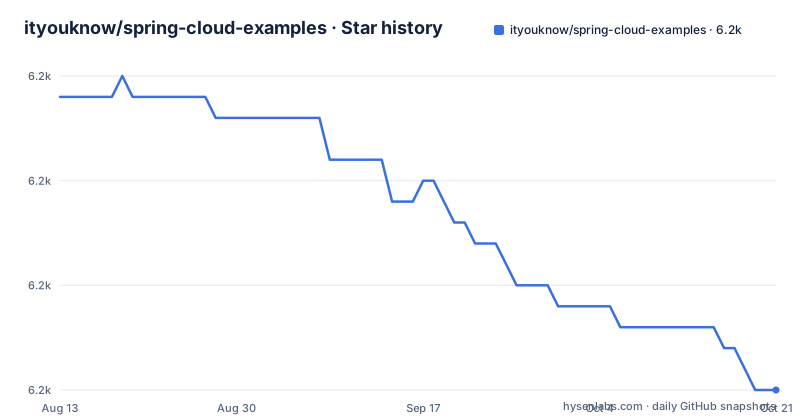
Star history
- ityouknow/spring-cloud-examples6,175 ★ · -14
| Repository | 2026-08-13 | 2026-10-21 |
|---|---|---|
| ityouknow/spring-cloud-examples | 6.2k | 6.2k |
-14 Stars in the last 69 days, measured from the daily GitHub snapshot. Compare with other projects
Editorial analysis
What This Repository Actually Provides
The repository is a collection of Spring Cloud sample projects, each addressing one common microservice concern. The README lists fourteen modules, ranging from Eureka server setups (single, double, and cluster) to a producer-consumer example that demonstrates service invocation through Eureka. There are also samples for Hystrix circuit breaking, Hystrix Dashboard with Turbine, configuration management via Git and SVN, Zuul gateways (both basic and advanced), Sleuth and Zipkin tracing, Spring Boot Admin monitoring, Consul as a service center, and the newer Spring Cloud Gateway. The stated goal is to provide the simplest and most practical examples. The intended audience is developers who want to see how these components work in isolation, not necessarily how to build a full production system.
How the Examples Are Organized
Each example lives in its own directory, and the README gives a one-line description of what it demonstrates. For instance, spring-cloud-eureka covers Eureka server in single, double, and cluster modes, while eureka-producer-consumer shows service registration and invocation. The configuration examples are split into three: spring-cloud-config-git for Git-based config, spring-cloud-config-svn-refresh for SVN with client refresh, and spring-cloud-config-eureka-bus which combines config with a message bus, described as the final version of the config center. This modular layout means you can open one directory and study a single concept without wading through unrelated code. The trade-off is that there is no overarching project that ties everything together; you must assemble the pieces yourself if you want a complete microservice stack.
Getting Started with the Samples
The README does not include explicit build or run commands. It assumes you know how to run a Spring Boot application, which typically means using Maven or Gradle from each module's directory. The repository is written in Java, and each sample likely contains a pom.xml with the necessary Spring Cloud dependencies. The linked blog posts, such as the series starting with 'springcloud(一): 大话Spring Cloud', provide step-by-step instructions, but those are external to the repository. For a hands-on start, you would clone the repository, navigate to a module like spring-cloud-eureka, and run its main application class. The examples are best used as reference implementations: copy the relevant code into your own project and adjust the configuration.
What Each Sample Demonstrates in Practice
The Eureka sample shows how to set up a service registry in different topologies. The producer-consumer example illustrates how a service registers itself and then calls another service through Eureka, which is the core of client-side service discovery. The Hystrix sample demonstrates circuit breaking, and the dashboard-turbine module aggregates Hystrix streams for monitoring. The Config samples cover external configuration with Git and SVN, including a refresh mechanism for clients. The Zuul samples start with basic routing and load balancing, then move to filters, authentication, circuit breaking, and retry. Sleuth and Zipkin are used to trace requests across services. Spring Boot Admin provides a UI for monitoring the cluster. Consul serves as an alternative to Eureka. The Gateway sample introduces the reactive gateway, which is a different approach from Zuul.
A Real Limitation: Age and Version Drift
The blog posts linked in the README date from 2017 to 2019, and the repository's default branch is master with no recent release information. This suggests the examples were built against older Spring Cloud releases, likely the Finchley or Greenwich train. Spring Cloud has evolved significantly since then, with changes in dependency management, configuration properties, and the deprecation of certain components like Zuul in favor of Spring Cloud Gateway. If you try to use these samples with a current Spring Cloud version, you will likely encounter compatibility issues. The examples are valuable for learning the concepts, but they are not drop-in templates for a modern setup. You should check the pom.xml files for the exact versions and be prepared to update them.
Alternative Approaches and Comparisons
If you are looking for a more current and comprehensive set of Spring Cloud examples, the official Spring Cloud samples on GitHub are a direct alternative. They are maintained by the Spring team and track the latest releases, but they tend to be more terse and assume deeper background knowledge. Another alternative is to follow the Spring Cloud documentation and build your own minimal projects, which gives you full control but takes more time. The ityouknow repository stands out for its focus on simplicity and its accompanying blog posts, which walk through each example in narrative form. That pedagogical angle is its main advantage over the official samples. However, the official samples are more likely to work with the current Spring Cloud versions without modification.
Maintenance and Licensing Considerations
The repository does not specify a license, which is a significant issue. Without a license, you have no explicit permission to use, modify, or distribute the code, even for learning purposes. The README mentions a Chinese index and a Gitee mirror, but no license file is referenced. This means you should treat the code as copyrighted and seek permission from the author if you plan to use it beyond personal study. The last push date is unknown, and there are no recent releases, so maintenance appears to be sporadic. The author, ityouknow, is a known figure in the Chinese Spring Cloud community, and the blog posts indicate ongoing updates until 2019, but the repository has not seen visible activity since then. For a learning resource, this is acceptable; for a dependency, it is not.
Editorial conclusion
Adopt this repository if you are a Java developer learning Spring Cloud and want to see how Eureka, Config, Zuul, Hystrix, or Sleuth fit together in small, runnable projects. Avoid it if you need production-ready configurations or support for the latest Spring Cloud versions, since the samples appear tied to older releases and lack explicit licensing. Before using any example, verify the Spring Boot and Spring Cloud versions in its pom.xml, and confirm that the sample's dependencies are still compatible with your target environment. The repository is a teaching tool, not a framework, and its value lies in the clarity of its individual modules, not in its currency.
Frequently asked questions
What is Spring Cloud, and what does this repository show about it?
Spring Cloud is the subject of this repository, which collects runnable examples of it rather than the framework itself. The fourteen example directories cover service discovery with Eureka and Consul, service registration and invocation, circuit breaking with Hystrix, config centre modules backed by git or svn, gateways built on Zuul or Spring Cloud Gateway, tracing with Sleuth and Zipkin, and cluster monitoring with Spring Boot Admin. A separate Chinese index repository, awesome-spring-cloud, is linked as the wider catalogue.
Can you give me some examples of Spring Boot projects from ityouknow?
The repository is a set of separate Spring Cloud example projects, one per directory: eureka-producer-consumer for registering a service and calling it, spring-cloud-hystrix for circuit breaking, spring-cloud-config-git for a git backed config centre, and spring-cloud-sleuth-zipkin for distributed tracing. A companion repository named spring-boot-examples is linked for Spring Boot samples, and another link points at a Spring Boot 2.0 tutorial.
What are the disadvantages of starting from these Spring Cloud examples?
The visible listing pins no Spring Boot or Spring Cloud version, so a new project picks versions itself, and no build file sits at the top level, only inside each example directory. The linked article series ends on 2019-01-26 while the last push to master was 2023-07-18, and the repository publishes no releases. Eureka, Hystrix, Zuul and Turbine each get their own directory while Consul and Spring Cloud Gateway arrive later in the same list, so the examples span more than one generation of the stack.
Official sources
Add this badge to your README
If you maintain this project, the badge below links readers to this analysis and shows its maintenance status from the daily GitHub snapshot. Paste the markdown into your README; add ?metric=license or ?metric=stars to the image URL for a different field.

[](https://hysenlabs.com/projects/ityouknow-spring-cloud-examples)Star history chart for your README
[](https://hysenlabs.com/projects/ityouknow-spring-cloud-examples)