innodb_ruby for Investigating InnoDB File Formats
A parser for InnoDB file formats, in Ruby
At a glance
- What is it?
- innodb_ruby is a Ruby parser for exposing hidden InnoDB structures, with an explicit warning that its APIs, output, and reliability are unsuitable for critical production use. It fits learning, teaching, and investigative work on InnoDB storage internals.
- Who is it for?
- Adopt innodb_ruby for learning, teaching, or targeted investigation when unstable output and possible defects are acceptable. Do not use it for critical production processing.
- Can I use it commercially?
- Check first. The repository uses a licence we do not classify automatically, so read its LICENSE file before any commercial use.
- Is it still maintained?
- Activity is slowing. The repository last received commits 6 months ago.
- What is it written in?
- Mainly Ruby, according to GitHub's language statistics.
Answers come from the project's GitHub data, last synced on November 7, 2026, and from our analysis. They are not legal advice.
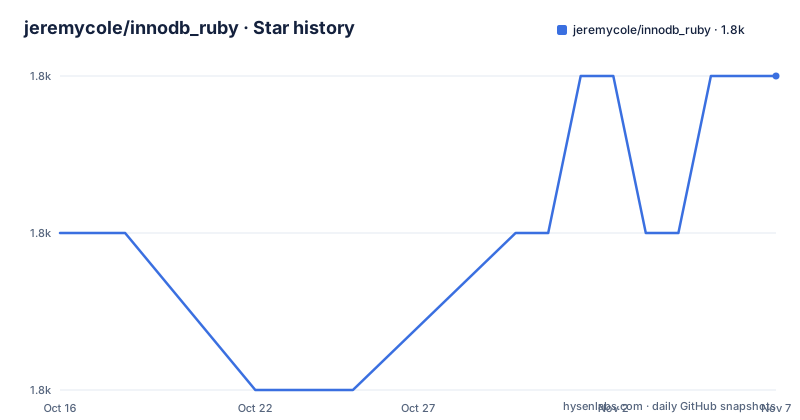
Star history
- jeremycole/innodb_ruby1,795 ★ · +1
| Repository | 2026-10-16 | 2026-11-07 |
|---|---|---|
| jeremycole/innodb_ruby | 1.8k | 1.8k |
1 Stars in the last 22 days, measured from the daily GitHub snapshot. Compare with other projects
Editorial analysis
innodb_ruby's Role in InnoDB Storage Investigation
innodb_ruby addresses a visibility problem in InnoDB. The README says the storage engine does not expose enough information about what it has done on disk, including page fullness, record counts per page, and the B+tree structure of a particular table. The parser is intended to make those internal structures accessible for people who need to answer concrete questions about physical storage.
The intended users are narrow but clear: developers learning InnoDB internals, instructors demonstrating disk structures, investigators examining stored files, and engineers debugging changes to InnoDB behavior. It is not positioned as a general database administration interface, query engine, or replacement for MySQL tooling. Its value comes from parsing the file formats and exposing data that ordinary InnoDB operation leaves hidden.
That purpose also explains why a familiar Ruby application pattern may be a poor fit. A parser does not repair a damaged database, provide transactional guarantees, or promise a stable schema for recovered rows. The repository explicitly warns that the code may be buggy and dangerous. Its output should therefore be treated as evidence for investigation rather than an authoritative production record.
Repository Structure and Parsing Surface
Based on the repository layout, the project separates a reusable library from command-line material, examples, and specifications. Core Ruby code is under `lib/`, packaged metadata is defined through `innodb_ruby.gemspec`, and executable material is located under `bin/`. The `spec/` directory contains the test structure, while `.github/` includes workflow configuration associated with the README's RSpec and RuboCop status badges.
This layout suggests a conventional Ruby gem organization, but the README does not document the individual parser classes, public method names, supported InnoDB versions, or the exact file formats handled by each component. It would be unsafe to imply that every InnoDB page type or file version is covered. The README only states the broader goal of parsing InnoDB file formats and exposing internals.
The `examples/` directory contains `examples/analysis.r`, a `examples/describer/` directory, and an `examples/images/` directory. Those names indicate areas covered by the repository's examples, but their contents are not described in the README. In particular, the article cannot claim that `analysis.r` is runnable without reading its code and checking its dependencies. The README also does not describe a supported workflow for mapping a physical table file to a particular parser operation.
Interactive Use of innodb_ruby with irb
The README identifies `irb` as the main interactive route for teaching and investigation. The suggested use is to inspect structures on disk interactively, allowing an engineer to examine individual values while learning how a record, page, or tree structure is represented. That is a more fitting first use for this project than attempting an undocumented bulk recovery job.
The README does not give a complete installation command, executable invocation, `require` statement, constructor call, or parsing example. It directs users to the RubyGems page for `innodb_ruby` and to the project wiki for additional references and getting-started documentation. Since no executable example is documented there, inventing commands here would risk producing code that cannot be traced to an authoritative source.
A first real session should therefore begin from the RubyGems documentation or wiki, select the documented operation for the InnoDB file being examined, and work through one structure at a time in `irb`. The reader should expect parser objects or output that expose internal representations, but the exact result cannot be specified without the relevant public API and sample file. This limitation makes `innodb_ruby` less approachable than a tool with one documented analysis command, yet it preserves the library's investigative character.
Learning, Teaching, and Debugging Uses
The strongest use case is a question tied to a physical structure. Examples include determining how full a page is, counting records in a page, or inspecting the B+tree layout for a table. These are questions the README claims the tools can answer. They also require direct access to relevant InnoDB files and enough knowledge to interpret the parser's representation.
For learning and teaching, `irb` is particularly relevant because it lets participants inspect actual stored structures rather than relying only on diagrams. For debugging InnoDB behavior, the parser can expose before-and-after results so a developer can compare the original structure with a changed one. That comparison use case is concrete, although the README does not define a formal regression procedure or a stable serialization format for saved output.
The scope should remain narrow. The README does not claim support for operational monitoring, continuous analysis of a live server, or automated validation of an entire database. It also warns that different tools may have sharply different maturity levels because development is driven primarily by immediate author needs. A component that looks suitable for an interactive investigation should not automatically be treated as suitable for a repeatable pipeline.
Unstable APIs, Known Defects, and Production Boundaries
The central limitation is stated directly by the maintainer: the code is not intended for critical production usage, it is buggy, and it may be dangerous. Neither the internal APIs nor the output are stable and can change at any time. This is not a minor compatibility disclaimer. It means a consumer must expect changes in method contracts and in parsed representations even when the file format itself has not changed.
The warning is especially important because `innodb_ruby` exposes storage internals. A parser can produce plausible-looking output from a file that its implementation does not fully understand, and the README does not promise exhaustive validation for every structure or version. It also does not document recovery behavior for damaged files, recovery guarantees for partially written pages, or safeguards suitable for production automation. Those omissions prevent any claim that the parser can safely reconstruct every record from every damaged InnoDB file.
There is another boundary around interpretation. Questions such as page fullness or B+tree structure require correct file selection and a meaningful reading of the parsed structures. The README does not provide a single supported procedure for validating those assumptions. Users should keep original files unchanged and consult the wiki or RubyGems documentation before relying on a component. The repository's explicit warning supports investigative use, but not unattended processing where incorrect output could affect decisions.
RubyGems Packaging, Maintenance, and the Custom LICENSE
The README says packaged releases are published regularly to RubyGems.org and links the `innodb_ruby` page there as the place to obtain the gem and view online documentation. GitHub has no formal releases, so repository tags or GitHub release notes are not presented as an upgrade channel in the README. The distinction matters for adoption planning: the package distribution is documented through RubyGems rather than GitHub Releases.
Maintenance status comes from repository metadata rather than release frequency. The repository is not archived, and the last push was on 2026-04-28. That indicates recent repository activity, but it does not erase the README's warning that APIs and output can change at any time. The custom `LICENSE` file should also be read directly. GitHub classifies the license as one it cannot classify, and the repository description does not grant permission to summarize its terms. Engineers need to check redistribution, modification, packaging, and use conditions in that file before including the library in a product or service.
The maintenance burden is therefore higher than ordinary dependency churn might suggest. An upgrade can affect both Ruby-facing APIs and the shape or meaning of output. Since the README does not describe a compatibility policy or migration process, consumers should review each change relevant to their parsing workflow rather than assuming semantic versioning alone describes operational risk.
Where innodb_ruby Differs from Conventional Database Tools
The practical alternative to `innodb_ruby` is ordinary MySQL or InnoDB operational tooling that works through supported database interfaces and returns results at the SQL layer. That approach differs in purpose. Conventional tools answer application-level questions through queries and manage databases as supported services, whereas `innodb_ruby` parses physical file formats to expose internals that InnoDB does not report directly.
This makes conventional database tooling the better choice for routine application reads, administration, monitoring, and anything requiring stable service interfaces. It also avoids depending on the parser's explicitly unstable APIs and possible defects. However, it does not replace the investigation described in the README when the actual question concerns page fullness, records within a page, or the on-disk B+tree organization of a specific table.
A filesystem-level parser such as `innodb_ruby` is therefore complementary rather than a general substitute for database tooling. It is appropriate when access to InnoDB's hidden structures is the requirement and the reader can assess the risk of unstable output. It is the wrong choice when reproducible production automation, contractual stability, or safe handling of critical data is more important than internal visibility.
Editorial conclusion
Adopt innodb_ruby for learning, teaching, or targeted investigation when unstable output and possible defects are acceptable. Do not use it for critical production processing. Before adoption, verify that the custom LICENSE file grants the intended rights, inspect the parser component you need, and confirm that packaged gem documentation matches the repository version you plan to use.
Frequently asked questions
Is innodb_ruby suitable for critical production workloads?
No. The README explicitly says the code is not intended for critical production usage, may be buggy, and can be dangerous. It also states that the APIs and output are unstable.
How can innodb_ruby be installed?
The README directs users to the RubyGems page for `innodb_ruby`, where packaged releases and online documentation are published. It does not provide an installation command.
What kinds of InnoDB questions can innodb_ruby investigate?
The README specifically cites page fullness, the number of records per page, and the B+tree structure of a table. These questions require access to relevant InnoDB files and interpretation of the parsed structures.
Official sources
Add this badge to your README
If you maintain this project, the badge below links readers to this analysis and shows its maintenance status from the daily GitHub snapshot. Paste the markdown into your README; add ?metric=license or ?metric=stars to the image URL for a different field.

[](https://hysenlabs.com/projects/jeremycole-innodb-ruby)Star history chart for your README
[](https://hysenlabs.com/projects/jeremycole-innodb-ruby)Was this useful?