jp.htmlspecs.com: A Japanese Mirror of Web Standards That Demands a Maintenance Plan
HTML and related APIs, the CSS spec series, and the HTTP spec series.
At a glance
- What is it?
- This repository hosts a Japanese-language mirror of dozens of web specifications, from WHATWG HTML to RFC JSON patches. It is useful for Japanese-speaking engineers, but its value depends entirely on how faithfully and how quickly it tracks upstream changes.
- Who is it for?
- Adopt jp.htmlspecs.com if you are a Japanese-speaking developer who needs a single, browseable index of current web standards in your own language, and if you can accept that the mirror may lag behind the English originals. Do not use it as your sole reference for normative work, because the README does not document how or when the translations are updated, and the source links point to drafts and working drafts that change frequently.
- Can I use it commercially?
- Not without permission. GitHub finds no licence file in the repository, and without a licence all rights are reserved by default: you may read the code but not reuse it. Check the README, or ask the authors, before using it.
- Is it still maintained?
- Yes. The repository last received commits 1 day ago.
- What is it written in?
- Mainly HTML, according to GitHub's language statistics.
Answers come from the project's GitHub data, last synced on October 22, 2026, and from our analysis. They are not legal advice.
Star history
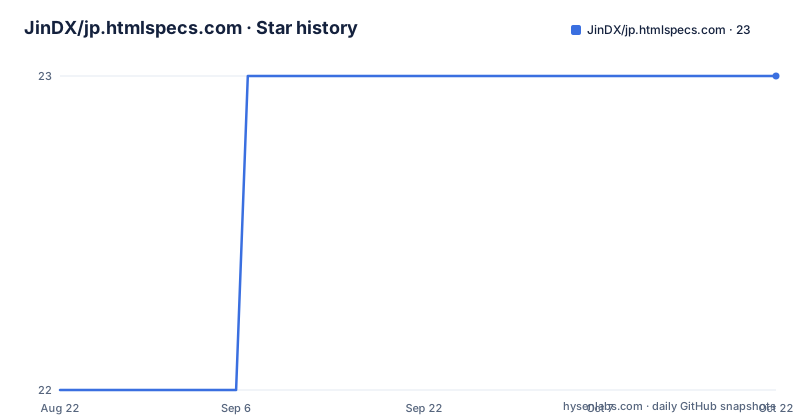
- JinDX/jp.htmlspecs.com23 ★ · +1
| Repository | 2026-08-22 | 2026-10-22 |
|---|---|---|
| JinDX/jp.htmlspecs.com | 22 | 23 |
1 Stars in the last 61 days, measured from the daily GitHub snapshot. Compare with other projects
Editorial analysis
What This Repository Actually Is
The repository is not a set of original specifications. It is a curated index of links to Japanese-language translations of web standards, hosted under the jp.htmlspecs.com domain. The README lists dozens of specifications, each with a Japanese URL and a link to the English source. The list covers core platform specs like HTML, DOM, URL, and Web IDL, plus data formats like JSON, YAML, and CBOR, and protocol specs like ActivityPub and WebFinger. There are also W3C notes and drafts, such as Web Sustainability Guidelines and Web Platform Design Principles. The intended audience is clear: Japanese-speaking developers who want to read standards without switching to English.
The Scope Is Wide but the Boundaries Are Blurry
The README organizes the list into categories, but the categories are not strict. The first group is labeled 'Platform core, language, and infrastructure' and includes HTML, ECMAScript, WebAssembly, DOM, and also Quirks Mode and Compression. The second group is about URIs and media types. The third is internationalization. The fourth covers data formats and semantic web. That last group mixes RFCs like JSON Patch with W3C recommendations like JSON-LD, and even includes a draft like YAML-LD 1.0. There is no stated policy for what gets included or excluded. That is a limitation if you expect a complete or authoritative registry. It is more like a personal bookmark list that happens to be public.
How the Mirror Works: Links, Not Content
Each entry in the README is a pair of links: the Japanese page on jp.htmlspecs.com and the English source. For example, the HTML entry points to https://jp.htmlspecs.com/ and the source is https://html.spec.whatwg.org/. The DOM entry points to https://jp.htmlspecs.com/dom/ and the source is https://dom.spec.whatwg.org/. The pattern is consistent. The repository itself contains no spec text; it is a static site that serves the translations. The README does not explain how the translations are generated or updated. There is no mention of a build process, a sync script, or a translation tool. That absence is a red flag for anyone who needs to know whether the Japanese text matches the latest English version.
Getting It Running: There Is Nothing to Install
Because the repository is a link index, there is no installation or setup. You do not clone and build. You visit the homepage and click through. The README gives no commands, no configuration keys, and no dependencies. If you want to contribute, the README does not explain how. There is no CONTRIBUTING file mentioned, no issue template, and no license. The license field in the repository metadata says 'unknown'. That is a genuine problem if you plan to reuse the translations or the site code. You cannot legally assume you may copy anything from this repository. For a project that is essentially a collection of other people's standards, the missing license is a notable gap.
Where the Mirror Is Likely to Stumble
The biggest failure mode is staleness. Several source links point to dated W3C drafts, such as 'CR-html-ruby-extensions-20260604' and 'CRD-wasm-js-api-2-20260826'. Those are snapshots from specific dates. The Japanese mirror may have been translated from an older version, and the README does not state which version each translation corresponds to. If you implement a feature based on the Japanese text, you might be coding against a draft that has since changed. Another weakness is coverage gaps. The README is truncated in the material I have, so I cannot see the full list, but even the visible list omits many active specs, such as CSS itself. The description mentions CSS, but the README does not list a single CSS specification. That is a direct inconsistency between the repository description and its content.
The Alternative: Read the English Sources Directly
The obvious alternative is to read the original English specifications. WHATWG specs like HTML, DOM, and URL are maintained as living standards, updated continuously. W3C recommendations and RFCs are stable documents. The difference is that the originals are always current, while the Japanese mirror is a snapshot that may lag. For a developer who reads English comfortably, the mirror adds little. For one who does not, the mirror is a convenience, but it carries the risk of translation errors or outdated content. Another alternative is to use browser vendor documentation like MDN, which offers Japanese versions of many web platform concepts, though not the full normative text of each spec. MDN is not a mirror; it is a secondary source that explains, rather than translates, the standards.
Maintenance and Upstream Tracking: The Real Cost
The repository metadata shows no recent releases and no archived flag, but also no last push date. That is a warning. A mirror of living standards needs constant maintenance. HTML, DOM, and URL change frequently. The README includes links to drafts dated 2026, which suggests the maintainer does update the list, but the frequency is unknown. There is no changelog, no news feed, and no version number. If you depend on this mirror, you must check the upstream sources yourself to know when the translation is outdated. The license being unknown also blocks any automated reuse. The cost of adopting this project is not in setup, but in vigilance: you must verify each spec against its source before trusting it.
Editorial conclusion
Adopt jp.htmlspecs.com if you are a Japanese-speaking developer who needs a single, browseable index of current web standards in your own language, and if you can accept that the mirror may lag behind the English originals. Do not use it as your sole reference for normative work, because the README does not document how or when the translations are updated, and the source links point to drafts and working drafts that change frequently. Before relying on it, verify the date of the mirrored version against the linked source, and check the repository's commit history to see how quickly it tracks new releases. For any spec that is critical to your implementation, go to the original WHATWG or W3C source directly.
Frequently asked questions
Where can I find official HTML documentation through jp.htmlspecs.com?
The HTML entry pairs `https://jp.htmlspecs.com/` with the source at `https://html.spec.whatwg.org/`, which is the WHATWG living standard. The index links out rather than substituting a translation for the normative text.
What is the HTML standard that jp.htmlspecs.com indexes?
It is the WHATWG living standard hosted at html.spec.whatwg.org, one of a set of living standards alongside DOM, URL, Web IDL, Encoding, MIME Sniffing and Infra, all of which the index also lists.
How do I tell a draft from a published recommendation in this index?
Read the source URL. Entries such as `2026/CRD-wasm-web-api-2-20260930` or `2026/DNOTE-web-sustainability-guidelines-20260924` name their status and date in the path, with CRD marking a Candidate Recommendation Draft and DNOTE a Group Note. WHATWG living standard URLs carry no version.
Does jp.htmlspecs.com cover YAML and CBOR specifications?
Yes, and it lists each across several documents rather than one. YAML appears as revision 1.2.2 plus a separate Media Type entry at RFC 9512, and CBOR appears as the format itself, as CBOR-LD 1.0, and within the JSON family entries alongside JSON Pointer, Patch and canonicalization.
Official sources
Add this badge to your README
If you maintain this project, the badge below links readers to this analysis and shows its maintenance status from the daily GitHub snapshot. Paste the markdown into your README; add ?metric=license or ?metric=stars to the image URL for a different field.

[](https://hysenlabs.com/projects/jindx-jp-htmlspecs-com)Star history chart for your README
[](https://hysenlabs.com/projects/jindx-jp-htmlspecs-com)Was this useful?