EvoTrace: Turning Claude Code and Codex Logs into Verified Training Data
Compile real-world Claude Code and Codex trajectories into verified, tradable post-training assets.
At a glance
- What is it?
- EvoTrace compiles local coding-agent sessions into evidence-backed training assets, but it is early alpha and leans on a developer preview. The real question is whether its strict validation gates justify the setup cost.
- Who is it for?
- Adopt EvoTrace if you already have a deep pile of Claude Code or Codex sessions and you are willing to accept an early alpha plus a developer-preview harness. Do not adopt it if you need a stable production pipeline today, if your team cannot run Docker for validation, or if you expect one-command magic: the README warns that generated tasks and verifiers remain candidates until they pass evidence and Docker gates.
- Can I use it commercially?
- Yes. Apache-2.0 is a permissive licence: you can use, modify and sell software built on it, as long as you keep its copyright and licence notices.
- Is it still maintained?
- Yes. The repository last received commits 22 days ago.
- What is it written in?
- Mainly Python, according to GitHub's language statistics.
Answers come from the project's GitHub data, last synced on October 4, 2026, and from our analysis. They are not legal advice.
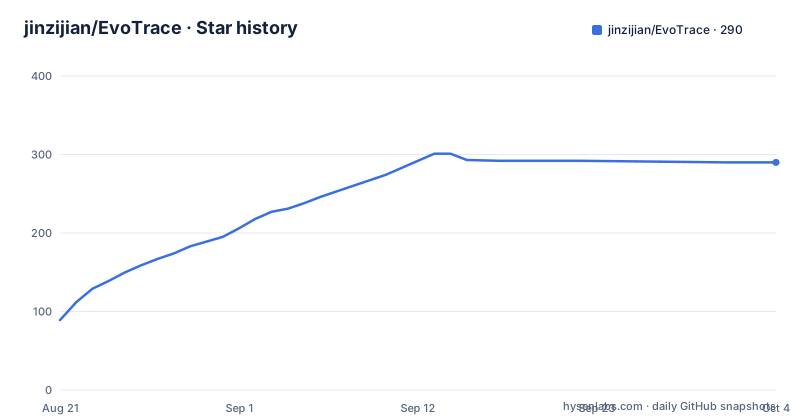
Star history
- jinzijian/EvoTrace290 ★ · +201
| Repository | 2026-08-21 | 2026-10-04 |
|---|---|---|
| jinzijian/EvoTrace | 89 | 290 |
201 Stars in the last 44 days, measured from the daily GitHub snapshot. Compare with other projects
Editorial analysis
The Gap EvoTrace Fills
Raw transcripts from Claude Code or Codex are not training data. A long chat contains multiple task boundaries, no repository state from before the task, no reproducible environment, and no independent verifier. EvoTrace exists to close that gap. It imports the session history already on your machine, finds the sessions worth keeping, and compiles them into preference data, executable task bundles, verifier candidates, and difficulty evidence. The intended user is an engineer or research team doing post-training work who wants to reuse real agent trajectories instead of synthetic ones. It is not another coding agent, and the README is explicit that you do not need to change how you use Claude Code or Codex. The project is local-first: you keep the source data and the resulting assets under your control.
How the Compilation Works
The core workflow starts with /init, which imports and normalizes session history and runs what the README calls Git archaeology. That step recovers the repository state before the task began. Then /candidates ranks sessions by evidence strength and hides nested subagent duplicates. The /review command runs a sequential four-agent process: mine episode, gate route, build or harden, and criticize. The output is routed to one of several destinations: preference or recovery data, an executable candidate, a hardening seed, or rejection with explicit reasons. Rejection is a designed outcome, not a failure. The README stresses that a long but weak trajectory should not be mislabeled as training-ready. After review, /validate runs the task in Docker, and /calibrate measures difficulty with fresh solver attempts. The status ladder is strict: Mined means signals exist but nothing executable is implied; Buildable means task, repo base, reconstruction confidence, reference patch, verifier commands, and environment gates pass; Bundle generated means a Docker-ready candidate exists but its verifier is not trusted; Verified means a conforming Docker run rejected the base, accepted the reference, and was recorded against the exact bundle digest; Calibrated means fresh solver attempts measured the task, with a default target of two verifier passes in five attempts.
Getting It Running
Installation is a one-liner. On macOS, Linux, or WSL, run curl -LsSf https://raw.githubusercontent.com/jinzijian/EvoTrace/main/install.sh | sh. On Windows PowerShell, run irm https://raw.githubusercontent.com/jinzijian/EvoTrace/main/install.ps1 | iex. Then launch with evotrace. That opens the DeepSeek Harness Web app. In Settings, you choose a provider supported by your Harness setup, such as DeepSeek, OpenAI, or Anthropic. Local import and deterministic mining do not require a model. Agent review, hardening, calibration, and evolution do. New sessions start with Harness Full access by default. To use a narrower workspace sandbox, set DSH_PERMISSION_MODE=workspace-write evotrace. Docker is required only when you build or validate executable environments. The first asset build uses slash commands: /init, /candidates, /show 1, /review 1, /assets. The README gives a clear recipe for compiling and validating an executable task: /review 1, /build 1, /validate 1, /runs.
What the Outputs Are Good For
The README lists six output types. The candidate catalog captures task intent, repo, corrections, failures, effective actions, and provenance gaps. Preference and recovery data includes rejected and chosen attempts, human corrections, and successful recoveries, useful for DPO, SFT, QA, and failure-recovery training. An executable task bundle contains a repository base, initial state, dependency evidence, and a task specification, usable for coding-agent evals, regression tasks, and RL environments. Verifier and reward candidates include test commands, behavioral checks, policy, and provenance, meant for rollout scoring and execution rewards after validation. Difficulty evidence comes from fresh independent solver attempts and verifier outcomes, replacing guesses from patch size. Execution experience is compressed runtime facts from exploration trajectories, for training examples and held-out experience-transfer experiments. The same validated task can evaluate an agent today, score newly sampled rollouts tomorrow, and produce verifier-grounded RL data later. That reuse is the core value proposition.
Where It Can Fail or Be the Wrong Tool
The README is upfront that EvoTrace is early alpha and DeepSeek Harness is a developer preview. Generated tasks and verifiers remain candidates until they pass documented evidence and Docker validation gates. That is a real limitation. If your sessions lack clean task boundaries, missing reference patches, or missing verification commands, EvoTrace will fail closed. The README lists failure modes: empty prompt wrappers, low-confidence reconstruction, missing reference patches, missing verification commands, unsupported environments, candidate switching, and mismatched asset lineage. That means a large fraction of real-world history may be rejected. The tool is also wrong for teams that cannot run Docker, because validation and calibration depend on it. And if you only have a handful of sessions, the compilation overhead may not be worth it. The deterministic mining step does not need a model, but the review and calibration steps do, so you need API access or a local model through Harness.
The Alternative: Manual Curation or Synthetic Data
The alternative is not another trajectory compiler, because few exist. The practical alternative is manual curation: an engineer reads transcripts, writes task descriptions by hand, builds Docker environments manually, and writes verifiers from scratch. That approach gives you full control and no dependency on an alpha tool, but it does not scale and it is prone to the same mislabeling problem EvoTrace tries to solve. Another alternative is synthetic trajectory generation, where you run agents on controlled tasks and record the sessions. That gives you clean provenance from the start, but it does not exploit the real-world history already on your machine. The difference in approach is that EvoTrace assumes your existing messy history has value and tries to mine it with deterministic gates, whereas synthetic generation avoids the mess entirely. If you already have a large corpus of real sessions, EvoTrace is the only tool in this space that attempts to automate the compilation. If you do not, synthetic generation is simpler and more predictable.
Maintenance, Upgrades, and License
The project is under Apache-2.0, which means you can use, modify, and distribute it freely, with attribution. The repository shows recent releases v0.3.2, v0.3.1, and v0.3.0, all on the same day, with the v0.3.0 release noting a project rename. That suggests active development but also instability. The README mentions a future opt-in EvoTrace Marketplace and fine-tuning integrations, but those are roadmap products, not part of the current local release. Maintenance cost is nontrivial: you are tied to DeepSeek Harness, which is a developer preview, so upstream changes can break your setup. You also need to keep Docker images current and track bundle digests if you want reproducible validation. The one-command onboarding in the release notes is a convenience, but the real cost is in learning the status ladder and debugging why sessions fail gates. Verify the current state of the harness before committing to a workflow.
Editorial conclusion
Adopt EvoTrace if you already have a deep pile of Claude Code or Codex sessions and you are willing to accept an early alpha plus a developer-preview harness. Do not adopt it if you need a stable production pipeline today, if your team cannot run Docker for validation, or if you expect one-command magic: the README warns that generated tasks and verifiers remain candidates until they pass evidence and Docker gates. Before relying on any asset, verify the status field, confirm the bundle digest matches the recorded run, and check that your environment is supported. Start with /init and /candidates to see how much of your history survives the deterministic gates. If the compiled assets fail validation, treat that as a signal about your data, not a bug in the tool.
Frequently asked questions
What does EvoTrace need a language model for?
Local import and deterministic mining need no model. Agent review, hardening, calibration and evolution do, and those are the steps that cost you tokens, so the first pass over your own history is free. A provider is configured in the settings once the application opens, and the project is a pinned distribution of DeepSeek Harness rather than a separate coding agent.
How do I install EvoTrace?
On macOS, Linux or WSL, pipe the install script into a shell. On Windows PowerShell, fetch and execute the PowerShell script. Then run the launcher, which opens the DeepSeek Harness web application. Docker is needed only if you intend to build or validate executable environments, and sessions start in a full access mode unless you set the narrower workspace-sandbox environment variable.
What is the difference between a bundle and a verified asset in EvoTrace?
A generated bundle means a container-ready candidate exists and its verifier is not yet trusted. Verified means a conforming container run rejected the base state, accepted the reference, and was recorded against the exact bundle digest, so the claim is bound to the bytes that were tested rather than to a label.
How does EvoTrace decide a task is hard?
By running fresh independent solver attempts and recording verifier outcomes, which is what the calibration step does with a default target of two verifier passes in five attempts. Hardening is defined as adding testable behaviour, compatibility work, edge cases or failure constraints, and the documentation states that making a patch longer is not treated as making a task harder.
What stops EvoTrace producing junk training data?
It fails closed on seven conditions, including empty prompt wrappers, low-confidence reconstruction, a missing reference patch, missing verification commands, unsupported environments, candidate switching, and mismatched asset lineage. A review can also reject a session outright with explicit reasons, and the documentation names rejection as a useful result rather than a failure.
Official sources
Add this badge to your README
If you maintain this project, the badge below links readers to this analysis and shows its maintenance status from the daily GitHub snapshot. Paste the markdown into your README; add ?metric=license or ?metric=stars to the image URL for a different field.

[](https://hysenlabs.com/projects/jinzijian-evotrace)Star history chart for your README
[](https://hysenlabs.com/projects/jinzijian-evotrace)Was this useful?