AgentMesh360 Job Agent: A CLI That Runs Job Searches Through Your Own Browser Session
AgentMesh360 Job Agent — agent-native job search CLI for Boss Zhipin, Liepin, Zhaopin, and 51Job. Built for Claude Code, OpenClaw, Cursor, and Codex.
At a glance
- What is it?
- AgentMesh360 Job Agent is an agent-native CLI for Boss Zhipin, Liepin, Zhaopin, and 51Job that uses your logged-in browser and a paid cloud decision layer. It suits engineers who want automated job discovery but demands careful account and state management.
- Who is it for?
- Adopt AgentMesh360 Job Agent if you are a developer who uses Claude Code, Cursor, or Codex, want job search automated across Chinese platforms, and accept a paid cloud dependency for decisions. Do not adopt it if you need a fully offline tool, cannot tolerate per-round credit costs, or want to avoid browser-cookie handling.
- Can I use it commercially?
- Check first. The repository uses a licence we do not classify automatically, so read its LICENSE file before any commercial use.
- Is it still maintained?
- Yes. The repository last received commits 4 days ago.
- What is it written in?
- Mainly Python, according to GitHub's language statistics.
Answers come from the project's GitHub data, last synced on October 22, 2026, and from our analysis. They are not legal advice.
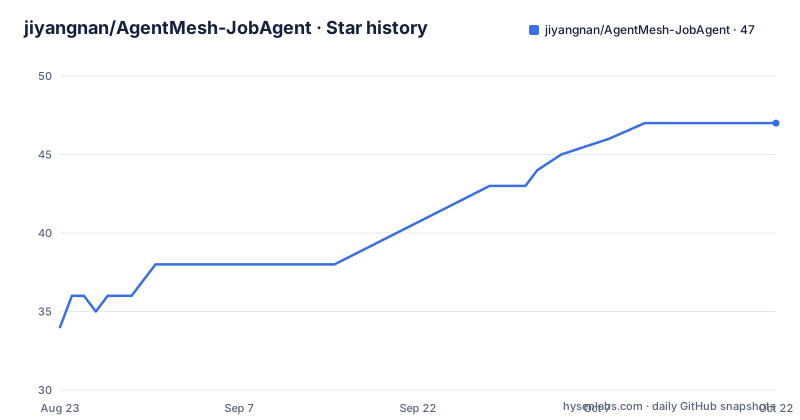
Star history
- jiyangnan/AgentMesh-JobAgent47 ★ · +13
| Repository | 2026-08-23 | 2026-10-22 |
|---|---|---|
| jiyangnan/AgentMesh-JobAgent | 34 | 47 |
13 Stars in the last 60 days, measured from the daily GitHub snapshot. Compare with other projects
Editorial analysis
What It Solves and Who It Is For
The project addresses a specific pain: job hunting across multiple Chinese recruiting platforms is repetitive and manual. You open Boss Zhipin, Liepin, Zhaopin, and 51Job, search for roles, read listings, and craft greetings. AgentMesh360 Job Agent automates that flow by turning your resume into a structured profile and then driving discovery, review, and delivery through a CLI. The intended user is an engineer already working inside an agentic coding environment like Claude Code, OpenClaw, Cursor, or Codex. The CLI is designed to be invoked by those agents, not just by a human typing commands. The README repeatedly refers to a host Agent rendering cards and continuing suggested commands, which makes the tool's orientation clear. It is not a general-purpose job board scraper; it is a component for agent workflows.
The Cloud-Browser Split: What Stays Local and What Leaves
The architecture has a clear boundary. The resume file and recruiting-site cookies remain on your machine. The CLI uses your own browser session to connect to the platforms, which avoids the need for platform-specific API credentials. What goes to the AgentMesh360 cloud is the resume profile and the candidate job fields needed for Discover. The cloud builds a 36-dimension candidate profile from your resume, creates search plans, classifies each deduplicated job into signed `selected / review / rejected` results, and generates personalized greetings where the platform supports them. The CLI then verifies those cloud results before delivery. That split matters: the cloud makes the decisions, but the browser does the delivery. If the browser session fails before a decision, you are not charged. If the cloud decision fails, you get a refund. The signed cloud response is the authoritative record for charges and refunds, which is a useful audit trail.
Installation and First Run: Commands That Matter
Installation is a one-liner for macOS or Linux: `curl -fsSL https://raw.githubusercontent.com/jiyangnan/AgentMesh-JobAgent/main/scripts/install.sh | bash`. Windows users run a PowerShell equivalent with `irm ... | iex`. The installer creates a managed installation that verifies signed releases and updates between commands. After install, you run `jobagent init --key <your_api_key>` to register the key, then `jobagent doctor env` to check the environment. Resume analysis starts with `jobagent resume analyze --file ~/Downloads/resume.pdf --target-cities <city1> [city2 ...]`. A round begins with `jobagent round start`. The README stresses that at least one target city is required, and if you omit it, the CLI asks for cities before the cloud call to avoid a second paid analysis. If no target role is supplied, `round start` returns an `interaction_required` payload with three choices: accept suggested roles, keep and append roles, or replace them. A host Agent must render a native prompt card if available, or a numbered-text fallback. For Codex, the response includes ready-to-call `host_presentations.adapters.codex.arguments` plus an `answer_mapping`.
Credits, Costs, and the Free-Tier Trap
The open-source client is free, but the cloud is not. One completed Discover round, which covers one platform and processes up to 100 deduplicated jobs, costs a fixed 10 credits. Cloud resume analysis costs 5 credits. New accounts start with zero credits, so you cannot evaluate the core flow without paying. The optional monthly pass costs CNY 29 and includes 1,000 credits shared across AgentMesh360 cloud products. It lasts 30 days, does not renew automatically, and unused credits expire. That means a single round costs about 1% of the monthly pass, so a heavy user could burn through credits quickly. The README is explicit that retrying the same task does not charge twice, and pre-decision browser failures are not charged. But the cost model is a real constraint. If you are exploring many roles across four platforms, each platform is a separate round, so a full sweep costs 40 credits plus the initial 5 for analysis.
Platform Isolation and the Round Model
The product flow is structured as rounds. Each round covers one platform: Discover, signed review, delivery preview, user confirmation, delivery, audit. The four platform workflows are independent, so a page change on one platform does not disable the others. That isolation is a genuine design advantage. If Boss Zhipin changes its layout, your Liepin workflow keeps running. The round model forces a user to explicitly start a round with `jobagent round start`. Reading status never creates a round, which prevents accidental charges. The Discover step processes up to 100 deduplicated candidate jobs per round. Deduplication is important because the same job listing can appear across searches. The signed review step means the cloud returns a signed decision, and the CLI verifies it before delivery. That verification step is a check against a corrupted or tampered decision, though the README does not detail how the signature is verified.
State, Accounts, and Upgrade Pitfalls
The CLI binds local profiles, rounds, decisions, and audits to the opaque AgentMesh account behind your API Key. That binding creates a migration headache. If you switch to a Key from another account, you must preserve the previous account's state and enter the new account namespace explicitly with `jobagent account switch --new-state`. The README warns against deleting `~/.jobagent` or the Chrome profile as a general upgrade fix. When the CLI returns `client_upgrade_required`, you must relay every reported conflict and use its recovery command. There is also a legacy-state issue: pre-`0.4.0` state is never claimed silently. You must confirm it once with `jobagent account bind --confirm-legacy` if it belongs to the current account. Updates automatically clear rebuildable runtime caches and migrate compatible saved state, but API Keys, cookies, resume profiles, audit history, and preferences are preserved. This state management is the most complex part of the tool, and the README's detailed instructions suggest that mistakes here are common.
Limitations and When It Is the Wrong Tool
The most obvious limitation is the dependency on a paid cloud service for every meaningful action. Without credits, the CLI cannot analyze a resume or run a Discover round. That makes it unsuitable for users who want a self-contained open-source tool. The cloud also receives your resume profile and candidate job fields, which is a privacy consideration. The README says the resume original stays local, but the derived profile goes to the cloud. Another limitation is the platform scope: it only supports four Chinese platforms. If you target international job boards, this tool does nothing for you. The requirement for a real browser session with cookies means you must keep that session alive and logged in. The README does not describe what happens if the browser profile becomes corrupted or if a platform forces a re-login mid-round. The CLI is also clearly built for agent orchestration, not for direct human use. A non-technical user will find the interaction payloads and card rendering instructions baffling.
Alternatives and How They Differ
A direct alternative is writing your own browser automation with Playwright or Selenium, targeting the same platforms. That approach gives you full control over search logic, costs nothing per round, and keeps all data local. The difference is that you must build the resume parsing, deduplication, and decision logic yourself, and you must maintain selectors as platforms change. AgentMesh360 Job Agent offloads those decisions to a cloud service that presumably keeps its selectors and logic updated, but you pay per use and lose control over the classification criteria. Another alternative is using each platform's official API if one exists, but those APIs are often restricted or require enterprise agreements. The README does not mention any official API support, so the browser-session approach is the only path this project offers. The trade-off is clear: convenience and maintenance vs. cost and data locality.
Editorial conclusion
Adopt AgentMesh360 Job Agent if you are a developer who uses Claude Code, Cursor, or Codex, want job search automated across Chinese platforms, and accept a paid cloud dependency for decisions. Do not adopt it if you need a fully offline tool, cannot tolerate per-round credit costs, or want to avoid browser-cookie handling. Before committing, verify your account state with `jobagent account status`, confirm any legacy state with `jobagent account bind --confirm-legacy`, and run `jobagent upgrade-check` to confirm `ok=true` before any platform command.
Frequently asked questions
What is agentic mesh and what is it used for?
The repository is about a job search client rather than a mesh of agents. It is a command line tool for finding and applying to jobs on four Chinese recruiting platforms, driven through your own browser session, with the candidate profile, the per job decisions and the personalised greetings produced by a separate paid cloud service.
What is a multi-agent environment, in the JobAgent design?
Not what this project builds. The architecture is one host tool driving a command line client that returns a single task at a time. The page states that browser permissions and real interface observations still belong to the host, and that the task protocol cannot intercept actions taken outside it.
What are the 7 types of AI agents?
No such taxonomy appears here. What the page does describe is a set of host tools the client is built to run inside, and a distinction between the open source client, which is free, and the cloud service, which is billed in credits per discovery round.
What are the top 3 AI agents, for this job CLI?
The page names no comparison and ranks nothing. It states which coding tools the client is built for, and it documents the deployment modes it supports, including a native computer use path for one of them and a fallback path for hosts that expose only an application reference.
Official sources
Add this badge to your README
If you maintain this project, the badge below links readers to this analysis and shows its maintenance status from the daily GitHub snapshot. Paste the markdown into your README; add ?metric=license or ?metric=stars to the image URL for a different field.

[](https://hysenlabs.com/projects/jiyangnan-agentmesh-jobagent)Star history chart for your README
[](https://hysenlabs.com/projects/jiyangnan-agentmesh-jobagent)