XRP Community Wallet: a mainnet table with a testnet explorer in the XRP row
Fully decentralized and the most secure XRP & EVM wallet - built by the community, for the community.
At a glance
- What is it?
- This is a non-custodial browser wallet for the XRP Ledger and three EVM chains, MIT licensed, built inside a shared monorepo. The parts worth reading are the supported networks table, whose XRP row points at a test network while the other three point at mainnets, a feature list where staking is the only entry that describes a section rather than a behaviour, and eight workspace-wide version overrides two of which are server libraries a browser wallet cannot use.
- Who is it for?
- The engineering choices visible here are mostly the right ones for the job. Keys stay in the browser, the seed phrase is a standard word list, hardware wallet support goes through the browser's device interface rather than an extension bridge, both chain ecosystems have first-class libraries, and there are eleven languages with right-to-left support, which is more than most wallets in this space manage.
- Can I use it commercially?
- Yes. MIT is a permissive licence: you can use, modify and sell software built on it, as long as you keep its copyright and licence notices.
- Is it still maintained?
- Yes. The repository last received commits 136 days ago.
- What is it written in?
- Mainly TypeScript, according to GitHub's language statistics.
Answers come from the project's GitHub data, last synced on November 22, 2026, and from our analysis. They are not legal advice.
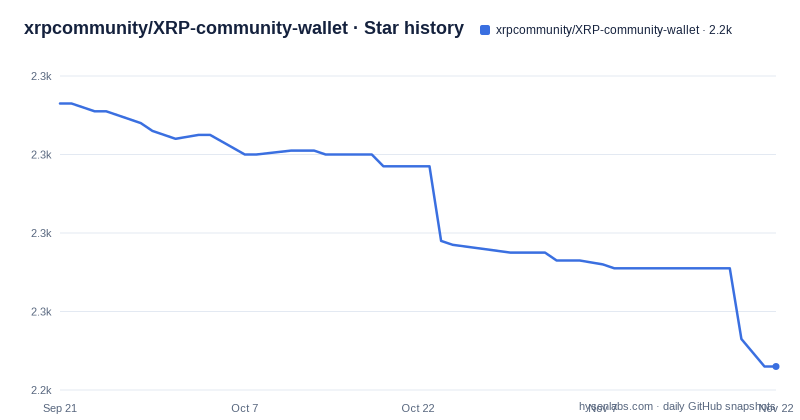
Star history
- xrpcommunity/XRP-community-wallet2,246 ★ · -67
| Repository | 2026-09-21 | 2026-11-22 |
|---|---|---|
| xrpcommunity/XRP-community-wallet | 2.3k | 2.2k |
-67 Stars in the last 62 days, measured from the daily GitHub snapshot. Compare with other projects
Editorial analysis
The XRP row of the network table points at a test network
There are four supported networks and one explorer column. Three of those links are unambiguous mainnet block explorers, one per EVM chain. The XRP row is different: it points at a host whose name is the XRP Ledger's own name for its test network, not the one its mainnet uses. So the table that a user reads to answer which chain an asset lives on, and that a developer copies into tooling, lists three live chains and one test chain without marking the difference. Nothing on the page says any of it is a testnet. The feature list compounds it, because send and receive is described as including address validation, and address validation against a test network is exactly the check that would happily accept something you did not mean to send. The staking feature sits in the same table's ecosystem and has the same ambiguity. The single highest-value edit to this readme would be a word in that one cell.
Staking is the only feature described as a section
Ten of the eleven feature bullets describe behaviour. Keys are encrypted locally and stored in browser storage. A wallet can be generated or restored from a standard word list. Hardware wallets are supported through the browser's device interface. Transfers validate addresses and produce codes to receive by. Balances aggregate across networks and tokens. Operations are listed with links out to explorers. Those are sentences about what the software does. The eleventh bullet says staking is a section for participating in community staking, which describes a part of the interface rather than a capability, and adds nothing about how the delegation works. That matters more than the phrasing, because the About section's central claim is that there are no servers holding funds and no intermediaries, a claim that is true of the other ten features and changes shape the moment funds are delegated somewhere. Whether a stake is self-custodied, whether it can be locked, and who it earns from are all unanswered on the page.
This repository cannot be built without five sibling packages
The local development section opens with requirements and then says the quiet part out loud. The app is one part of a shared monorepo and depends on five internal packages for types, components, translation, an API client and the base TypeScript configuration. Those packages have to be present, and the instruction is to run the commands from the monorepo root, which the readme does not name or link. Then it lists six commands that all look like a standalone project's commands. The documented project structure has the same problem: it describes an application source tree, while the repository root contains applications and packages directories and no source directory at all. So the readme is written from the application's point of view and lives in the monorepo, and a contributor who clones the one repository the page points at and types the six commands will not get a working tree. The page is honest about needing the siblings and wrong about where they are.
The structure the page documents is the application one:
src/
  app/        — application root, providers, routing
  features/   — feature modules (onboarding, send, receive,
                portfolio, history, staking, settings, ...)
  layouts/    — page layouts
  lib/        — crypto, network logic (chains), explorers, theme, wallet
public/       — static assets (logos, favicon)
None of those paths exists at the repository root, where the applications and packages directories do.
Eight workspace overrides, two of them server libraries a browser wallet cannot use
The root manifest pins eight transitive dependencies across the entire workspace to minimum versions, and two of the eight should not be reachable from a browser wallet. A Redis client, pinned to an exact version rather than a floor, and a multipart file-upload handler are both server-side packages, and neither appears in the project's own dependency summary, which lists one state library, one query library, a router, two styling systems, a component library, a translation library, two chain libraries, three crypto libraries and a browser storage wrapper. Two further overrides, a query-string parser and a YAML parser, are in the same category. What this tells you is that the override block is not derived from this application's dependency graph, and the exact-pin on the Redis client in particular suggests one of them was lifted to clear a specific break. For a wallet, an override list that is not traceable to its own imports is worth asking about before it is trusted to hold a version floor.
A logs directory is committed at the root and no CI appears in the tree
The repository root contains a directory whose name is a dot, a capitalised word for logs, and a trailing slash, sitting alongside the gitignore, the manifest, the workspace files and a licence. A gitignore is present, so whatever writes into that directory is being tracked rather than ignored, in a repository whose subject is private keys. The root also has no continuous integration directory, so no test or build gate is visible here. The readme's only claim about testing is that one command runs unit tests. For a project that encrypts a seed phrase with a user password and signs transactions, unit tests are a thin description of the assurance picture, and the absence of a visible pipeline means an audit has to be requested rather than read. Neither of these is evidence of a problem. Both are reasons to ask rather than to assume.
The description says most secure, the security section has three bullets
The repository description opens with a claim of being the most secure wallet for these chains. The readme drops that word and keeps the decentralised part. The security section that replaces it has three items: keys and the seed phrase are never sent to a server and are stored only encrypted on the device, wallet access is protected by a password and unlocking happens locally, and you should back up your seed phrase because recovery is only possible with it. All three are correct and all three describe what any non-custodial wallet does. None of them addresses what is different about a wallet that keeps its key material in browser storage rather than in an application or on a device. There is no statement about the script supply chain, none about the consequence of any dependency on the page, no audit reference and no bug bounty. The third bullet is the only advice in the section, and it is the advice that matters most.
Two crypto libraries with different lineages, and no version pins in the text
The dependency summary names the pieces, and the two most important ones come from different places. Seed phrase handling is done with a well-regarded pure-JavaScript library that follows the modern audited-primitive lineage, and the hashing library beside it is from the same lineage. XRP-specific signing is done with the vendor's own keypair library, and the chain library is the vendor's. That is a defensible split: the standard word list should come from a general purpose audited implementation, and the chain-specific curve work should come from the chain's own library. What the summary does not give is a single version for any of them, in a project whose whole value proposition is that a compromise in a key-handling library is unrecoverable. Pinning them to exact versions and saying so in the readme would cost one sentence and remove the largest unverifiable dependency in the project.
Editorial conclusion
The engineering choices visible here are mostly the right ones for the job. Keys stay in the browser, the seed phrase is a standard word list, hardware wallet support goes through the browser's device interface rather than an extension bridge, both chain ecosystems have first-class libraries, and there are eleven languages with right-to-left support, which is more than most wallets in this space manage. What the page does not do is describe the risks that a browser wallet actually carries. Three things to check before you put funds in it. What the actual threat model is, because the security section covers key custody and password entry and stops there, while a wallet holding a seed phrase in page storage is a target for any script that runs on the page. What staking does to the non-custodial claim, since it is the one feature that can move funds into a different custody relationship and the page describes it as a section and says nothing further. And which explorer you are reading, because the network table on the page points the XRP row at a test network and copying that row's link into your own tooling would send you looking for transactions that do not exist.
Frequently asked questions
Is there a decentralised wallet for XRP?
This is one, and it describes itself as non-custodial: the seed phrase and keys are encrypted locally and stored in browser storage, a user password unlocks them, and nothing is sent to a server. It covers the XRP Ledger plus Ethereum, BNB Smart Chain and Polygon, with hardware wallet support for XRP through the browser's device interface.
Which networks does the XRP Community Wallet support?
Four, listed in a table with an explorer link each: the XRP Ledger, Ethereum, BNB Smart Chain and Polygon. The explorer given for the XRP row is the ledger's test network rather than its mainnet, while the other three rows point at mainnet explorers.
Can I build the XRP Community Wallet from this repository alone?
No. The app depends on five internal workspace packages for types, components, translation, an API client and the base TypeScript configuration, and the readme says to run the commands from the monorepo root. The documented source structure describes the application while the repository root contains applications and packages directories.
What are the security properties of the XRP Community Wallet?
Three are stated: keys and the seed phrase never leave the device and are stored only encrypted, wallet access is protected by a password and unlocking is local, and you should back up your seed phrase because recovery needs it. The page says nothing about audits, a bug bounty, or the script supply chain.
What languages does the XRP Community Wallet support?
Eleven, including a right-to-left language, and the choice is detected automatically from browser settings. The features list mentions the automatic detection but not a manual override, though a settings module appears in the documented project structure.
Official sources
Add this badge to your README
If you maintain this project, the badge below links readers to this analysis and shows its maintenance status from the daily GitHub snapshot. Paste the markdown into your README; add ?metric=license or ?metric=stars to the image URL for a different field.

[](https://hysenlabs.com/projects/xrpcommunity-xrp-community-wallet)Star history chart for your README
[](https://hysenlabs.com/projects/xrpcommunity-xrp-community-wallet)Was this useful?