kgateway: the Envoy control plane that outgrew the Gloo name
The Cloud-Native API Gateway and AI Gateway
At a glance
- What is it?
- A Kubernetes Gateway API implementation built on Envoy, launched as Solo.io's Gloo in 2018 and now maintained as a CNCF sandbox project.
- Who is it for?
- kgateway is worth reading for the shape of its policy model rather than its feature list. GatewayParameters, ListenerPolicy, TrafficPolicy and BackendConfigPolicy form a clear three-tier split between cluster, listener and route scope, and the examples directory is more informative than the README.
- Can I use it commercially?
- Yes. Apache-2.0 is a permissive licence: you can use, modify and sell software built on it, as long as you keep its copyright and licence notices.
- Is it still maintained?
- Yes. The repository last received commits 4 days ago.
- What is it written in?
- Mainly Go, according to GitHub's language statistics.
Answers come from the project's GitHub data, last synced on November 23, 2026, and from our analysis. They are not legal advice.
Star history
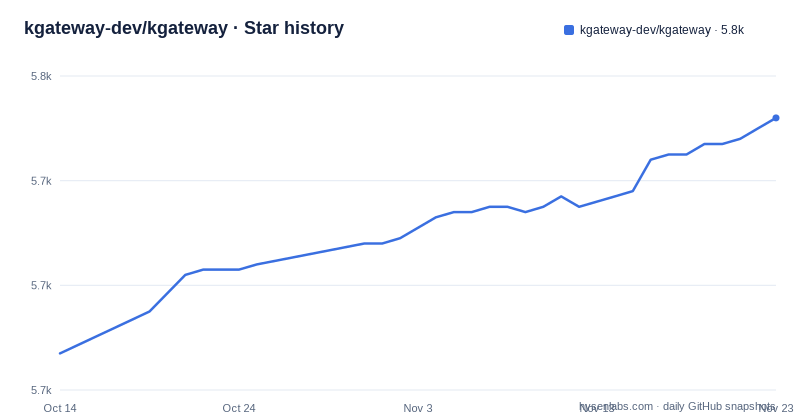
- kgateway-dev/kgateway5,752 ★ · +45
| Repository | 2026-10-14 | 2026-11-23 |
|---|---|---|
| kgateway-dev/kgateway | 5.7k | 5.8k |
45 Stars in the last 40 days, measured from the daily GitHub snapshot. Compare with other projects
Editorial analysis
From Gloo to kgateway, and what the tree says about it
The project started in 2018 as Gloo, built by Solo.io, and reached a production-ready 1.0 in 2019. It now lives under the kgateway-dev organisation, describes itself as the Cloud-Native API Gateway and AI Gateway, points its homepage at kgateway.dev, and carries 5,729 stars with 829 forks and 192 open issues. The last push was 2026-11-02.
The README itself is short. It opens with badges, one paragraph about being a resilient and performance-oriented control plane that implements the Kubernetes Gateway API for Envoy, three use-case bullets, a history note, and then a block of community links. There is no YAML in it. The first honest observation about this repository is that it is a signpost to kgateway.dev/docs rather than a manual in its own right.
The directory listing carries more information than the prose does. `api/` holds the custom resource types, `cmd/` the entry points, `internal/` and `pkg/` the implementation, `install/` the packaging, `design/` the design documents, `devel/` contributor guides, `examples/` thirteen YAML files plus a `plugin/` directory, `test/`, `hack/` and `tools/`. At the root sit a `Tiltfile`, `.golangci.yaml`, `.goreleaser.yaml`, `osv-scanner.toml`, `THREAT_MODEL.md` and both `AGENTS.md` and `CLAUDE.md`, which says something concrete about how the project expects day-to-day work to happen.
Two release lines shipping on the same afternoon
The three most recent releases are v2.5.0 on 2026-11-02, and v2.5.0-rc.1 and v2.5.0-beta.5 on 2026-10-27.
Four resource kinds and a three tier policy split
`examples/` is the most useful directory in the repository. It contains `example-gw.yaml`, `example-http-route.yaml`, `httpbin.yaml`, and then a run of policy examples whose filenames spell out the resource model: `example-listener-policy-with-additional-fields.yaml`, `example-basic-auth-traffic-policy.yaml`, `example-backendconfigpolicy-circuit-breakers.yaml`, `example-gatewayparameters-stats-matcher.yaml`, `example-direct-response-route.yaml`, `example-http-route-with-header-modifier.yaml`.
The naming pattern separates two families. Gateway and HTTPRoute come from the Gateway API itself, so those examples are about compliance rather than invention. Everything else is a kgateway-specific kind, and they sort cleanly into three scopes: GatewayParameters for cluster-wide configuration, ListenerPolicy for anything that belongs to a listener, and TrafficPolicy plus BackendConfigPolicy for things attached at route or service level.
What version 2.3.0 handed back to agentgateway
One README callout explains the most significant structural decision. kgateway previously acted as a control plane for the agentgateway data plane in order to enable AI and agentic features. Starting with version 2.3.0, that control plane was migrated to the agentgateway repository, so that kgateway could concentrate on being a stable, well-tested API gateway powered by Envoy.
The README closes by thanking Envoy and agentgateway as the two data planes it builds on, describing the result as a dual control plane architecture. That is the honest answer to the question of how kgateway and agentgateway differ: they sit at different points in the same architecture rather than competing for the same traffic, and kgateway no longer carries the agent-side control plane at all.
The practical consequence is that anyone arriving from the AI gateway side may land on a repository that no longer serves that purpose, and the roadmap questions move elsewhere. For the traffic kgateway does claim, the README describes a range from lightweight microgateway deployments sitting between services up to massively parallel centralised gateways handling billions of API calls, with route delegation and composable policies for multi-team tenancy.
Reading go.mod to understand what this is built on
The module header is two lines and the dependency list is the real specification.
module github.com/kgateway-dev/kgateway/v2
go 1.27.3
The require block pulls in `envoyproxy/go-control-plane` with its contrib, ratelimit and envoy submodules, `istio.io/api`, `istio.io/client-go` and `istio.io/istio`, `k8s.io/api` and `k8s.io/apiextensions-apiserver`, and `helm.sh/helm/v3`. The Istio entries are the headline. kgateway consumes Istio's API types rather than defining a parallel service mesh vocabulary, which places it as a peer that interoperates with a mesh instead of one that tries to replace it.
Two other root files are load bearing rather than decorative. `.custom-gcl.yml` configures a custom build of the Go linter, and `osv-scanner.toml` drives dependency vulnerability scanning. That combination of an explicit threat model document, a scanner config and monthly releases is a reasonable signal about how seriously the security side is handled.
Distribution, governance, and where the documentation takes over
The Makefile defaults the image registry to `ghcr.io/kgateway-dev`.
The README footer carries a CNCF sandbox project badge. Sandbox is the earliest governance tier, so it is worth naming accurately: this is a project under active development with an outside sponsor, not a graduated one with a mature technical steering committee.
Almost everything you need to decide anything lives off the README. Contributing and releasing both point into `devel/contributing/`, and configuration, policy reference and upgrade guidance are on kgateway.dev. So the practical reading order for someone evaluating this is unusual: skip the README, work through the example YAML files to learn the resource model, then use the docs site for the details those files deliberately leave out. The question the README does not answer is which policy kind owns which scope.
Editorial conclusion
kgateway is worth reading for the shape of its policy model rather than its feature list. GatewayParameters, ListenerPolicy, TrafficPolicy and BackendConfigPolicy form a clear three-tier split between cluster, listener and route scope, and the examples directory is more informative than the README. The trade is that the README is a pointer to kgateway.dev, not a manual. Before committing, check which release your install guide targets, since v2.5.0 shipped on 2026-11-02.
Frequently asked questions
What are the key differences between Agentgateway and Kgateway?
They sit at different points in one architecture rather than competing. kgateway is the control plane for Envoy, and until version 2.3.0 it also hosted the control plane for the agentgateway data plane. That agent-side control plane has moved to its own repository, leaving kgateway focused on L7 API gateway work.
What policy types does kgateway add beyond the Gateway API?
Four custom kinds, split across three scopes. GatewayParameters covers cluster-wide settings, ListenerPolicy covers anything bound to a listener, and TrafficPolicy and BackendConfigPolicy attach at route or service level. The examples directory has a YAML file for each, which is the fastest way to see how they compose.
Is kgateway the same project as Gloo?
It is the continuation of it. The project launched in 2018 as Gloo under Solo.io and was production ready by 2019. It now ships as kgateway under the kgateway-dev organisation, and the README points at a published migration plan covering the transition.
How is kgateway distributed?
The Makefile defaults the image registry to ghcr.io/kgateway-dev, and the repository ships a Tiltfile plus an install directory for local development.
Official sources
Add this badge to your README
If you maintain this project, the badge below links readers to this analysis and shows its maintenance status from the daily GitHub snapshot. Paste the markdown into your README; add ?metric=license or ?metric=stars to the image URL for a different field.

[](https://hysenlabs.com/projects/kgateway-dev-kgateway)Star history chart for your README
[](https://hysenlabs.com/projects/kgateway-dev-kgateway)Was this useful?