Susskind Lecture Notes Repository: A TeX Archive of the Theoretical Minimum
The lecture notes of Professor Leonard Susskind.
At a glance
- What is it?
- This repository bundles Leonard Susskind's course subtitles, transcripts, editable TeX notes, and published PDFs into a single archive. It is a useful reference for self-learners and educators, but the machine-generated transcripts carry recognition errors that you must verify.
- Who is it for?
- Adopt this repository if you are a self-learner or educator who wants editable TeX sources and published PDFs of Susskind's Theoretical Minimum lectures, and if you accept that the transcripts are machine-generated with possible errors. Do not use it if you need verbatim, lecturer-endorsed transcripts, or if you require a single authoritative source.
- Can I use it commercially?
- Yes, with conditions. GPL-3.0 is a copyleft licence: if you distribute software that includes it, you must release that software's source code under the same licence. Running it internally without distributing it does not trigger that obligation.
- Is it still maintained?
- Yes. The repository last received commits 8 days ago.
- What is it written in?
- Mainly TeX, according to GitHub's language statistics.
Answers come from the project's GitHub data, last synced on October 21, 2026, and from our analysis. They are not legal advice.
Star history
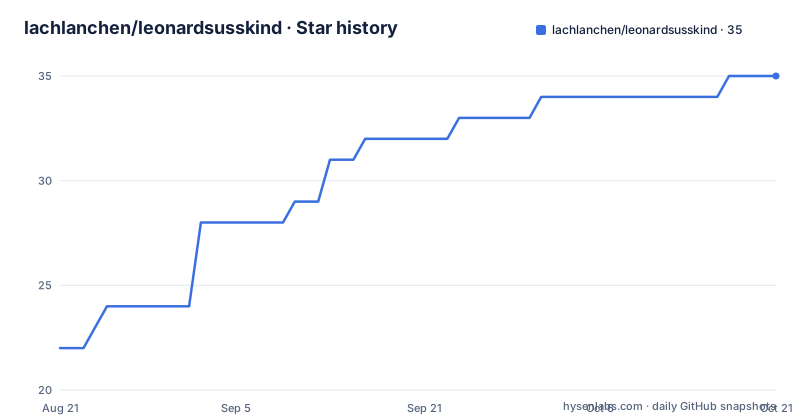
- lachlanchen/leonardsusskind35 ★ · +13
| Repository | 2026-08-21 | 2026-10-21 |
|---|---|---|
| lachlanchen/leonardsusskind | 22 | 35 |
13 Stars in the last 61 days, measured from the daily GitHub snapshot. Compare with other projects
Editorial analysis
What This Archive Actually Solves
The repository addresses a specific pain: Susskind's Theoretical Minimum lectures are scattered across YouTube playlists, with subtitles, transcripts, and notes living in different places. This project pulls them together by course, offering subtitles, timestamped transcripts, editable TeX files, and published PDFs in one structure. It is for people who want to study the material offline, remix the notes, or produce their own companion materials. The README states it covers the Theoretical Minimum sequence and supplementary lectures, so the scope is clear: not just one course, but the entire arc from classical mechanics to cosmology and beyond.
The Pipeline Behind the Notes: Video2Book
The repository does not just store static files. It includes a submodule called Video2Book, which the README describes as the reusable download, transcription, and notes pipeline. That means the project is built on a repeatable process: videos are downloaded, transcribed with timestamps, and then notes are generated from those transcripts plus blackboard frames. This is a significant architectural choice. It means the content can be regenerated when new lectures appear, but it also means the output quality depends on the transcription step. The README is explicit that timestamped transcripts are machine-generated and may contain recognition errors. So the pipeline is a trade-off: automation at the cost of perfect fidelity.
What You Get: Courses, Editions, and Formats
The repository organizes content into core and supplementary sections. The core includes Classical Mechanics, Quantum Mechanics, Special Relativity, General Relativity, Statistical Mechanics, and Cosmology, each with multiple runs. For example, Classical Mechanics has both the 2011 Fall Theoretical Minimum and a Stanford partial run. Supplementary books cover Advanced Quantum Mechanics, Quantum Entanglement (Parts 1 and 3), Particle Physics in three parts, String Theory, and the Higgs boson. Each course has a published PDF, and there are also pocket-size editions tuned for 10-inch e-ink devices and iPad-class screens. The README shows two variants: Pocket-size 1.0x and 1.2x. This variety is useful for different reading devices, but it also means you have to choose the right build for your hardware.
Getting Started: Cloning and Building
The README does not provide explicit build commands, but it points to the canonical repository at lachlanchen/leonardsusskind and notes that Video2Book is included as a submodule. That implies you need to clone with submodules to get the full pipeline. A typical command would be git clone --recurse-submodules https://github.com/lachlanchen/leonardsusskind.git. The repository is primarily TeX, so you would need a TeX distribution to compile the .tex files into PDFs. The published PDFs are already in the repository, so you can skip compilation if you only want to read. The README also mentions an editorial revision log at references/editorial_revision_status.md, which you should inspect to understand which chapters have verified source and figure provenance.
The Critical Limitation: Machine-Generated Transcripts
The biggest caveat is the accuracy of the transcripts. The README clearly states that timestamped transcripts are machine-generated and may contain recognition errors. That is not a minor footnote; it affects every downstream product. The compiled books are described as independently edited, AI-assisted companion notes reconstructed from transcripts and blackboard frames. They are not exact transcripts, not original Susskind manuscripts, and not lecturer-endorsed editions. So if you are using this for precise quotes or rigorous study, you must cross-check against the original videos. The editorial revision log exists precisely to track provenance, but it is a manual process and may not cover every chapter. This is a real failure mode for anyone who treats the notes as authoritative.
Alternatives: The Original Videos and Official Books
The natural alternative is to go directly to the YouTube playlist linked in the README, which contains the original lectures. That gives you the exact spoken content, but you lose the edited structure and the TeX source. Another alternative is Susskind's published books, which are professionally edited and lecturer-endorsed, but they are not free and do not include the full lecture series. The difference in approach is clear: this repository offers a free, editable, and comprehensive archive, but with the risk of transcription errors. The official books offer accuracy and editorial quality, but at a cost and with less granularity. For someone who needs verbatim accuracy, the videos are the only safe source.
Maintenance, Licensing, and Upgrade Costs
The repository is actively maintained, with the latest release v1.1.0 dated 2026-08-25. The release title is Polished Course Editions, which suggests ongoing refinement of the compiled books. The license is GPL-3.0, which means you can use, modify, and distribute the content, but any derivative work must also be GPL-3.0. That has implications if you plan to create commercial products from the notes. The README also notes that a legacy mirror at chenmiaomiao/leonardsusskind is planned for deprecation, so you should use the canonical repository to avoid confusion. Upgrade cost is moderate: because the pipeline is reusable, you can regenerate notes when new content is added, but you must re-verify transcripts each time. The editorial revision log is the place to track those changes.
Who Should Adopt This, and What to Verify First
This repository is a strong fit for self-learners who want a structured, offline copy of Susskind's lectures, and for educators who want to adapt the TeX notes for their own courses. It is not a fit for researchers who need exact quotes or for anyone who cannot tolerate transcription errors. Before adopting it, verify the state of the editorial revision log: check which chapters have confirmed provenance and which are still marked as AI-assisted. Then spot-check a few transcripts against the original videos, especially for technical terms and equations. The repository is comprehensive and well organized, but its value depends on how much you trust the automated pipeline. That trust should be earned, not assumed.
Editorial conclusion
Adopt this repository if you are a self-learner or educator who wants editable TeX sources and published PDFs of Susskind's Theoretical Minimum lectures, and if you accept that the transcripts are machine-generated with possible errors. Do not use it if you need verbatim, lecturer-endorsed transcripts, or if you require a single authoritative source. Before relying on any content, check the editorial revision log at references/editorial_revision_status.md to see which chapters have verified provenance, and compare the compiled books against the original video playlists when accuracy matters.
Frequently asked questions
What is Leonard Susskind famous for?
That is a question about the lecturer, and this repository does not answer it. What the archive records is the course material: the Theoretical Minimum sequence from 2011 through 2013 plus nine supplementary courses, gathered as subtitles, timestamped transcripts, TeX notes and published PDFs.
Is Leonard Susskind a good teacher?
The repository makes no claim about teaching quality. It documents the courses themselves and is explicit about the edition status, describing the compiled books as independently edited, AI-assisted companion notes reconstructed from transcripts and blackboard frames.
What is Leonard Susskind doing now?
Nothing about his current work appears in this repository. What it states concerns itself: the canonical repository is lachlanchen/leonardsusskind, a second copy under chenmiaomiao is a temporary legacy mirror planned for deprecation, and the latest release is v1.1.0, described as polished course editions.
Official sources
Add this badge to your README
If you maintain this project, the badge below links readers to this analysis and shows its maintenance status from the daily GitHub snapshot. Paste the markdown into your README; add ?metric=license or ?metric=stars to the image URL for a different field.

[](https://hysenlabs.com/projects/lachlanchen-leonardsusskind)Star history chart for your README
[](https://hysenlabs.com/projects/lachlanchen-leonardsusskind)Was this useful?