LangChain4j: The Java-native LLM toolkit that is not a LangChain port
LangChain4j is an idiomatic, open-source Java library for building LLM-powered applications on the JVM. It offers a unified API over popular LLM providers and vector stores, and makes implementing tool calling (including MCP support), agents and RAG easy. It integrates seamlessly with enterprise Java frameworks like Quarkus and Spring Boot.
At a glance
- What is it?
- LangChain4j offers unified Java APIs for LLM providers and vector stores, plus tool calling, agents, and RAG. It is built for JVM conventions, not ported from Python, and suits Quarkus and Spring Boot teams.
- Who is it for?
- Adopt LangChain4j if you are a Java or Kotlin team needing a unified API over LLM providers and vector stores, especially if you already use Quarkus, Spring Boot, Helidon, or Micronaut. It is the wrong choice if you expect a direct migration from Python LangChain code, because the API is independent and Java-idiomatic.
- Can I use it commercially?
- Yes. Apache-2.0 is a permissive licence: you can use, modify and sell software built on it, as long as you keep its copyright and licence notices.
- Is it still maintained?
- Yes. The repository received new commits within the last day.
- What is it written in?
- Mainly Java, according to GitHub's language statistics.
Answers come from the project's GitHub data, last synced on November 13, 2026, and from our analysis. They are not legal advice.
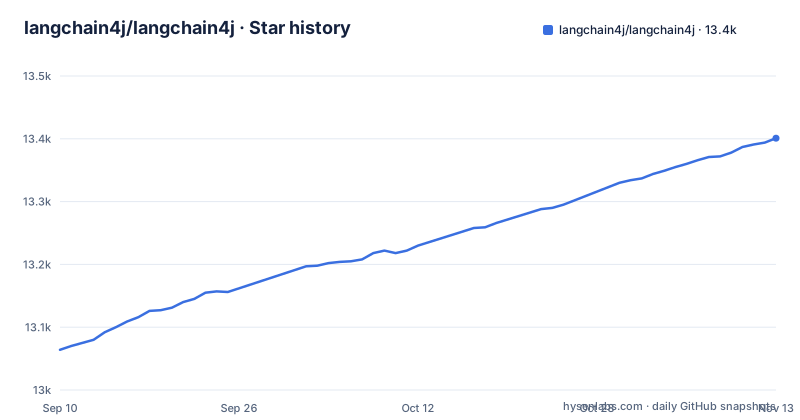
Star history
- langchain4j/langchain4j13,401 ★ · +337
| Repository | 2026-09-10 | 2026-11-13 |
|---|---|---|
| langchain4j/langchain4j | 13.1k | 13.4k |
337 Stars in the last 64 days, measured from the daily GitHub snapshot. Compare with other projects
Editorial analysis
What LangChain4j solves for JVM teams
Java developers who want to add LLM features face a fragmented ecosystem. OpenAI, Google Vertex AI, and dozens of other providers each have their own HTTP APIs, request formats, and authentication. Vector stores like Pinecone and Milvus are similarly divergent. LangChain4j addresses this by offering a unified API layer that hides provider-specific details. The README states the goal is to avoid learning and implementing each proprietary API, allowing you to switch between LLMs or embedding stores without rewriting your code. It targets teams building chatbots, RAG pipelines, or agentic systems on the JVM, and it claims support for 20+ LLM providers and 30+ embedding stores. The library is not a Java translation of Python's LangChain. The README is explicit: it is built for Java from the ground up, with type safety, POJOs, annotations, and dependency injection as core conventions.
The architecture: interfaces, abstractions, and Java idioms
LangChain4j structures itself around common patterns that emerged from LLM application development since early 2023. The README describes a toolbox that ranges from low-level prompt templating and chat memory to high-level agent and RAG abstractions. For each abstraction, the library provides an interface plus multiple ready-to-use implementations. This design means you code against a stable interface, then choose a concrete implementation for your provider or store. The Java-centric approach shows in how integrations are offered. Quarkus, Spring Boot, Helidon, and Micronaut each have their own integration modules, such as quarkus-langchain4j or micronaut-langchain4j. That is a different model from Python libraries that bolt onto a web framework. Here, the framework integration is part of the ecosystem, which matters for teams that rely on CDI or Spring context to manage beans.
Getting started: Maven coordinates and examples
The primary distribution is through Maven Central under the group dev.langchain4j, with the core artifact langchain4j. The README points to a getting started guide at docs.langchain4j.dev/get-started, and a separate examples repository. For plain Java, you can look at other-examples/src/main/java. For Quarkus, the samples live in the quarkus-langchain4j repository. For Spring Boot, there is a spring-boot-example directory in the langchain4j-examples repo. Helidon and Micronaut have their own integration guides. The exact dependency coordinates for each framework are not listed in the README, but the pattern is clear: you add the core module, then a provider module for your chosen LLM (such as OpenAI or Anthropic), and optionally a store module. The release history shows how active the project is, with 1.19.5, 1.11.12 and 1.5.4 all released on 2 November 2026. That cadence means you should pin a specific version rather than float on latest.
The tool calling and MCP angle
The repository description highlights tool calling, including MCP support, as a core capability. Tool calling is what lets an LLM request an external function, like a database lookup or a calculation, and receive the result to continue its response. LangChain4j provides a unified API over this, which is useful because each provider implements function calling differently. The description also mentions agents and RAG as easy to implement. However, the README itself does not go into detail on how MCP is wired. It only appears in the repository metadata. If you are evaluating this for a production agent, you will need to consult the documentation or the source to see which MCP features are supported and how they map to Java types. The high-level claim is promising, but the README does not show a concrete MCP example, so treat that as a feature to verify, not a given.
Where LangChain4j falls short: release volatility and thin docs
The release history reveals a real operational risk. The project ships beta versions alongside stable ones. The 1.19.5 release, for example, shipped as 1.19.5 and 1.19.5-beta29, and 1.11.12 and 1.5.4 were released the same day with their own beta versions. If you pick a version without checking the suffix, you may end up on a beta. The README also admits that some features are still being worked on, though core functionality is in place. For a team that needs long-term stability, this is a warning sign. You will need a disciplined dependency management process. The documentation is external, and the README does not contain a full API reference, so you rely on docs.langchain4j.dev, which may lag behind the rapid release cycle.
How it compares to alternatives: Python LangChain and direct SDKs
The most obvious alternative is the Python LangChain, but that comparison is misleading because LangChain4j is not a port. The API, internals, and release cycle are independent, so you cannot take Python code and translate it line by line. A more practical alternative is using the official SDK for each provider, such as the OpenAI Java client or the Vertex AI SDK, plus a separate vector store client. That approach gives you direct access to each vendor's features, but it multiplies your integration effort and makes switching providers expensive. LangChain4j sits in between: it trades some vendor-specific control for a uniform interface. Another alternative is to use a framework-specific integration like Spring AI, which also targets Java but is tied to Spring. LangChain4j's advantage is that it is framework-agnostic at its core, even though it offers first-class integrations for multiple frameworks. The trade-off is that you depend on the library's abstractions, which may not expose every new provider feature as soon as it ships.
Maintenance cost and licence implications
LangChain4j is licensed under Apache-2.0, which is permissive for commercial use, but it is not legal advice. That licence means you can incorporate it into proprietary software without copyleft obligations, though you should check each integration module's own licence because some provider SDKs may have different terms. The maintenance burden is real. The project pushes updates frequently, as shown by multiple releases within days. Each new version may change APIs, especially while features are still stabilizing. The README acknowledges active development and says some features are unfinished. You should budget time for upgrading and for reading changelogs. The project also maintains a separate examples repository, which is helpful for keeping your code current, but it is another dependency on the community's documentation quality. If you are not prepared to track releases closely, you may prefer a less volatile library or a direct SDK.
Editorial conclusion
Adopt LangChain4j if you are a Java or Kotlin team needing a unified API over LLM providers and vector stores, especially if you already use Quarkus, Spring Boot, Helidon, or Micronaut. It is the wrong choice if you expect a direct migration from Python LangChain code, because the API is independent and Java-idiomatic. Before adopting, verify that your specific provider or embedding store has a maintained integration, confirm the version you pick is not a beta, and test the tool calling and RAG abstractions against your use case. The project is active and release-heavy, so plan for frequent upgrades.
Frequently asked questions
What is LangChain4j used for?
Putting LLMs into Java applications on the JVM. It offers one API over 20+ LLM providers and 30+ embedding stores, with a toolbox spanning prompt templating, chat memory management, function calling, agents and RAG.
What is the difference between LangChain and LangChain4j?
LangChain4j is not a port of the Python LangChain. It was built for Java rather than ported to it, and its API, internals and release cycle are independent of the Python project.
What is the difference between Spring AI and LangChain4j?
The repository makes no such comparison. What it does state is that LangChain4j offers first-class integrations with Quarkus, Spring Boot, Helidon and Micronaut.
Is LangChain available for Java?
Not as a port of the Python LangChain. LangChain4j covers the same problem space for Java and is built on Java conventions, but it is a separate project with its own API and release cycle.
How do you use LangChain4j in Java?
The README gives no install command and sends you to the getting started guide at https://docs.langchain4j.dev/get-started, with plain Java examples in the langchain4j-examples repository and a separate example set for each of Quarkus, Spring Boot, Helidon and Micronaut.
Is LangChain4j open source?
Yes. The project is hosted on GitHub and released under the Apache-2.0 license, with contribution rules in CONTRIBUTING.md and a code of conduct in CODE_OF_CONDUCT.md.
Official sources
Add this badge to your README
If you maintain this project, the badge below links readers to this analysis and shows its maintenance status from the daily GitHub snapshot. Paste the markdown into your README; add ?metric=license or ?metric=stars to the image URL for a different field.

[](https://hysenlabs.com/projects/langchain4j-langchain4j)Star history chart for your README
[](https://hysenlabs.com/projects/langchain4j-langchain4j)Was this useful?