lieflat-less-ai-tone: a corpus study that decides which AI-tone rules survive
An AI-tone removal skill grounded in a 2.83-million-character corpus study.
At a glance
- What is it?
- A Chinese-language Agent Skill built from a 2.83-million-character comparison of model output and human writing. Its first round compared 300 generated articles from five models with 329 human ones, and a second round re-tested features on paired texts.
- Who is it for?
- Adopt this if you write or edit Chinese prose and want a rule set whose markers were measured against a human control corpus rather than repeated from social media. Do not adopt it if you need English rewriting, semantic judgement about whether a metaphor works, or any change to facts, numbers or hedged claims, because the rule set excludes all three.
- Can I use it commercially?
- Check first. The repository uses a licence we do not classify automatically, so read its LICENSE file before any commercial use.
- Is it still maintained?
- Yes. The repository last received commits 4 days ago.
- What is it written in?
- Mainly Python, according to GitHub's language statistics.
Answers come from the project's GitHub data, last synced on November 15, 2026, and from our analysis. They are not legal advice.
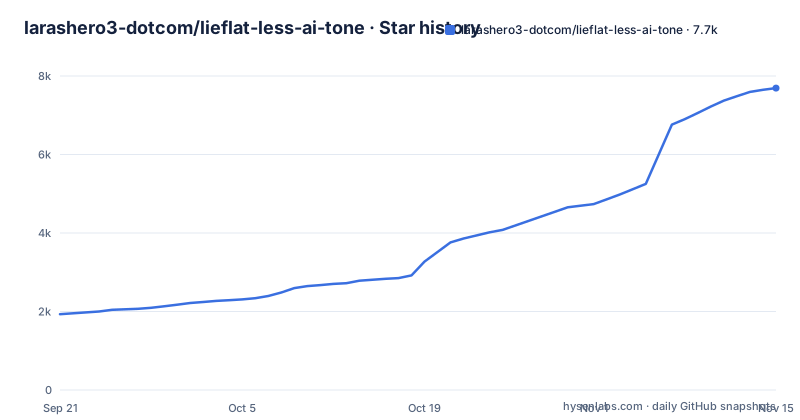
Star history
- larashero3-dotcom/lieflat-less-ai-tone7,691 ★ · +5,760
| Repository | 2026-09-21 | 2026-11-15 |
|---|---|---|
| larashero3-dotcom/lieflat-less-ai-tone | 1.9k | 7.7k |
5,760 Stars in the last 55 days, measured from the daily GitHub snapshot. Compare with other projects
Editorial analysis
What the project actually measures, and who it is for
Most advice about removing AI tone is a list. Lieflat Less AI Tone treats the list as a hypothesis. The README states that the study assembled 629 articles, 2,826,972 Chinese characters, 95,551 sentences and 45,721 paragraphs, with 300 articles generated by five models under controlled conditions and 329 written by humans. It then tested candidate markers that circulate in public discussion as signs of AI writing, computing a frequency ratio between the generated side and the human side.
Not all of them passed, and some point the other way. That reversal is the reason to read this project rather than another writing guide. The README reports that human writers use metaphor markers 2.4 times as often as generated text. A rule that says delete the rhetorical question makes Chinese prose less human, not more.
The audience is narrow and specific. It is for people producing Chinese text who want a mechanical, auditable cleanup pass, and for people who want to see how a style claim can be tested at all. The repository ships README.md, README.en.md, RESEARCH.md, RESEARCH.en.md and SKILL.md, so the evidence and the rules are separate artifacts.
How the frequency ratio works and why the denominator decides the answer
The core statistic is R, the generated-side frequency divided by the human-side frequency. The README gives four bands: R at or above 2.0 is included, 1.25 to 2.0 is conditional on cross-group consistency and sufficient absolute volume, 0.8 to 1.25 has no discriminating power, and below 0.8 means the human side is higher, which the study treats as unusable for deletion rules.
Three further conditions gate inclusion: cross-group consistency (a range of no more than 5x), locatability (the operator can point to the sentence to change) and actionability (a rewrite that cannot be checked, such as adding function words, drops the feature).
Segmenting the corpus: the bug that produced a 51x claim
The README describes three measurement layers for the second round. The script layer covers 90 computable indicators, such as punctuation density, sentence-length distribution and lexical diversity, tested on 540 articles with paired Wilcoxon and Cliff's δ, where |δ|≥0.33 counts as significant. The semantic layer covers 9 indicators that scripts cannot judge, decided through a structured interface (Jev) in about 500,000 judgements. The human layer is sentence-by-sentence annotation with sampled review, used for metaphor aptness.
A feature counts if it is significant in any one layer; it does not have to pass all three.
Installing the skill and running a first pass
The README documents a four-step workflow built around scripts/detect.py. The first step runs script-layer detection, which only reports and does not rewrite, and saves JSON for the later comparison:
python3 scripts/detect.py <文件或目录> --json > /tmp/before.jsonStep 1.5 extracts semantic-layer candidates for the in-session model to judge against the closed criteria in references/semantic-criteria.md:
python3 scripts/detect.py <文件> --candidates --out /tmp/candidates.jsonIn step two the model reviews the hits and reports the indicators, research significance, example sentences, suggested changes and exclusions, then waits for the user to reply. Only after that reply does step three rewrite, following the rules in SKILL.md. Step four re-runs detection and produces a before-and-after report, Markdown by default or HTML with --format html:
python3 scripts/detect.py <改后文件> --json > /tmp/after.json
python3 scripts/report.py 原文 改后文 /tmp/before.json /tmp/after.json \
    --semantic /tmp/candidates_labeled
A complete worked example is in examples/agent-memory-case, with the pre-rewrite report, the rewritten text, a two-column HTML comparison page and the re-test conclusion.
The eleven surviving markers and the structural bias in the results
The README sorts its results into tiers by strength of evidence. The first tier is nine indicators significant in the same direction for both GPT-5.6 and Opus 4.6: the contrastive 不是A而是B construction (script-layer δ +0.88 / +0.72, which the README calls the strongest pure writing signal), avoiding word repetition (mtld/mattr), sections cut too fine, sentence length and rhythm that are too even, long pre-nominal modifiers, conclusion-announcing colons (2.1 times on the semantic layer), over-smooth transitions between paragraphs, dense parallel listing (7.845 against 5.398 per thousand characters, 1.45 times) and poor metaphor aptness, which only the human layer could confirm.
The paragraph-opening comment with no backward reference (段首零回指评论) is not in that tier. The README places it among the indicators that were not significant enough, at 4.9 percent against 3.3 percent, about 1.5 times, alongside adjacent-sentence structural isomorphism at 8.71 percent against 5.52 percent.
Blacklist words such as 赋能, 闭环 and 抓手 (δ +0.10) and connectives such as 首先/其次/总之 (δ +0.02) did not hold up once texts were paired on the same facts.
Model-to-model spread makes single-model evidence useless
The README's second tier covers habits that differ by model, and the direction can flip. Em dashes score δ −0.54 for GPT-5.6, fewer than human writers, and +0.95 for Claude Opus 4.6, where 100 percent of articles use them; the README says a rewrite has to know which model the text resembles first. The particle 的 per clause runs −0.75 for GPT and +0.62 for Opus. Semicolons and enumeration commas (+0.80 / +0.56) are GPT-specific, while Opus uses quotation marks far less than humans (−0.67) and pushes new information to the end of the sentence (+0.47).
The study's own history supports the point. The README calls unpaired corpora the fundamental flaw of the first round; the second round turned the numbers and events in human articles into task cards so the models wrote on the same facts. Some first-round signals, such as precise-number density and blacklist words, disappeared after pairing.
Where the rule set refuses to act, and why that is the right boundary
The README sets limits on what gets changed. Detection findings are graded: A items are mechanical fixes such as deleting lead-in phrases or swapping punctuation; B items need sentence restructuring; C items, such as even sentence length or fragmented structure, are reported but not changed unless the user asks; H items, such as personified metaphors, are left for human review and kept by default; X items were rejected by the paired re-test and are never changed, with their counts shown to prevent mistaken edits. A and B changes happen only after the user replies.
The original text's facts and qualifiers are protected by an information-conservation principle, and the skill keeps the original metaphors by default because models agreed on metaphor aptness only 0 to 40 percent of the time.
This is a genuine limitation. A text can be clean on every measured indicator and still read badly; the skill targets measured surface habits and will not tell you whether the argument holds.
The rejected list is the more useful half, and the honest alternative
The README publishes the indicators it rejected alongside the ones it kept. Grade X covers features the paired re-test showed are not AI tone, and they are never changed. The clearest reversal is the generalisation rule: the first semantic pass found 24.7 percent of comparable paragraphs became more general than specific, and a rewrite rule was built on it, but a symmetric re-check found 26.0 percent moving the other way, a net difference near zero, so the rule was downgraded to X. Other indicators fell short as well: precise-number density (δ −0.06), blacklist words (δ +0.10), 首先/其次/总之 connectives (δ +0.02), and 这意味着-style restatement, which humans use more.
The alternative to this project is a style linter or a general-purpose rewrite prompt. A linter matches patterns you configure, with no control group and no evidence about whether the pattern separates AI from human text. A rewrite prompt can change your claims. The difference here is that each indicator carries measured evidence, and the project shows you the ones it threw away.
Editorial conclusion
Adopt this if you write or edit Chinese prose and want a rule set whose markers were measured against a human control corpus rather than repeated from social media. Do not adopt it if you need English rewriting, semantic judgement about whether a metaphor works, or any change to facts, numbers or hedged claims, because the rule set excludes all three. Verify first that the SKILL.md rules match the indicators the README marks as significant rather than the rejected grade-X ones, and read RESEARCH.md before trusting any ratio you intend to act on.
Frequently asked questions
What is an AI tone?
The project treats it as a set of measurable textual features rather than a vibe, and tests each candidate against a human control corpus. Nine indicators were significant in the same direction for both GPT-5.6 and Opus 4.6; the README calls the contrastive 不是A而是B construction the strongest pure writing signal.
How do I make this sound less like AI?
Run the skill's workflow: scripts/detect.py reports the measured indicators first, the model reviews the hits and proposes changes, and the rewrite happens only after you reply, followed by a re-test and a before-and-after report. The README warns that feeding a model a pile of heuristic rules makes it aggressively delete natural rhetorical questions and ordinal subheadings.
Does lieflat-less-ai-tone work on English text?
The corpus and the rules are Chinese. The README counts Chinese characters throughout, and the repository ships README.en.md and RESEARCH.en.md as English versions of the documentation.
Will lieflat-less-ai-tone add data or citations to my text?
The README says the original text's facts and qualifiers are protected by an information-conservation principle. A rule against replacing specific information with generalisations was downgraded to grade X, never changed, after a symmetric re-check found no net difference.
Why does lieflat-less-ai-tone reject some well-known AI writing markers?
Because they did not separate the two corpora once texts were paired on the same facts. The README lists blacklist words such as 赋能/闭环/抓手 at δ +0.10, 首先/其次/总之 connectives at δ +0.02 and 这意味着-style restatement, which humans use more, and notes metaphor-marker density is 2.4 times higher on the human side.
Official sources
Add this badge to your README
If you maintain this project, the badge below links readers to this analysis and shows its maintenance status from the daily GitHub snapshot. Paste the markdown into your README; add ?metric=license or ?metric=stars to the image URL for a different field.

[](https://hysenlabs.com/projects/larashero3-dotcom-lieflat-less-ai-tone)Star history chart for your README
[](https://hysenlabs.com/projects/larashero3-dotcom-lieflat-less-ai-tone)Was this useful?