Laravel Echo for browser-based realtime event subscriptions
Laravel Echo library for beautiful Reverb, Pusher, and Ably integration.
At a glance
- What is it?
- Laravel Echo is the JavaScript client library for subscribing to Laravel broadcast events over channels. It targets applications using Laravel broadcasting with transports such as Reverb, Pusher, or Ably, but the repository documentation leaves transport configuration to Laravel's broadcasting guide.
- Who is it for?
- Application teams building browser interfaces around Laravel broadcast events should evaluate Echo when they want one JavaScript subscription layer across supported broadcasting providers. Teams that need a complete backend, connection server setup, or transport-specific configuration should treat Echo as only the client component.
- Can I use it commercially?
- Yes. MIT is a permissive licence: you can use, modify and sell software built on it, as long as you keep its copyright and licence notices.
- Is it still maintained?
- Yes. The repository last received commits 4 days ago.
- What is it written in?
- Mainly TypeScript, according to GitHub's language statistics.
Answers come from the project's GitHub data, last synced on November 7, 2026, and from our analysis. They are not legal advice.
Star history
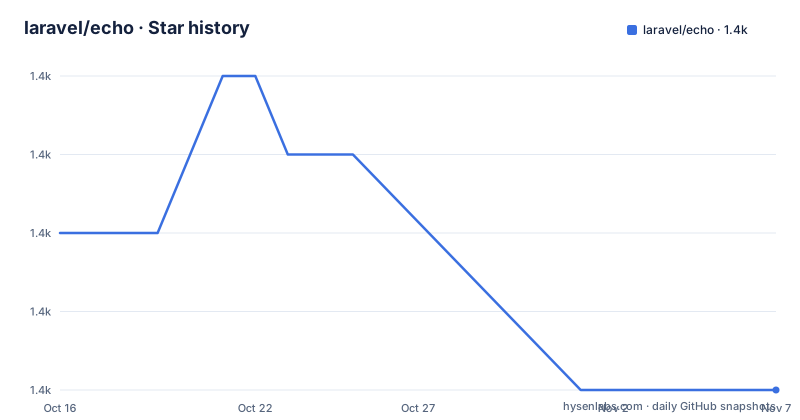
- laravel/echo1,359 ★ · -2
| Repository | 2026-10-16 | 2026-11-07 |
|---|---|---|
| laravel/echo | 1.4k | 1.4k |
-2 Stars in the last 22 days, measured from the daily GitHub snapshot. Compare with other projects
Editorial analysis
Where Laravel Echo fits in a Laravel broadcasting stack
Laravel Echo addresses the browser side of realtime applications. The README describes a common flow in which server data changes, Laravel broadcasts an event over a WebSocket connection, and client-side JavaScript handles that event. Echo is the library used in the browser to subscribe to channels and listen for those broadcasts. It does not create the server-side events, decide when data should be broadcast, or replace the WebSocket service.
The intended audience is developers building JavaScript interfaces for Laravel applications that update live as information changes on the server. Typical examples would include interfaces that receive application events without repeatedly polling, although the repository does not document a complete application example. Its value is narrower: it gives the client a Laravel-oriented interface for channels and events, allowing the server and browser to use the same event names.
The description names Reverb, Pusher, and Ably as integration targets. That means Echo should be considered alongside the broadcasting provider selected for the Laravel application, not as a standalone real-time platform. The README points to Laravel's broadcasting documentation for the surrounding configuration. It does not explain server credentials, channel authorization, WebSocket endpoints, private channels, presence channels, or provider-specific connection options. Those omissions matter during adoption because Echo alone does not establish whether a browser client will be allowed to subscribe or receive an event.
Echo's channel and event subscription model
The documented mechanism has two linked layers. Laravel applications broadcast named events, and Echo subscribes to channels in client-side JavaScript before listening for those event names. This shared naming model is the main architectural idea visible in the README. The server remains responsible for deciding what happened and whether it should be broadcast. The browser-side library receives selected event information and lets the application attach its own handling logic.
That division makes Echo useful when the same Laravel domain event has different browser effects, such as changing one region of a page or recording that an update arrived. The README does not promise a local application store, state reconciliation, optimistic updates, retry policy, event persistence, or offline delivery. Accordingly, an application should not treat the existence of an Echo subscription as proof that every event will reach the browser. Delivery still depends on the Laravel broadcasting setup, its WebSocket connection, and the provider or server handling that connection.
The repository is written primarily in TypeScript and contains a `packages/` directory managed through a pnpm workspace. That layout indicates a library repository with internal packages rather than a Laravel application template. Based on the repository layout, developers changing Echo itself work through the root package scripts and workspace configuration. Consumers should distinguish those contributor and maintainer commands from the npm installation steps documented by Laravel.
Installing Echo and completing a first browser subscription
The README identifies the npm package as `laravel-echo` and says Echo may be installed through the npm package manager. It does not include an installation command, npm version, import form, initialization options, or a first subscription example. The repository links to `https://laravel.com/docs/broadcasting` as the official documentation, where client-side installation is documented.
For a first real use, follow the client-side installation section there and select the Laravel broadcasting configuration that matches the application's provider. The expected result is a configured Echo client in the browser. Then subscribe through Echo to a channel already authorized and broadcast by the Laravel server, and listen for the exact server event name. The README does not document the method names or option object needed to perform those steps, so no speculative JavaScript block is appropriate here.
This documentation boundary can slow initial setup. Echo is the client library, but adoption depends on Laravel's server-side event definition, broadcasting configuration, channel rules, and provider credentials. A team should verify that its server contract exists before treating a browser subscription failure as an Echo problem. The event name shared between server and client is especially important because Echo's stated purpose is to preserve that shared naming convention.
Reverb, Pusher and Ably support without provider setup details
Echo's repository description presents the library as an integration point for Reverb, Pusher, and Ably. That framing positions Echo above provider-specific browser concerns, at least at the level of its purpose and public integration surface. However, the README does not enumerate each provider's connection arguments, authentication behavior, reconnect handling, or supported protocol options. It also does not claim identical feature coverage across all three providers.
This distinction matters when comparing providers. Choosing a WebSocket provider affects server connection management and channel delivery, while Echo provides the JavaScript-side subscription API used by the application. Echo should therefore be evaluated after the Laravel application has settled on its broadcasting path, or alongside that decision if the provider choice depends on the client libraries involved.
The alternative approach is to integrate a provider's own browser client directly and implement the application's channel subscriptions without Echo. Such an approach can reduce abstraction when an application uses only one provider and already follows that provider's API. Echo becomes more relevant when the Laravel server-side contract and multi-provider intent justify a shared client layer. The repository does not quantify that benefit, so the decision should rest on the actual broadcasting configuration rather than broad compatibility claims.
Limits of the client-only abstraction
The clearest limitation is that Echo does not supply the full real-time stack described by the README. The WebSocket connection, Laravel broadcasting setup, event authorization and channel access remain parts of the surrounding application. A working Echo subscription cannot compensate for a server that emits a different event name, rejects an unauthorized channel, or has no reachable broadcasting configuration.
The README is also brief about operational behavior. It does not document reconnection semantics, offline buffering, delivery guarantees, message ordering, retry limits, or compatibility expectations for particular browsers and JavaScript runtimes. These are not minor details for applications that treat server changes as important interface state. Teams requiring an explicit offline or recovery contract will need to consult the official Laravel and provider documentation or inspect the implementation.
Echo is also the wrong tool when there is no Laravel broadcasting model to consume. A standalone JavaScript application, a non-Laravel server, or an application that only makes occasional HTTP requests may gain little from a client library organized around Laravel event names. Likewise, a backend-only feature with no browser listener does not need Echo. Its scope is clearest when Laravel controls the event vocabulary and the frontend needs live updates over a supported broadcasting connection.
Maintenance signals and the cost of extending Echo
The repository is not archived, and its last push was on 2026-10-16. Recent releases include `v2.6.1` and `v2.6.0` on 2026-10-07, followed by `v2.5.0` on 2026-09-08. These facts indicate recent activity around the default `2.x` branch, but they do not by themselves describe support policy, long-term compatibility or upgrade effort.
The root `package.json` names `[email protected]` as its package manager and defines workspace scripts including `build`, `test`, `typecheck`, `lint`, `format`, `compile` and `declarations`. For maintainers, that means repository work is organized around a pnpm workspace and several packages. Contributor changes may require type checking and package builds in addition to tests. Consumer upgrades have a different cost: the README gives no migration procedure or compatibility matrix, so package upgrades should be checked against the application's Echo initialization and Laravel configuration.
Laravel Echo is licensed under the MIT licence. The repository supplies `LICENSE.md`, but this review does not interpret legal obligations. Organizations should review that file for their own compliance and distribution needs. The practical maintenance boundary is clear: Echo's release activity concerns the client library, while provider services, Laravel application compatibility and server broadcasting configuration remain separate upgrade surfaces.
Editorial conclusion
Application teams building browser interfaces around Laravel broadcast events should evaluate Echo when they want one JavaScript subscription layer across supported broadcasting providers. Teams that need a complete backend, connection server setup, or transport-specific configuration should treat Echo as only the client component. Before adoption, verify the current Laravel broadcasting installation instructions for the chosen provider, the npm package version, and the channel and event names emitted by the server. Echo fits this narrow role best when server and browser already share Laravel's event naming convention.
Frequently asked questions
What is Laravel Echo used for?
Laravel Echo is a JavaScript client library for subscribing to channels and listening for events broadcast by Laravel. It provides the browser-side portion of a Laravel broadcasting flow.
How do I install Laravel Echo?
The README says Echo may be installed with the npm package manager and identifies the package as `laravel-echo`. It does not provide a command; the official Laravel broadcasting documentation is linked for client-side installation.
Does Laravel Echo support Reverb, Pusher, and Ably?
The repository description names Reverb, Pusher, and Ably as supported integration targets. The README does not document provider-specific setup or claim identical feature coverage.
Official sources
Add this badge to your README
If you maintain this project, the badge below links readers to this analysis and shows its maintenance status from the daily GitHub snapshot. Paste the markdown into your README; add ?metric=license or ?metric=stars to the image URL for a different field.

[](https://hysenlabs.com/projects/laravel-echo)Star history chart for your README
[](https://hysenlabs.com/projects/laravel-echo)Was this useful?