Laravel Reverb for Real-Time Laravel Applications
Laravel Reverb provides a real-time WebSocket communication backend for Laravel applications.
At a glance
- What is it?
- Laravel Reverb is an MIT-licensed PHP backend for WebSocket communication in Laravel applications. The README is concise and sends users to Laravel's official documentation for installation and use.
- Who is it for?
- Laravel developers who need a WebSocket service explicitly intended for Laravel applications can evaluate Reverb. Teams that need locally documented installation commands, event schemas, deployment guidance, or upgrade procedures should inspect the official Laravel documentation first.
- Can I use it commercially?
- Yes. MIT is a permissive licence: you can use, modify and sell software built on it, as long as you keep its copyright and licence notices.
- Is it still maintained?
- Yes. The repository last received commits 19 days ago.
- What is it written in?
- Mainly PHP, according to GitHub's language statistics.
Answers come from the project's GitHub data, last synced on November 7, 2026, and from our analysis. They are not legal advice.
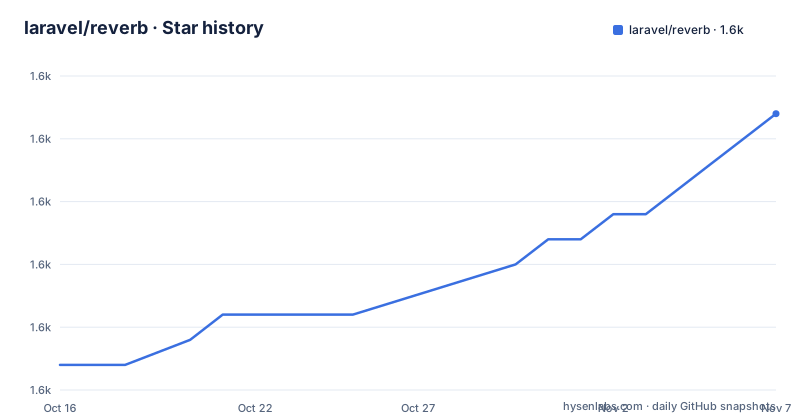
Star history
- laravel/reverb1,636 ★ · +10
| Repository | 2026-10-16 | 2026-11-07 |
|---|---|---|
| laravel/reverb | 1.6k | 1.6k |
10 Stars in the last 22 days, measured from the daily GitHub snapshot. Compare with other projects
Editorial analysis
Laravel Reverb's Place in a Real-Time Laravel Stack
Laravel Reverb addresses a specific problem: establishing a backend channel for real-time WebSocket communication in applications built with Laravel. Its intended users are Laravel developers who need a server-side component for communication that is not limited to a conventional request and response cycle. The repository describes Reverb as a "real-time WebSocket communication backend," which places it below the application layer rather than presenting it as a complete front-end notification system or a general-purpose messaging product.
That boundary matters when evaluating adoption. The README does not claim that Reverb defines browser APIs, manages client-side state, or decides how a Laravel interface should render incoming events. It does not document browser code, event payload schemas, or delivery guarantees in the README. Those responsibilities are therefore not established by this repository alone. The documented point of interest is the Laravel-facing communication backend.
Reverb is also clearly associated with Laravel rather than being described as a protocol library that can be dropped into any PHP application. That makes it most relevant to teams already using Laravel and seeking a WebSocket backend within that ecosystem. The association alone does not prove compatibility with every Laravel release, hosting environment, or application design, so those points remain outside what the README confirms.
What the Reverb Repository Reveals About Its Structure
Based on the repository layout, Reverb is distributed as a PHP project with distinct implementation, configuration, resource, and test directories. The `src/` directory is the natural location for application code, while `config/` indicates that runtime configuration has a separate home. A `resources/` directory is also present, but the README does not identify its contents, so it would be speculative to assign templates, translations, or another specific purpose to it. The `tests/` and `phpunit.xml.dist` entries show that the project includes a PHPUnit-oriented test structure, although no individual test behavior is documented in the README.
The root files provide a clearer view of project maintenance. `composer.json` identifies this as a Composer-based PHP package, while `.editorconfig`, `phpstan.neon.dist`, and `phpunit.xml.dist` indicate distinct editor, static analysis, and test configuration files. However, the README does not list supported PHP versions, Laravel versions, Composer commands, extension requirements, or runtime dependencies. None of those details should be inferred merely from the presence of a file.
The repository description establishes WebSocket communication as the functional core, but it does not expose a protocol sequence, event dispatcher, channel model, persistence layer, or scaling design. A useful architecture review would need source inspection or the official Laravel documentation. The repository layout is enough to identify conventional package boundaries, not enough to certify runtime behavior.
Installing Reverb and Reaching a First Real Use
The README does not provide installation steps, configuration keys, ports, environment variables, or a first-use example. It directs readers to the official Laravel documentation for Reverb. Since that documentation's contents are not quoted in the repository README, inventing a Composer command or configuration example would risk sending readers to an incorrect setup path.
A new user should begin at `https://laravel.com/docs/reverb`, using the package identity `laravel/reverb` as the reference point. The repository links to that documentation rather than presenting its own abbreviated tutorial. This matters because Reverb is a network service component, and a usable first example would need to establish at least a running server and a client connection. Neither side of that flow is documented in the README.
The same limitation applies to verification. The repository includes `tests/`, but the README does not explain how to execute them and does not include a package installation command. It would therefore be inaccurate to present a command sequence as an official setup. The shortest confirmed tutorial is procedural: locate the official Reverb documentation, follow its Laravel-specific installation instructions, and compare the resulting configuration with the `config/` entry in this repository once the documentation supplies those details. The reader should expect no command here that the repository README has not published.
Where Reverb Documentation Leaves Operational Questions Open
The README is intentionally concise, but that concision leaves several decisions unresolved for an engineer considering production use. It does not document authentication, authorization, channel privacy, message validation, event naming, reconnect behavior, backpressure, delivery guarantees, or monitoring. It also says nothing about Redis or any external process used for coordination across multiple server instances. Reverb should not be described as depending on those technologies because the README does not connect Reverb to them.
Deployment is another open area. There is no documented configuration file example in the README, and it names no port or environment variable. The repository has a `config/` directory, which supports the limited observation that configuration is organized separately from PHP source, but the absence of examples means operators cannot resolve environment-specific settings from the README alone.
These omissions do not prove that Reverb lacks the capabilities. They mean that the README cannot substantiate them. A team requiring strict message isolation, predictable retention behavior, centralized observability, or a documented horizontal scaling model should locate those answers before committing to the service. That is especially important for applications where a WebSocket connection carries account data, private notifications, or commands that must not reach unauthorized recipients.
Reverb Compared with an External Real-Time Service
The relevant alternative is to connect a Laravel application to a separately operated real-time messaging service instead of using `laravel/reverb`. The difference is architectural: Reverb is presented as a backend created for Laravel applications, while an external service is a separate platform reached through its own client, protocol, configuration, and operational process. The README does not document which external services are compatible or which integration mechanism would be used, so it cannot support a feature-by-feature comparison.
For a Laravel team, the Laravel-specific positioning may reduce the conceptual distance between the application and its real-time backend. That is the concrete advantage stated by the project. It is not evidence of lower latency, simpler deployment, better delivery semantics, or lower operating cost. No benchmarks or capacity figures are supplied, and the README makes none of those claims.
An external service may be more appropriate when an organization already standardizes on that service, requires its established client libraries, or needs operational features that Reverb's official documentation demonstrates. Reverb is more relevant when a WebSocket backend is specifically wanted as part of a Laravel-oriented stack. The adoption decision should compare documented deployment steps and security controls rather than infer either option is easier from its category.
Reverb Maintenance, Upgrades, and MIT Terms
The repository is not archived, and its last push was on 2026-10-14. Recent releases include `v1.12.0` on 2026-09-22, `v1.11.1` on 2026-08-11, and `v1.11.0` on 2026-07-21. These dates show recent repository activity and successive 1.x releases. They do not by themselves describe release cadence guarantees, support duration, or compatibility policy.
The repository includes `CHANGELOG.md` and `UPGRADE.md`, but the README does not summarize their contents. An engineer considering an upgrade therefore cannot determine from the README which configuration keys changed, whether migrations are involved, or whether there are breaking changes between particular versions. The presence of an upgrade file is useful for locating migration instructions, but it is not a substitute for reading the instructions for the versions actually involved.
Laravel Reverb is licensed under the MIT license through `LICENSE.md`. That permits use, modification, distribution, and sublicensing subject to the license terms, including preservation of its copyright and permission notice. This is a technical summary rather than legal advice. Organizations with policy review requirements should read `LICENSE.md` and account for the PHP, Laravel, WebSocket, and infrastructure components used with the application.
Editorial conclusion
Laravel developers who need a WebSocket service explicitly intended for Laravel applications can evaluate Reverb. Teams that need locally documented installation commands, event schemas, deployment guidance, or upgrade procedures should inspect the official Laravel documentation first. Reverb is a better fit than an unrelated real-time service when Laravel integration is the primary requirement, but it is not the right choice when the README cannot supply the operational details needed for production. The first project-specific check is whether the official documentation covers the required WebSocket events and intended deployment topology.
Frequently asked questions
What is Laravel Reverb used for?
Laravel Reverb provides a real-time WebSocket communication backend for Laravel applications. The README does not document particular event types, payloads, or client-side behavior.
How do I install Laravel Reverb?
The README links to `https://laravel.com/docs/reverb` for documentation. It does not contain installation commands, configuration keys, environment variables, or a setup example.
What license does Laravel Reverb use?
Laravel Reverb uses the MIT license. The license text is stored in `LICENSE.md` at the repository root.
Official sources
Add this badge to your README
If you maintain this project, the badge below links readers to this analysis and shows its maintenance status from the daily GitHub snapshot. Paste the markdown into your README; add ?metric=license or ?metric=stars to the image URL for a different field.

[](https://hysenlabs.com/projects/laravel-reverb)Star history chart for your README
[](https://hysenlabs.com/projects/laravel-reverb)Was this useful?