Laravel Scout for Eloquent full-text search
Laravel Scout provides a driver based solution to searching your Eloquent models.
At a glance
- What is it?
- Laravel Scout adds driver-based full-text search to Eloquent models and synchronizes model changes with search indexes. It is for Laravel applications that need search backed by Algolia, Meilisearch, or Typesense without building a separate integration layer for every model.
- Who is it for?
- Laravel Scout is appropriate for a Laravel application that already uses Eloquent and wants search through Algolia, Meilisearch, or Typesense. It is less suitable if the application needs a standalone search service, custom indexing logic not exposed by a driver, or operational independence from Laravel.
- Can I use it commercially?
- Yes. MIT is a permissive licence: you can use, modify and sell software built on it, as long as you keep its copyright and licence notices.
- Is it still maintained?
- Yes. The repository received new commits within the last day.
- What is it written in?
- Mainly PHP, according to GitHub's language statistics.
Answers come from the project's GitHub data, last synced on November 7, 2026, and from our analysis. They are not legal advice.
Star history
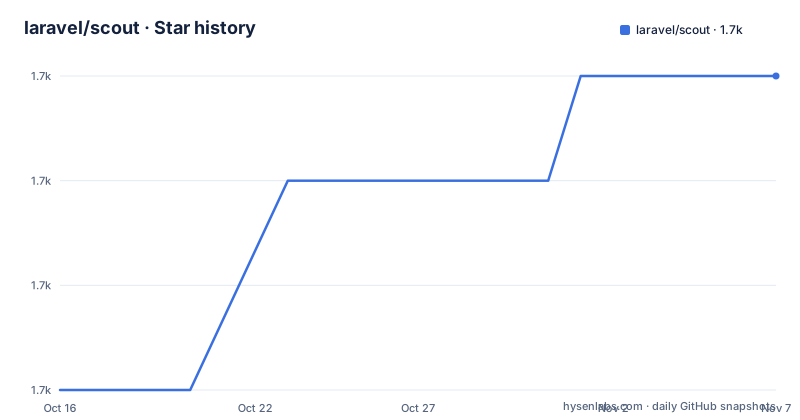
- laravel/scout1,681 ★ · +3
| Repository | 2026-10-16 | 2026-11-07 |
|---|---|---|
| laravel/scout | 1.7k | 1.7k |
3 Stars in the last 22 days, measured from the daily GitHub snapshot. Compare with other projects
Editorial analysis
What Laravel Scout Adds to Eloquent
Laravel Scout addresses a specific integration problem: full-text search for Eloquent models. Without a search layer, an application can retrieve records through database queries, but it does not receive Scout's driver-based search abstraction or automatic synchronization between model changes and a search index. Scout is for developers building Laravel applications whose users need to search records held by Eloquent, such as searchable content stored in the application's database.
The package does not present itself as a general-purpose search server. Its documented integrations are Algolia, Meilisearch, and Typesense. That list gives an application team a choice of search backends while keeping the Laravel-facing package as the common integration point. The README describes the result as a simple, driver-based solution for adding full-text search to Eloquent models.
This scope also defines the audience. Scout is most relevant when search is part of a Laravel application and the application already relies on Eloquent. A project seeking an independent search platform, or a non-Laravel application, would need a different integration approach. The repository contains Laravel-oriented source, tests, configuration, workbench files, and Composer metadata, so its intended boundary is the PHP and Laravel ecosystem rather than a language-neutral search layer.
Scout's Driver and Index Synchronization Model
The central mechanism is a driver-based layer between Eloquent models and supported search services. Scout supports three named drivers in the README: Algolia, Meilisearch, and Typesense. The documentation summary states that, after installation and configuration, Scout automatically synchronizes model changes to search indexes. That means the indexing relationship is not described as a separate application responsibility that must be manually rebuilt after every model edit.
The repository layout supports this interpretation. The `src/` and `config/` directories contain the package implementation and configuration surface, while `tests/` contains the automated test suite and `types/` contains type-related files. The project also includes a `docker-compose.yml`, which defines local containers for Typesense and Meilisearch. Those services are not part of Scout itself, but they provide concrete infrastructure for development and testing against two of the supported search backends.
The `docker-compose.yml` maps Typesense port `8108` to the host and exposes its data directory through the named volume `typesense-data`. It also maps Meilisearch port `7700` to the host. The file includes health checks for both services, which gives a local environment a defined readiness signal. The configuration uses `TYPESENSE_DATA_DIR`, `TYPESENSE_API_KEY`, and `TYPESENSE_ENABLE_CORS` for the Typesense container, while the Meilisearch container uses the image tag `latest`.
The README does not document the internal classes, queue names, indexing lifecycle, or deletion behavior. It also does not explain which model events trigger synchronization. Those details should be checked in the official Laravel documentation or the package source before relying on a particular update or deletion policy.
Supported Search Backends and Local Configuration
Scout's backend choice is explicit rather than provider-neutral in implementation. Algolia, Meilisearch, and Typesense are the three search services named by the README. This makes Scout suitable for teams that have already selected one of those services, or that want to evaluate them through a common Laravel package. It does not indicate that the three services have identical configuration, ranking behavior, query syntax, or operational profiles. The driver changes the destination, not necessarily the search characteristics supplied by that destination.
The repository's local container file gives the clearest concrete configuration information available here. Typesense uses the image `typesense/typesense:30.1`, publishes port `8108`, stores data at `/typesense-data`, and uses the API key value `xyz` in this development configuration. Meilisearch uses `getmeili/meilisearch:latest` and publishes port `7700`. The health checks request `http://localhost:8108/health` and `http://localhost:7700/health` respectively.
The `latest` tag for the local Meilisearch image is also a concrete operational consideration. The repository file does not pin that image to a fixed release, so the container configuration alone does not establish a reproducible Meilisearch version. The Typesense image is pinned to `30.1` in this file. For production use, the selected search service, its version, credentials, network exposure, and data persistence should be reviewed separately from Scout's package version.
The README does not provide Algolia container settings, model configuration examples, searchable attribute definitions, ranking rules, or driver-specific environment variables. It points readers to the official documentation instead.
Installation and First Search Setup
The README does not contain installation commands or a first-use code example. It directs users to the official Laravel Scout documentation for setup. Consequently, there are no package installation commands, Composer flags, model traits, searchable callbacks, or configuration snippets to reproduce here without going beyond the repository information available.
The repository does provide a Docker Compose file for local search infrastructure. It defines Typesense and Meilisearch services, so it can support development against those backends, but the README does not state the command used to start it. The file itself contains service definitions rather than an installation tutorial. A reader following the project's documentation should first confirm the current installation steps for the default `11.x` branch, then select Algolia, Meilisearch, or Typesense as the driver.
For a first real use, the documented workflow is to install and configure Scout, define the Eloquent model as searchable according to the official documentation, and connect the selected backend. Scout's stated synchronization behavior then handles model changes. The exact model declaration and configuration keys are not present in the README, so this article cannot safely reproduce them. This omission is a documentation boundary, not evidence that a minimal setup is unavailable.
The local `docker-compose.yml` confirms that port `8108` and port `7700` are the intended host ports for the two containerized services. It does not establish that either service is required for Algolia or that a production deployment should use these container settings.
Where Scout Is the Wrong Abstraction
Scout is the wrong choice when the application does not use Eloquent or does not want search tied to Laravel model synchronization. Its documented purpose is Eloquent full-text search, not standalone ingestion from arbitrary sources. A search interface that needs its own indexing pipeline, independent language runtime, or custom external service boundary would require a design outside the package's stated scope.
There is another limitation around control. The README names supported drivers but does not document fine-grained control over tokenization, typo tolerance, ranking, faceting, synonyms, custom relevance rules, or partial updates. Those capabilities may exist in the selected backend, but Scout's documentation excerpt does not establish how each is exposed or whether applications can customize them through Scout. A team whose requirements depend on those details should verify the driver implementation and official documentation before committing.
Scout also does not replace operational ownership of the selected service. The repository can define local Typesense and Meilisearch containers, but the production availability, access control, backups, index rebuilding, and monitoring of a search backend remain separate concerns. The README does not claim that Scout handles service deployment, recovery, or index administration.
Maintenance, Releases, and MIT Licensing
The repository is not archived, and its last push was on 2026-10-14. The listed release history includes v11.9.0 on 2026-10-06, v11.8.0 on 2026-09-22, and v11.7.0 on 2026-09-08. Those records indicate recent releases on the `11.x` default branch. The README does not provide a longer-term support policy, compatibility matrix, or upgrade procedure for each Laravel version.
Maintenance cost therefore includes more than installing the package. An adopting application must review changes to the Scout driver configuration, confirm compatibility with its Laravel and PHP versions, and review changes in the selected search service. The presence of `UPGRADE.md` and `CHANGELOG.md` indicates that upgrade information is maintained in the repository, but the README does not state their contents. The release history also does not establish the cost or difficulty of a particular upgrade.
Scout is distributed under the MIT license. The repository identifies the license as `MIT` and includes `LICENSE.md`. That designation matters for source availability and redistribution terms, but this review does not provide legal advice. Teams should read the license file and account for the separate terms of their chosen search service, container images, and application dependencies.
Comparing Scout with Direct Backend Integration
A direct backend integration is the practical alternative for applications that do not want Scout's Eloquent synchronization layer. Such an integration would send application data and queries to a search service through that service's client or HTTP API, with application code responsible for indexing events, retries, deletion, and reindexing. The repository README does not describe a competing Laravel package or benchmark Scout against a particular direct implementation, so the meaningful difference is architectural rather than a claimed performance result.
Scout reduces the amount of Laravel-specific integration code by providing a common driver-based package and automatic synchronization of model changes. Direct integration offers more control over exactly when and how records are indexed, but makes those responsibilities explicit in the application. The choice depends on whether the team values a Laravel model-oriented workflow or needs search behavior outside that boundary.
The three supported drivers also affect this decision. A direct integration can be preferable when the application already has a client abstraction for its chosen service and needs backend-specific features. Scout is more relevant when Eloquent models are the primary source of searchable records and automatic model synchronization is a stated requirement.
Editorial conclusion
Laravel Scout is appropriate for a Laravel application that already uses Eloquent and wants search through Algolia, Meilisearch, or Typesense. It is less suitable if the application needs a standalone search service, custom indexing logic not exposed by a driver, or operational independence from Laravel. Before adoption, verify the official Scout documentation for installation instructions, driver configuration, searchable model definitions, index synchronization behavior, and the operational requirements of the selected search service. The repository's default branch is 11.x, and its latest listed release is v11.9.0.
Frequently asked questions
Which search services does Laravel Scout support?
Laravel Scout supports Algolia, Meilisearch, and Typesense. The README lists all three as current drivers for Eloquent full-text search.
Does Laravel Scout automatically synchronize Eloquent model changes?
Yes. The README states that, once Scout is installed and configured, it automatically synchronizes model changes to search indexes. It does not specify the detailed event or queue mechanism in the README.
How do I install Laravel Scout?
The README does not include installation commands or a Composer command. It directs users to the official Laravel Scout documentation for installation and configuration.
Official sources
Add this badge to your README
If you maintain this project, the badge below links readers to this analysis and shows its maintenance status from the daily GitHub snapshot. Paste the markdown into your README; add ?metric=license or ?metric=stars to the image URL for a different field.

[](https://hysenlabs.com/projects/laravel-scout)Star history chart for your README
[](https://hysenlabs.com/projects/laravel-scout)Was this useful?