Lienol/openwrt: a modified OpenWrt tree you compile yourself
Lienol's Modified OpenWrt source
At a glance
- What is it?
- Lienol/openwrt is a fork of the OpenWrt build system rather than a firmware download. The tree is current, but the README is upstream's, and the fork's own changes are not documented in it.
- Who is it for?
- Adopt Lienol/openwrt only if you already build OpenWrt from source and want a fork to diff against upstream on the 25.12 branch; the last push was on 2026-09-04, so the tree is current, but no releases are published and the README documents no fork-specific changes. If you want a firmware image today, use the OpenWrt Firmware Selector instead, since this repository ships no built images.
- Can I use it commercially?
- Check first. The repository uses a licence we do not classify automatically, so read its LICENSE file before any commercial use.
- Is it still maintained?
- Yes. The repository last received commits 4 days ago.
- What is it written in?
- Mainly C, according to GitHub's language statistics.
Answers come from the project's GitHub data, last synced on November 14, 2026, and from our analysis. They are not legal advice.
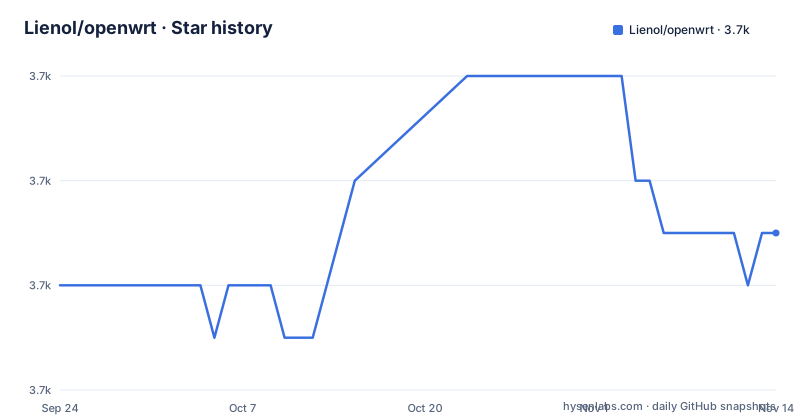
Star history
- Lienol/openwrt3,667 ★ · +1
| Repository | 2026-09-24 | 2026-11-14 |
|---|---|---|
| Lienol/openwrt | 3.7k | 3.7k |
1 Stars in the last 51 days, measured from the daily GitHub snapshot. Compare with other projects
Editorial analysis
What Lienol/openwrt is, and who compiles it
Lienol/openwrt is described in its own repository as "Lienol's Modified OpenWrt source". That wording matters more than it looks. This is a source tree, not a firmware distribution: there is no download page for ready images, no release artifacts, and the homepage field is empty. The README you find inside it is upstream OpenWrt's, including the links to the Firmware Selector and the wiki. So the project solves a narrower problem than "install OpenWrt on a router". It solves "I want to build OpenWrt from source with a set of modifications I did not write myself".
The audience follows from that. You need a GNU/Linux, BSD or macOS machine with a case-sensitive filesystem, because the README says Cygwin is unsupported for exactly that reason. You need the build toolchain the README lists: binutils, bzip2, diff, find, flex, gawk, gcc-6+, getopt, grep, install, libc-dev, libz-dev, make 4.1+, perl, python3.7+, rsync, subversion, unzip and which. If you are looking for a web interface to flash a TP-Link or an x86 box, this repository is the wrong entry point, and the README points you elsewhere on purpose.
The fork is not archived, and its last push was on 2026-09-04. The default branch is 25.12, which tracks an OpenWrt release line rather than a main development branch.
How the build tree actually flows
The mechanism is visible in the top-level Makefile. On the first invocation, OPENWRT_BUILD is not set to 1, so the Makefile sets it, exports it, and includes include/debug.mk, include/depends.mk and include/toplevel.mk. That is the configuration phase: the tree is not building anything yet, it is setting up the entry points. When OPENWRT_BUILD is already 1, the Makefile instead includes rules.mk, include/depends.mk, include/subdir.mk, and then target/Makefile, package/Makefile, tools/Makefile and toolchain/Makefile. Those four sub-makefiles are the four build stages.
The dependency chain is stated explicitly in the same file. toolchain/stamp-compile waits on tools/stamp-compile. target/stamp-compile waits on toolchain/stamp-compile, tools/stamp-compile and $(BUILD_DIR)/.prepared. package/stamp-compile waits on target/stamp-compile and package/stamp-cleanup. package/stamp-install waits on package/stamp-compile, and target/stamp-install waits on both package stamps. Read in order, that is: host tools, then cross toolchain, then target kernel and libc, then packages, then installation into the target root. A failure early in that chain stops everything after it, which is why a missing host dependency surfaces as a tools or toolchain error rather than a package error.
The Makefile also enforces one constraint before any of this runs: if the path to the tree contains a space, it errors out with "The path to the OpenWrt directory must not include any spaces". The build directory is also pinned: LC_ALL, LANG and TZ are exported as C, C and UTC. If your fork's modifications touch package Makefiles, those settings are what make the output reproducible across machines.
Installing the tree and running a first build
There is no installer. You obtain the tree with git, using the default branch name given in the repository metadata. The README's Quickstart assumes you are already inside the checkout.
The first step pulls package definitions from the feeds listed in feeds.conf or feeds.conf.default. The README states that ./scripts/feeds update -a obtains all the latest package definitions. Expect network traffic here, and expect the command to touch the feeds configuration files rather than the package tree itself.
./scripts/feeds update -aThe second step creates the symlinks that make those packages visible to the build. The README says this installs symlinks for all obtained packages into package/feeds/.
./scripts/feeds install -aThen you choose a target. This opens the ncurses configuration interface where you select the toolchain, the target system and the firmware packages.
make menuconfigFinally, the build. The README states that make downloads all sources, builds the cross-compile toolchain, and cross-compiles the kernel and the chosen applications for your target.
makeTwo practical notes. The build refuses to start if the checkout path contains a space, so clone into something like /home/user/openwrt. And because the tree exports TZ=UTC, timestamps in your build output will not match your local clock.
The fork's own changes are the part nobody documents
This is the real limitation, and it is structural rather than technical. The README is upstream OpenWrt's text. It describes upstream's feeds, upstream's Firmware Selector, upstream's wiki and upstream's support channels. Nothing in it describes what Lienol changed. The repository description says "Modified OpenWrt source", and that is the entire specification of the modification.
For a build-system fork that matters more than it would for an application. You are compiling a router operating system whose entire job is to sit on the network edge. If the fork patches a package, changes a default, or carries a target tweak, you find out by reading the diff against openwrt/openwrt, not by reading documentation. There is no changelog, no release notes and no releases at all.
There is a second gap: the licence field. The repository metadata reports NOASSERTION, while the README states OpenWrt is licensed under GPL-2.0 and the tree carries a COPYING file and a LICENSES/ directory. A fork that redistributes GPL-2.0 code inherits obligations, and the NOASSERTION value means the hosting platform could not classify the licence automatically. That is a signal to check the files, not a conclusion about the fork's compliance.
A third constraint is build cost. Nothing here suggests the fork shortens the toolchain build. You are still compiling a cross toolchain and a kernel before you get a single package.
Lienol/openwrt against upstream OpenWrt and the Firmware Selector
The honest alternative is not another fork. It is upstream OpenWrt itself, used in one of two ways.
The first is the Firmware Selector, which the README links directly. That path gives you a built image for a supported device and skips the entire toolchain. The difference in approach is total: the Selector is a download service with a package selection step, while Lienol/openwrt is a source tree where you run make. If your goal is a working router this evening, the Selector wins on every axis. If your goal is a firmware with a package or a patch that no published image contains, the Selector cannot help you at all, because you cannot express arbitrary source changes through it.
The second is cloning openwrt/openwrt at the same 25.12 line and applying your own changes. That is the alternative to weigh against this fork. The trade is maintenance: with upstream you own every patch and rebase it yourself on each release, but you know exactly what is in your image because you wrote it. With Lienol/openwrt you inherit someone else's modifications for free, and you also inherit the obligation to audit them. Given that the README documents none of them, that audit is the actual cost of choosing this fork.
A fork also changes where you get support. The README routes bug reports to bugs.openwrt.org and patches to the openwrt-devel mailing list. Those channels are for upstream. A bug that exists only in the fork's modifications does not belong there, and no fork-specific channel is named.
Maintenance, licence and upgrade cost
The tree is current: the last push was on 2026-09-04, on the 25.12 branch. That is a fact about activity, not about the quality or the scope of the modifications. The repository has no published GitHub releases, so there is no versioned artifact to pin and no release notes describing what changed between snapshots.
Upgrade cost follows from the branch model. Because the default branch tracks a release line, moving forward means either pulling into that branch or switching to a newer one, then rebuilding. The Makefile's dependency chain means a full rebuild after a branch switch is the normal case, not an incremental one: tools, toolchain, target and packages are separate stages with stamp files, and changing the toolchain invalidates everything downstream. Budget the toolchain build, not just the package you care about.
On licensing, the evidence points two ways. The README states OpenWrt is licensed under GPL-2.0. The repository metadata says NOASSERTION. COPYING and LICENSES/ exist at the top level, and the Makefile carries SPDX-License-Identifier: GPL-2.0-only in its header. If you redistribute images built from this tree, read COPYING and the LICENSES/ directory yourself and get your own advice; nothing here settles the question, and the NOASSERTION field is precisely the reason not to assume.
One more cost that is easy to miss: the build requires subversion among its host tools, which is unusual enough on modern systems that it is worth checking before you start a long build.
Editorial conclusion
Adopt Lienol/openwrt only if you already build OpenWrt from source and want a fork to diff against upstream on the 25.12 branch; the last push was on 2026-09-04, so the tree is current, but no releases are published and the README documents no fork-specific changes. If you want a firmware image today, use the OpenWrt Firmware Selector instead, since this repository ships no built images. Before committing, verify the licence status, because the repository carries NOASSERTION while COPYING and LICENSES/ indicate GPL-2.0, and check what the fork actually changes against openwrt/openwrt.
Frequently asked questions
What is Lienol/openwrt used for?
It is a modified OpenWrt source tree, used to build your own firmware rather than to download one. The README's Quickstart covers updating feeds, installing them, running make menuconfig and running make.
How do I install Lienol/openwrt?
There is no installer. You clone the source and run ./scripts/feeds update -a, ./scripts/feeds install -a, make menuconfig and make, on a GNU/Linux, BSD or macOS system with a case-sensitive filesystem.
How do I use Lienol/openwrt to build a firmware image?
The README states that make downloads all sources, builds the cross-compile toolchain, then cross-compiles the kernel and the selected applications for your target. The target and packages are chosen in make menuconfig.
Does Lienol/openwrt support the OpenWrt firmware selector?
The Firmware Selector link in the README is upstream OpenWrt's, and it serves built images rather than builds from this fork. This repository publishes no firmware images, so the Selector is an alternative to it, not a part of it.
Which routers can I build Lienol/openwrt for?
No device list for this fork appears in the README. It points to the OpenWrt Hardware Database for supported devices, and the target is selected in make menuconfig.
Official sources
Add this badge to your README
If you maintain this project, the badge below links readers to this analysis and shows its maintenance status from the daily GitHub snapshot. Paste the markdown into your README; add ?metric=license or ?metric=stars to the image URL for a different field.

[](https://hysenlabs.com/projects/lienol-openwrt)Star history chart for your README
[](https://hysenlabs.com/projects/lienol-openwrt)Was this useful?