liyupi/codefather: a VuePress documentation site of Chinese programming roadmaps, not a code library
Programmer Yupi's programming bible: the most complete 2026 programming learning roadmap, covering Java, front-end, Python, C++, algorithms, computer fundamentals, AI application development and AI Agent development. Provides programming intro tutorials, LLM application development, RAG practice, MCP development, prompt engineering guides, interview questions, job-hunting experience, resume tips and more, for beginners, career changers, CS students and job seekers.
At a glance
- What is it?
- The repository behind codefather.cn is a content site built with VuePress, offering curated learning roadmaps and tutorials in Chinese. Its value depends entirely on whether you read Chinese and want the site's editorial bundle rather than a reusable package.
- Who is it for?
- Adopt liyupi/codefather only if you want a Chinese-language curriculum you can fork and edit as Markdown, and you accept that the licence is not stated in the repository metadata. Do not adopt it if you need a versioned library, an English-language resource, or a guaranteed maintenance commitment: the single release, tagged basic and dated 2024-10-30, is a documentation template rather than a library version.
- Can I use it commercially?
- Not without permission. GitHub finds no licence file in the repository, and without a licence all rights are reserved by default: you may read the code but not reuse it. Check the README, or ask the authors, before using it.
- Is it still maintained?
- Yes. The repository last received commits 126 days ago.
- What is it written in?
- Mainly TypeScript, according to GitHub's language statistics.
Answers come from the project's GitHub data, last synced on November 13, 2026, and from our analysis. They are not legal advice.
Star history
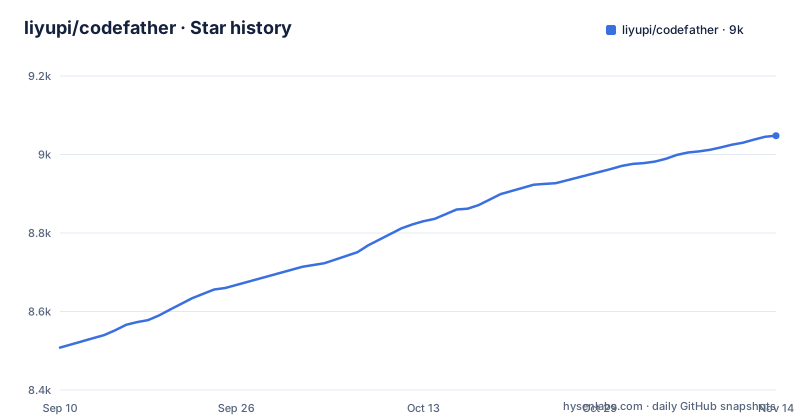
- liyupi/codefather9,045 ★ · +537
| Repository | 2026-09-10 | 2026-11-13 |
|---|---|---|
| liyupi/codefather | 8.5k | 9k |
537 Stars in the last 64 days, measured from the daily GitHub snapshot. Compare with other projects
Editorial analysis
What the repository actually is: a documentation site, not an installable package
The most common mistake with liyupi/codefather is to treat it as a library. It is not. The repository is the source behind codefather.cn, and its primary language is TypeScript, which points to a static site toolchain rather than published runtime code. The README opens with a permalink front matter block and then lists site sections: learning roadmaps, the author's self-taught path, programming tips, project tutorials, a community called 编程导航, technical notes, a Bug handbook, products and services, and a programming dictionary. Every one of those entries is a route on a website, written as a Markdown link. The only release in the repository is tagged basic and is described in the release name as a documentation site template, ready to use out of the box (文档网站模板(开箱即用)), dated 2024-10-30. So the artefact you get is a template plus content, not a versioned dependency you add to a manifest. If you arrived looking for a Java library, an SDK, or a CLI, this is the wrong repository and no amount of reading the roadmap pages will change that.
Who the content is written for, and the language boundary
The README describes the audience in broad strokes: people starting from zero, people learning AI development, career changers, computer science students, and job seekers. The roadmap section names Java, frontend, C++, Python, SQL, computer fundamentals, data structures and algorithms, Git and GitHub, Linux, and design patterns. The dictionary section claims coverage of around 30 directions, listing Java, Python, frontend, Go, C++, game development, AI, big data, cloud computing, blockchain, machine learning, deep learning, network security, algorithms, operating systems, databases, IoT, embedded, and mobile development. The material is entirely in Chinese. There is no indication in the README of an English translation or a bilingual mode. That single fact decides most adoption questions. If your team reads Chinese, the site is a structured curriculum. If it does not, the repository is a large corpus of Markdown you cannot use without translation work, and the effort of translating a multi-track roadmap is almost certainly larger than finding an English equivalent.
How the site is assembled: routes, Markdown and a template release
The mechanism visible in the README is conventional for a static documentation site. The README carries YAML front matter with permalink: /, which is the front matter convention used by static site generators to map a Markdown file to a URL path. Internal links are written as absolute site paths such as /学习路线 and /项目实战, which means the generator resolves them against the site root rather than the file's own location. Content is organised by section, one directory or page per topic, and the release tagged basic is explicitly a documentation website template. The generator is VuePress: package.json lists vuepress ^1.9.10 as a devDependency alongside plugins such as vuepress-plugin-sitemap, vuepress-plugin-seo and vuepress-plugin-feed, and the site configuration lives in the .vuepress/ directory at the repository root.
Getting it running: what the material supports and what it does not
The README gives no installation commands. The scripts are in package.json instead: docs:dev runs vuepress dev. and docs:build runs vuepress build. So the workflow is to clone the default branch main, install the dependencies from package.json, then run docs:dev to preview the site locally or docs:build to build it. The front matter key permalink: / and the absolute link style are the two concrete conventions a contributor must respect when adding a page, because breaking either produces broken navigation rather than a build error in most generators. The homepage field points at https://codefather.cn, which is the deployed site, so the fastest way to see the intended output is to read the live site before touching the source.
The licence gap is the real adoption blocker
GitHub lists the repository's licence as unknown: there is no LICENSE file among the top-level entries and no licence section in the README. The only licence statement is "license": "MIT" in package.json, which does not say whether it covers the written content. For a documentation site that is a meaningful gap, because the content is the product. Forking the template for your own docs is one thing; republishing the roadmaps, tutorials, interview questions and dictionary entries is another, and the two are governed by the same missing document. Without a LICENSE file that clearly covers the content, the default position under most copyright regimes is that no rights are granted beyond what the platform's terms allow, which typically covers viewing and forking within the platform but not redistribution. I am not giving legal advice here, and the practical step is simple: ask the author. The README links to an author page and to a community, so a direct question is answerable. Until you have an answer, treat the content as read-only reference material.
Where it is the wrong tool, and what to use instead
Three cases where codefather is the wrong choice. First, you want a library: nothing here is published as a versioned package, and the single release is a template, so a dependency manager has nothing to resolve. Use the actual framework or tool you were looking for. Second, you want a maintained, community-edited curriculum with an open licence and an English edition. freeCodeCamp's curriculum repository is the direct comparison, and the difference in approach is structural rather than cosmetic: freeCodeCamp ships interactive exercises with automated tests that a learner runs locally, so progress is verified by code execution, while codefather ships reading material and project tutorials that a learner follows by hand. The first model scales review through test suites; the second scales through editorial effort by the author and contributors. Third, you want a general-purpose documentation generator to build your own site. In that case you want the generator itself, and the release tagged basic is only useful if you specifically want this site's content and structure as a starting point. Choosing between the two models is a question about how you want learning verified, not about which repository is better.
Maintenance cost and what a fork commits you to
The repository is not archived, and the last push recorded in the metadata is 2026-07-11, which indicates active work rather than a dormant project. That cuts both ways for a fork. Upstream content keeps moving, so a fork that edits the same pages will accumulate merge conflicts, and a fork that only adds pages will drift as upstream restructures its routes. The route-based link style makes restructuring cheap for the author and expensive for anyone tracking it, because a renamed section breaks every absolute link pointing at it. If you fork for your own curriculum, the realistic maintenance plan is to stop tracking upstream entirely and own your copy, or to keep your additions in separate directories that upstream is unlikely to touch. The release cadence gives little guidance: one release, tagged basic, from October 2024, against a last push in July 2026, suggests releases are not the unit of change here. Watch commits, not releases, if you intend to follow along.
The judgement: a reference site with a specific audience
codefather is a well-organised Chinese-language learning site whose source happens to live in a public repository. Its strength is breadth of structure: separate roadmaps for Java, frontend, C++, Python, SQL, fundamentals, algorithms, Git, Linux and design patterns, plus a dictionary spanning roughly 30 directions, all reachable from one index page. Its weaknesses are equally concrete. The licence appears only as MIT in package.json, with no LICENSE file. There are no setup commands in the README. The material is Chinese-only. The single release is a website template, not a library version. For a Chinese-speaking self-taught developer or student, the site is a legitimate starting point and the repository is a reasonable fork target once licensing is clarified. For an engineering team evaluating dependencies, or anyone needing English content, or anyone wanting exercises with automated verification, this is not the repository they are looking for, and the honest recommendation is to look at freeCodeCamp's curriculum instead.
Editorial conclusion
Adopt liyupi/codefather only if you want a Chinese-language curriculum you can fork and edit as Markdown, and you accept that the licence is not stated in the repository metadata. Do not adopt it if you need a versioned library, an English-language resource, or a guaranteed maintenance commitment: the single release, tagged basic and dated 2024-10-30, is a documentation template rather than a library version. Before forking, confirm the licence terms with the author, since GitHub lists no licence for the repository and only package.json declares MIT.
Frequently asked questions
Is codefather a code editor or an IDE I can install?
No. codefather is a static documentation site built with VuePress 1.x, holding Chinese learning roadmaps, knowledge notes, a bug fixing guide and interview questions. The only two npm scripts are docs:dev and docs:build, and neither opens an editor or compiles an application.
What license is codefather released under?
The root package.json declares MIT, but no license is recorded for the repository and no LICENSE file appears among the top level entries. Reuse terms are therefore not clearly stated, so check with the author before copying or translating pages.
Can I search inside codefather.cn for a topic?
No dedicated search plugin appears among the ten devDependencies in package.json, which cover back-to-top, Google Analytics, Baidu autopush, feeds, read-more, SEO, sitemap, tags and image zooming alongside vuepress itself. There is no i18n plugin either, and every route is in Chinese.
Does codefather have an iOS or Android app?
No. The repository contains no native or Electron project. It is a VuePress documentation tree of markdown folders built by two npm scripts and published at codefather.cn.
Official sources
Add this badge to your README
If you maintain this project, the badge below links readers to this analysis and shows its maintenance status from the daily GitHub snapshot. Paste the markdown into your README; add ?metric=license or ?metric=stars to the image URL for a different field.

[](https://hysenlabs.com/projects/liyupi-codefather)Star history chart for your README
[](https://hysenlabs.com/projects/liyupi-codefather)Was this useful?