LMCache: A KV Cache Management Layer for Multi-Engine LLM Inference
LMCache: Supercharge Your LLM with the Fastest KV Cache Layer
At a glance
- What is it?
- LMCache is a vendor-neutral KV cache management layer that turns ephemeral GPU memory into persistent, reusable storage across engines and hardware. This review covers its architecture, installation, limitations, and alternatives for teams evaluating it.
- Who is it for?
- Adopt LMCache if you run long-context agentic, multi-turn, or RAG workloads on vLLM or similar engines and need to cut TTFT and prefill cost without being locked to one storage vendor. Do not adopt it if your workloads are short, stateless, or if you cannot afford the operational overhead of a separate daemon and a tiered storage stack.
- Can I use it commercially?
- Yes. Apache-2.0 is a permissive licence: you can use, modify and sell software built on it, as long as you keep its copyright and licence notices.
- Is it still maintained?
- Yes. The repository received new commits within the last day.
- What is it written in?
- Mainly Python, according to GitHub's language statistics.
Answers come from the project's GitHub data, last synced on November 15, 2026, and from our analysis. They are not legal advice.
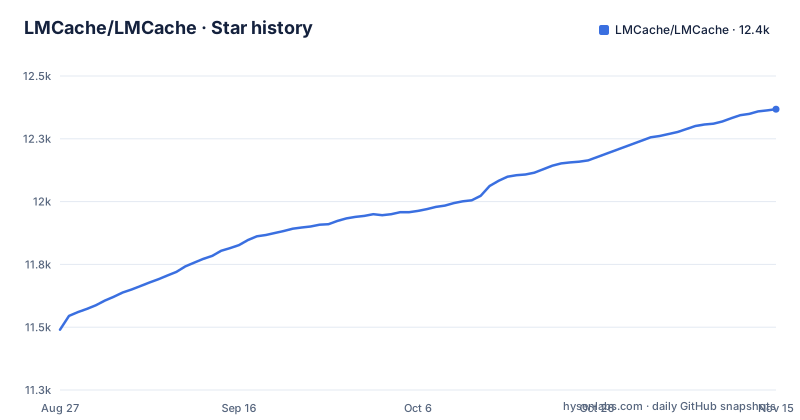
Star history
- LMCache/LMCache12,368 ★ · +878
| Repository | 2026-08-27 | 2026-11-15 |
|---|---|---|
| LMCache/LMCache | 11.5k | 12.4k |
878 Stars in the last 80 days, measured from the daily GitHub snapshot. Compare with other projects
Editorial analysis
What Problem LMCache Solves
Without a persistent cache layer, inference engines often recompute the KV cache for prompt prefixes they have already seen. That recomputation costs time and GPU cycles, and it is especially wasteful for long-context agentic loops, multi-turn conversations, and RAG pipelines where the same documents appear repeatedly. LMCache treats the KV cache as a persistent asset rather than a transient buffer. It stores KV caches in a tiered hierarchy that spans GPU memory, CPU RAM, local disk, and remote backends, then reuses them across requests, sessions, and even different engine instances. The project describes this as turning KV cache into reusable AI-native knowledge. The intended user is a team operating LLM serving infrastructure who wants to reduce time-to-first-token (TTFT) and improve throughput without rewriting their serving engine. The README positions LMCache as engine-independent, so it can sit between the engine and storage without forcing a specific vendor.
How the Architecture Avoids Fate-Sharing
The documented multiprocess mode runs LMCache as a standalone service separate from the inference engine. This provides process isolation and can preserve cached data across an engine restart, but data not yet stored, a failed cache service or an ephemeral backend can still lead to cache loss. The legacy in-process implementation is maintained separately. This is a deliberate departure from in-process caching libraries that die with the engine. The daemon manages the cache lifecycle, handles offloading to the storage hierarchy, and exposes a transport layer for moving KV data. The multiprocess (MP) architecture, announced in April 2026, is said to boost MoE inference performance by 10x, though the README does not provide benchmark details. Supported configurations can reuse or transfer cache across engine instances; compatibility and the selected transport and backend must be verified for the deployment. The architecture is built around pluggable backends, so the daemon can write to CPU RAM, local SSD, Redis, Mooncake, InfiniStore, S3-compatible storage, and more. The design trades simplicity for resilience, and the daemon introduces a new operational component that must be monitored and kept available.
Getting It Running: Installation and Configuration
Installation is straightforward: the README shows a single pip command, pip install lmcache. After that, the user must configure the storage backends and the engine integration. The README points to the documentation for setup options. The repository publishes nightly releases, including builds for ROCm 7.2, Moore Threads MUSA and Rebellions RBLN. The nightly tags suggest that users who need the latest features may run pre-release versions, while stable releases are available on PyPI. The README also references integration with vLLM and NVIDIA Dynamo, so a new user must consult the docs site to wire the daemon to their engine.
The CacheBlend Mechanism for Non-Prefix Reuse
Most prefix caching schemes only reuse KV blocks when the prompt starts with the same tokens. LMCache extends this with CacheBlend, which the README describes as reusing cached KV blocks at any position in the prompt. The mechanism selectively recomputes tokens to recover generation quality. This is significant for RAG workloads where the user question changes but the retrieved context block is similar, or for agentic loops where the middle of the prompt changes while the system prompt stays fixed. CacheBlend is the feature that differentiates LMCache from simple prefix caches. The trade-off is that selective recomputation adds complexity: the system must decide which tokens to recompute, and the quality recovery is not guaranteed to be lossless. Teams should test it on their own prompt distributions. If the workload has mostly exact prefix matches, CacheBlend adds little value, and a simpler prefix cache would suffice.
Storage and Transport Backends: The Pluggable Interface
LMCache's pluggable storage interface is what makes it vendor-neutral. The README lists CPU RAM, local disk, Redis/Valkey, Mooncake, InfiniStore, S3-compatible object storage, NIXL, and GDS as supported backends. The transport layer handles KV transfer between prefill and decode workers over NVLink, RDMA, or TCP, with NIXL as one transport. The backend interface can make it easier to change storage, but teams must check version-specific integration and configuration requirements before migrating. A separate pluggable KV transformation (SERDE) interface lets researchers write compression, token dropping and custom serialization. The breadth of backends is a strength, but it also means the performance profile varies wildly. A local SSD will have different latency than an S3 bucket, so teams should prototype with their target storage to measure real TTFT improvements, because the cache hit rate depends on the workload's reuse patterns.
Observability and Operational Monitoring
The README claims production-level KV cache observability, including Kubernetes metrics like health monitoring and performance diagnostics. It also mentions KV-cache-specific metrics: request-level and token-level prefix cache hits, lifecycle, and request-level KV cache performance. There are also management metrics for user-specific usage. This is a practical feature for operators who need to know whether the cache is actually helping. Without these metrics, a cache layer is a black box. The observability stack is part of the project's pitch, so check the documentation for the metric format and exact metric names. The presence of these metrics is a signal that the project is aimed at production deployments, not just research prototypes. The downside is that running a separate daemon with its own metrics adds operational surface area, and the monitoring stack must be deployed alongside the cache.
Limitations and Wrong Tool Cases
LMCache is not a fit for every inference workload. For short, stateless requests where the prompt changes completely each time, the cache may miss often, and daemon and storage overhead can outweigh the savings; measure the trade-off on your workload. The README does not claim to accelerate such workloads; it targets long-context and multi-turn scenarios. Another limitation is the dependency on engine integration. The README mentions vLLM and NVIDIA Dynamo, but not every serving engine is supported. If your engine is not in the integration list, check the documentation before assuming it works. The CacheBlend mechanism also has a quality trade-off, since it selectively recomputes tokens, and the README does not guarantee lossless output. Finally, pyproject.toml classifies the package as Development Status 3 - Alpha, the default branch is dev, and nightly releases are published, so production users should pin a stable version and test upgrades carefully.
Alternatives and How They Differ
The most direct alternative is vLLM's built-in prefix caching, which is a simpler, in-process mechanism that reuses KV blocks for exact prefix matches. LMCache's difference is that it operates as a separate daemon, persists caches to remote storage, and supports non-prefix reuse via CacheBlend. vLLM's prefix cache is ephemeral and tied to the engine's memory, so it loses the cache on restart and cannot share across engine instances. Another alternative is Redis-based KV cache systems, but those are storage backends, not full management layers. LMCache can actually use Redis as a backend, so the comparison is not either-or. NVIDIA Dynamo also integrates LMCache, according to the README, so Dynamo is not a pure alternative but a complementary orchestrator. For teams that only need exact prefix reuse within a single engine, vLLM's built-in cache is cheaper to operate. For teams that need cross-engine reuse, persistent storage, or non-prefix matching, LMCache offers a distinct architecture.
Editorial conclusion
Adopt LMCache if you run long-context agentic, multi-turn, or RAG workloads on vLLM or similar engines and need to cut TTFT and prefill cost without being locked to one storage vendor. Do not adopt it if your workloads are short, stateless, or if you cannot afford the operational overhead of a separate daemon and a tiered storage stack. Before committing, verify that your serving engine version is supported, test the CacheBlend non-prefix reuse on your actual prompt distributions, and benchmark the storage backends you plan to use, since performance will vary with network and disk. The project is Apache-2.0, actively maintained, and integrates with NVIDIA Dynamo and has joined the PyTorch Foundation, but its production readiness depends on your specific engine and hardware combination.
Frequently asked questions
What does LMCache do?
It is a KV cache management layer for LLM inference that moves cache out of GPU memory into a tiered hierarchy of CPU memory, local storage and remote backends, so it can be reused across requests, sessions and engine instances. The stated aims are lower time-to-first-token and higher throughput on long-context, multi-turn and retrieval augmented workloads.
what is lmcache
An Apache-2.0 licensed Python package described as a KV cache management layer and as an extension to an LLM serving engine, classified as Development Status 3 - Alpha, built for Linux on Python 3.10 to 3.14 with a GPU environment. It runs as a standalone daemon process rather than inside the engine.
how to use lmcache with vllm
Install LMCache and vLLM as described in the current quickstart, start the multiprocess LMCache service and configure the compatible vLLM connector. Process separation can let a cache service survive an engine restart, but retention depends on whether data was stored, the service and backend surviving, and the deployment configuration; it is not a durability guarantee.
What are the key differences between LMCache and vLLM?
vLLM is an inference serving engine. LMCache provides a cache layer integrated with supported engines, including a documented multiprocess service and connector. Its legacy in-process implementation is maintained separately; check version-specific integration requirements rather than assuming every deployment has the same architecture.
lmcache vs redis
Redis is one of the storage tiers LMCache connects to rather than a competitor. The pluggable backend list includes Redis or Valkey alongside CPU RAM, local SSD, Mooncake, InfiniStore, S3-compatible object storage, NIXL and GDS, all reached through one interface, and a Redis blog post is linked from the project updates for 2025/07.
Official sources
Add this badge to your README
If you maintain this project, the badge below links readers to this analysis and shows its maintenance status from the daily GitHub snapshot. Paste the markdown into your README; add ?metric=license or ?metric=stars to the image URL for a different field.

[](https://hysenlabs.com/projects/lmcache-lmcache)Star history chart for your README
[](https://hysenlabs.com/projects/lmcache-lmcache)Was this useful?