maizzle/framework: TypeScript Building Blocks for HTML Email
The modern email development framework.
At a glance
- What is it?
- Maizzle is the core TypeScript package behind a Vite-powered framework for building HTML emails with Vue and Tailwind CSS. It suits developers who want programmatic templates, CSS processing, and email-oriented transforms, but the README directs new users to a separate starter project for a complete setup.
- Who is it for?
- Adopt maizzle/framework when an engineering team needs the package-level, TypeScript-controlled foundation for Maizzle email templates and has Vue, Vite, and Tailwind CSS experience. Do not choose it as the only starting point for a new email workflow, because the README explicitly redirects first-time users to the separate Starter repository.
- Can I use it commercially?
- Yes. MIT is a permissive licence: you can use, modify and sell software built on it, as long as you keep its copyright and licence notices.
- Is it still maintained?
- Yes. The repository last received commits 4 days ago.
- What is it written in?
- Mainly TypeScript, according to GitHub's language statistics.
Answers come from the project's GitHub data, last synced on November 6, 2026, and from our analysis. They are not legal advice.
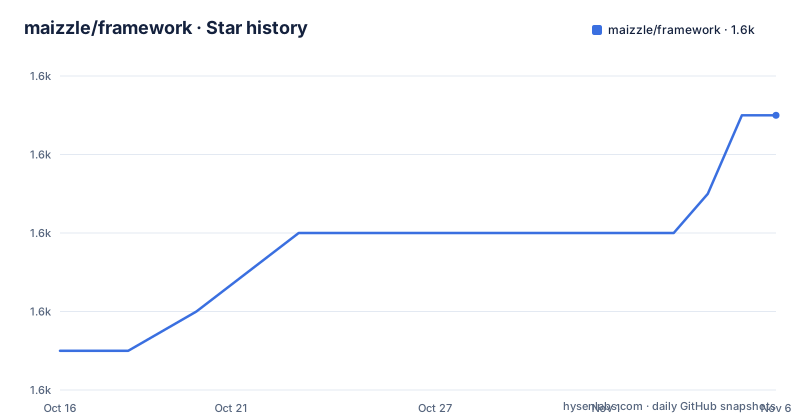
Star history
- maizzle/framework1,623 ★ · +6
| Repository | 2026-10-16 | 2026-11-06 |
|---|---|---|
| maizzle/framework | 1.6k | 1.6k |
6 Stars in the last 21 days, measured from the daily GitHub snapshot. Compare with other projects
Editorial analysis
Why maizzle/framework Exists
maizzle/framework addresses the repetitive work behind producing HTML emails from modern frontend components. Its stated purpose is to help developers build email markup with Tailwind CSS, while the README identifies the wider stack as Vue, Tailwind CSS, and Vite. That combination is aimed at developers who already understand component-oriented frontend work but need an output format with email-specific constraints rather than a conventional browser application.
The package is not presented as a visual editor or a complete campaign service. It is the core code for the Maizzle framework. This distinction matters because the README explicitly directs people who want to begin building emails to the separate Starter repository. Developers evaluating the repository should therefore separate two decisions: whether Maizzle fits their email development model, and whether this core package is the right entry point for their project.
That split also prevents a misleading conclusion from the package name. Installing a library called @maizzle/framework does not, by itself, show that a team has a ready-to-run Maizzle project. The documented starting point for that broader setup is the Starter repository. The core repository is better understood as infrastructure and reusable behavior for developers or maintainers working within that system.
The Vite, Vue, and TailwindCSS Processing Chain
According to the README, Maizzle uses Vite as its build foundation, Vue for email construction, and Tailwind CSS for styling. Based on package.json, the repository publishes an ES module through @maizzle/framework and includes Vue compilation dependencies such as @vitejs/plugin-vue. The package also depends on @tailwindcss/postcss and @tailwindcss/vite, which places CSS generation inside the same frontend toolchain rather than treating email HTML as an unrelated static asset.
The dependency list indicates a broader transformation pipeline than a component renderer alone. Packages including postcss, postcss-calc, postcss-merge-longhand, postcss-safe-parser, and postcss-sort-media-queries point to CSS transformation and normalization responsibilities. `juice` and `css-select` indicate inline-style-related processing, while `htmlparser2`, `domhandler`, and `dom-serializer` point to HTML document handling. These package names support the architectural conclusion, but the README does not provide a function-by-function pipeline diagram.
Other dependencies clarify that Maizzle templates can interact with email construction and optional delivery concerns. `email-comb` and `html-crush` are present alongside Markdown, color, URL, DOM, and utility dependencies. Nodemailer is also declared, although package.json does not establish that every Maizzle project automatically sends mail. The safe reading is that the core package contains or connects to email-focused processing capabilities; the exact enabled stages still depend on the application configuration, which the README does not show.
Package Surface, CLI Entry, and Repository Boundaries
The npm manifest defines the published package as @maizzle/framework, with version 6.2.1 in package.json. Its main export is an ES module at ./dist/index.js, accompanied by TypeScript declarations at ./dist/index.d.ts. That shape is relevant to adopters: the package is written in TypeScript, ships typed declarations, and is intended for import through its named package entry rather than by reaching into arbitrary source files.
It also defines a `maizzle` executable at ./bin/maizzle.mjs. The manifest confirms that the distribution includes both `dist` and `bin`, so consumers receive built package output and the command-line entry rather than the complete development repository. The README does not document the command syntax, configuration files, template directories, or output transport options, so this review does not infer flags or invent a working command sequence.
The repository is broader than the npm publication. Top-level entries include `src/`, `bin/`, `components.json`, TypeScript configuration, Vitest configuration, and `skills/`. Its build script uses `tsdown`, tests use Vitest with coverage, and linting uses `oxlint`. These files show the maintainers' development structure. They do not prove that downstream projects automatically inherit the same source layout or testing setup.
Starting a First Maizzle Email Project
The README does not provide an installation command or a first-template example for this core repository. Instead, it explicitly says that developers who want to start building HTML emails should visit the Starter repository at https://github.com/maizzle/maizzle. The external Maizzle documentation is also listed at https://maizzle.com.
That leaves a concrete tutorial path without pretending the core package is a standalone quick start:
1. Open the Starter repository identified by the core README. It is the documented route for creating a working Maizzle project. 2. Use the Maizzle documentation at https://maizzle.com to determine the current installation and configuration steps. The core repository does not reproduce those instructions. 3. Build an initial Vue-based email template with Tailwind CSS, following the Starter repository's own structure. 4. Consult the Maizzle documentation for the output and preview process. No preview command, transport method, or output path is stated in the core README.
There is intentionally no fenced command example here. The README does not show an exact installation command, template file, configuration key, port, or environment variable, and reproducing one would turn an unsupported guess into setup advice. The npm package name and `maizzle` binary are documented, but that alone does not establish the required argument syntax.
Where Core Maizzle Is the Wrong Level of Abstraction
The clearest limitation is the mismatch between the repository name and the recommended onboarding path. Someone searching for `maizzle/framework` may expect the primary project needed to create an email, yet the README says the repository contains core code and sends new users to the Starter repository. That adds an evaluation step and can make package adoption look self-contained when it is not.
The documentation is also sparse at the repository level. It does not explain which transformations are enabled by default, how a Vue template becomes deliverable email HTML, how CSS is inlined, how Tailwind content is detected, or how output is validated. The dependency list hints at these mechanisms, but dependency presence alone cannot settle configuration, ordering, or failure behavior. Teams that require exact control over these stages will need the external documentation before estimating integration work.
Maizzle is also a poor conceptual match for a developer who wants a standalone drag-and-drop email editor or a hosted campaign service. No such interface is identified in the repository. Its documented model centers on code, templates, and build tooling. Likewise, the README does not document per-client rendering tests, image hosting policy, deliverability monitoring, or rollback, so those requirements should not be assumed to be solved by the package.
Email-Comb, CSS Processing, and Nodemailer Boundaries
Compared with a plain Vue and Tailwind CSS build, maizzle/framework brings email-specific processing into the same package. The `email-comb` dependency suggests compatibility transforms, while PostCSS modules cover calculation, longhand merging, parsing, and media-query sorting. `juice` provides a CSS inlining mechanism at the dependency level, which is closely associated with preparing styles for HTML email. This is a materially different approach from shipping the browser bundle and relying on a separate mail-rendering service to handle client quirks.
Compared with a hosted email builder, however, Maizzle remains code-first. The repository exposes a package export, a CLI entry, build tooling, and source files. It does not advertise a visual canvas, asset library, collaboration model, or hosted sending environment. Engineers retain responsibility for templates, configuration, generated output, and the surrounding delivery pipeline.
Nodemailer's presence should be treated as an integration surface rather than proof of automatic delivery. The package declares `nodemailer` as a dependency, but the README does not say that a normal build sends mail or that credentials are required. A team can still need its own transport, credentials, scheduling, and failure handling. Those concerns sit outside what can be confirmed from this repository.
Maintenance Signals, Releases, and MIT Upgrade Work
The repository is not archived, and its last push was on 2026-10-11. Recent releases include v6.2.1 on 2026-10-11, v6.2.0 on 2026-10-08, and v6.1.7 on 2026-09-16. These dated signals show current release activity around the repository metadata, but they do not establish compatibility guarantees for every template or dependency.
The package uses several dependencies marked `latest`, including `maizzle` and `@maizzle/tailwindcss`. Reproducibility therefore depends on the committed `package-lock.json` during development and on the versions resolved when downstream packages are installed. The release process uses a build before publication, but the README does not describe a framework migration path, a long-term-support policy, or automatic handling of breaking changes.
The MIT license makes the framework open-source software with permissive reuse terms, subject to the license text. This is a licensing identification, not legal advice. Organizations should still review their own distribution, notice, dependency, and compliance processes before shipping software built with it. On upgrades, the practical questions are whether generated HTML changes, whether starter templates require edits, and whether `latest` dependency resolution introduces differences between installs.
Editorial conclusion
Adopt maizzle/framework when an engineering team needs the package-level, TypeScript-controlled foundation for Maizzle email templates and has Vue, Vite, and Tailwind CSS experience. Do not choose it as the only starting point for a new email workflow, because the README explicitly redirects first-time users to the separate Starter repository. Verify that setup path, your required transforms, and the generated HTML in target email clients before committing production templates to it.
Frequently asked questions
What is maizzle/framework used for?
It is the core TypeScript package behind Maizzle, a Vite-powered framework for building HTML emails with Vue and Tailwind CSS.
How do I start building an HTML email with Maizzle?
The README directs new users to the separate Starter repository at https://github.com/maizzle/maizzle. It does not provide a standalone installation tutorial in the core repository.
Does maizzle/framework send email automatically?
The package metadata includes Nodemailer, but the README does not state that builds automatically send email or document required delivery credentials.
Official sources
Add this badge to your README
If you maintain this project, the badge below links readers to this analysis and shows its maintenance status from the daily GitHub snapshot. Paste the markdown into your README; add ?metric=license or ?metric=stars to the image URL for a different field.

[](https://hysenlabs.com/projects/maizzle-framework)Star history chart for your README
[](https://hysenlabs.com/projects/maizzle-framework)Was this useful?