Memento-Skills Review: Persistent Skills for Agent Runtimes
Memento-Skills: Let Agents Design Agents
At a glance
- What is it?
- Memento-Skills is a Python runtime for agents that read, execute, reflect on, and write reusable skills. Its desktop app and guarded skill evolution suit experimentation, but the beta release and dependency-heavy design require careful evaluation.
- Who is it for?
- Memento-Skills fits developers who want to inspect and modify a skill-centric agent runtime, especially on Windows or macOS through the desktop app. It is less suitable for teams requiring a stable production release, a minimal dependency set, or documented rollback procedures.
- Can I use it commercially?
- Yes. Apache-2.0 is a permissive licence: you can use, modify and sell software built on it, as long as you keep its copyright and licence notices.
- Is it still maintained?
- Yes. The repository last received commits 83 days ago.
- What is it written in?
- Mainly Python, according to GitHub's language statistics.
Answers come from the project's GitHub data, last synced on November 7, 2026, and from our analysis. They are not legal advice.
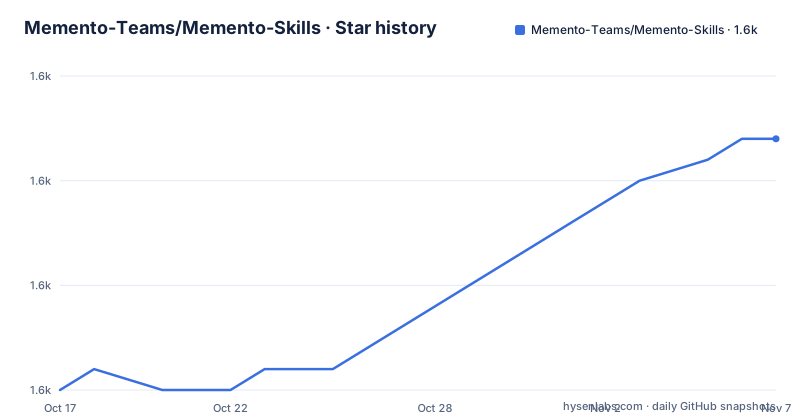
Star history
- Memento-Teams/Memento-Skills1,587 ★ · +12
| Repository | 2026-10-17 | 2026-11-07 |
|---|---|---|
| Memento-Teams/Memento-Skills | 1.6k | 1.6k |
12 Stars in the last 21 days, measured from the daily GitHub snapshot. Compare with other projects
Editorial analysis
Memento-Skills' Skill Memory Problem
Memento-Skills addresses a specific weakness in chat-oriented LLM agents: useful behavior is often confined to a conversation instead of becoming a reusable capability. The project describes its purpose as deploying an agent with persistent and extensible skills. A skill acts as an external memory of procedural behavior, while the model parameters can remain frozen. That changes the unit of reuse from a prompt or a single task into a named operation that can be selected during planning, executed, evaluated, and revised.
The intended users are developers who need more control over agent behavior than a general chat interface offers. The repository is organized around a skill-centric runtime, CLI, GUI, infrastructure layer, tools, tests, and integrations for several messaging platforms. Its stated capabilities include desktop chat, web research, multi-step task execution, direct skill calls, and reflection-based replanning. This is a developer-oriented agent framework rather than a narrow research library or a collection of disconnected prompts.
The accompanying technical study distinguishes Memento-Skills from parameter training. In the described configuration, model parameters remain unchanged and reusable behavior is stored in an external skill memory, represented as M. That design makes skill files inspectable project artifacts, although it also places more responsibility on skill selection, validation, and maintenance. A stored procedure is not automatically a correct procedure.
Read, Execute, Reflect, and Write Lifecycle
The documented architecture follows a Read, Execute, Reflect, Write lifecycle. During planning, the runtime identifies a skill from the task and routes the request to it. Version 0.4.0 supports configurable keyword routing, Qwen3 or Memento-Qwen based routing, and hybrid local-skill routing. The README also states that routing can fall back gracefully, which matters because a local router should not necessarily turn one unavailable or unsuitable model decision into a failed task.
After routing, the runtime executes the selected behavior and collects a trace. Reflection uses the outcome to reconsider the plan or attribute a failure. A trace that should become reusable knowledge can then be written into the skill system. This loop explains the project's slogan, "Let Agents Design Agents." It does not mean that the system rewrites its own model. It means that agent traces can support skill attribution, skill creation, and, under constraints, skill repair.
The repository layout supports this architecture through directories such as core, builtin, infra, middleware, shared, and tools. It also includes a unified tool registry introduced around v0.3.0. Based on that layout and the release description, skill selection and execution sit above reusable infrastructure rather than inside the GUI. The same runtime concepts can therefore be exposed through the CLI, desktop application, server components, or messaging integrations rather than tied to one interface.
Guarded Evolution Beyond Manual Skill Editing
Version 0.4.0's most consequential feature is guarded skill evolution. The release notes describe automatic attribution after failed traces, isolated file updates, static and unit checks, synthetic gates, atomic deployment, audit history, and rollback. These controls respond to a basic danger in self-modifying agent systems: an agent can convert a mistaken assumption into a persistent procedure and repeat it on later tasks.
Isolation limits the initial write surface, while the listed validation gates are intended to catch faulty changes before they become active behavior. Atomic deployment also narrows the period in which a partially written skill might be used. Audit history makes later inspection possible. The README does not explain the detailed rollback command or recovery procedure, so the existence of rollback should not be mistaken for a fully documented operator workflow.
This subsystem is still more complex than ordinary skill authoring. Automatic attribution has to identify which part of a trace failed and whether the cause belongs in a skill at all. The synthetic gates can only assess cases represented by their checks. For production use, reviewers would still need to know what data synthetic gates send to a model, which providers receive failed traces, and how a discovered defect is represented and restored. The release announces the mechanism, but it does not provide those operational details in the README.
Desktop Installation and First Agent Task
For most users, the README recommends the Memento-S desktop app rather than source setup. Windows and macOS users can download an installer from the release page linked by the README. The app is described as providing desktop chat, web research, multi-step task execution, skill calls, and reflection-based replanning. The project says this route avoids installing Python or launching the application from source.
A first real use begins after installing the Windows or macOS app and opening the release URL linked in the README. The README does not publish a short, exact UI script for creating and invoking a first skill, and it does not identify a default model credential. Those omissions matter because a useful first-use verification would need a skill name, an invocation, and an observable result. Without documented defaults, the exact steps depend on the app's current setup flow.
Source users face a stricter boundary. The project metadata requires Python 3.12 or later and identifies the distribution as memento-s, version 0.4.0. It also exposes optional dependency groups for testing and the Qwen router. The README excerpt does not provide the complete developer installation command or an initial CLI invocation, so presenting either would invent an operational step. The repository includes bootstrap.py, cli, and a pyproject.toml, but their presence alone does not establish the exact sequence or entry point a newcomer should use.
Operational Limits of the Memento-S Runtime
Memento-Skills is not a lightweight wrapper around a model API. Its declared dependencies include Typer, Pydantic, LiteLLM, Anthropic and OpenAI clients, MCP, HTTP and web research libraries, database and migration packages, Flet, and messaging libraries. This footprint supports many interfaces and execution modes, but it increases the number of components involved in installation, dependency resolution, security review, and upgrades.
The project is explicitly classified as `Development Status :: 4 - Beta`. That status makes it more suitable for prototypes and controlled evaluation than for assumptions of stable production behavior. The README also promotes a launch-period token package, which is product messaging rather than a technical guarantee. It should not affect an architecture decision.
Memento-Skills is the wrong tool when a single model call with a static prompt is sufficient. Adding persistent skills, tracing, routing, reflection, repair gates, and multiple interfaces adds operational and conceptual overhead. It may also be unsuitable where model output must remain deterministic, because automatic routing and reflection introduce model-dependent decisions. The local sandbox badge does not replace a threat model for web research or tool execution, and the README does not define the sandbox boundary. Security-sensitive adoption therefore requires reviewing the execution and research components directly.
Memento-Skills Versus Direct Tool Calling
A real alternative is direct tool calling in an application built around a model client's tool schema. In that approach, the developer exposes functions or APIs, sends their definitions with each request, and handles returned tool calls in application code. There is no external skill memory unless the application builds one.
Memento-Skills adds a persistent procedure layer around agent execution. It can route requests to local skills, retain traces, reflect on outcomes, support explicit skill calls, and create or repair skills. Direct tool calling is simpler when the available operations are a small set of stable APIs and their behavior fits directly into code. It is easier to inspect as ordinary application logic.
Memento-Skills becomes more relevant when the same behavior must survive across tasks, evolve from failure traces, or be reused through several interfaces. The cost is that skills become maintained artifacts with validation requirements. The project also targets broader use than a single chat application, including web research, a desktop app, CLI access, server components, and integrations for Feishu, DingTalk, WeCom, and WeChat. Buyers should compare that full scope with the much smaller surface of direct tool calling rather than evaluating the skill lifecycle alone.
Release Cadence, Licensing, and Upgrade Surface
The repository is not archived, and the last push was on 2026-08-17. Recent releases include v0.4.0 on 2026-08-17, v0.3.8 on 2026-06-12, and v0.3.0 on 2026-04-22. These dates show recent project activity, but they also reveal substantial interface and architecture movement across a short release history. For example, v0.3.0 introduced infrastructure and a unified tool registry, v0.3.8 made the desktop app the recommended path for most users, and v0.4.0 changed routing and skill evolution.
The project uses Apache-2.0. Its `pyproject.toml` identifies `LICENSE`, `NOTICE`, and `THIRD_PARTY_NOTICES.md` as license files, while the v0.4.0 notes say project-owned source files carry Apache-2.0 SPDX identifiers and separately licensed third-party material remains identified. This is relevant to redistribution and packaged deployments, but it is not a substitute for reviewing dependency licenses or obtaining legal advice.
Upgrades carry more than a version bump. Model clients, research tools, GUI dependencies, database migrations, routing, and guarded skill modification all affect the operating surface. Version 0.4.0 adds installed-wheel checks across Linux, macOS, and Windows, including metadata, dependencies, public imports, and CLI help without credentials. That release work supports packaging confidence, but it does not document compatibility with every existing skill, database, or provider configuration.
Editorial conclusion
Memento-Skills fits developers who want to inspect and modify a skill-centric agent runtime, especially on Windows or macOS through the desktop app. It is less suitable for teams requiring a stable production release, a minimal dependency set, or documented rollback procedures. The first checks should cover Python 3.12 compatibility for source use, model credentials required by the selected provider, and the behavior of automatic skill updates in the deployment environment.
Frequently asked questions
What problem does Memento-Skills solve?
Memento-Skills stores reusable agent behavior as external skills rather than changing model parameters. Its runtime routes tasks to skills, executes them, reflects on results, and supports controlled skill creation or repair.
How do I install Memento-Skills?
The README recommends downloading the desktop app for Windows or macOS through its release page. Source use requires Python 3.12 or later, but the README does not give the complete developer installation command.
What license does Memento-Skills use?
The project uses Apache-2.0. Its package metadata also lists `NOTICE` and `THIRD_PARTY_NOTICES.md` alongside the main `LICENSE` file.
Does Memento-Skills modify an agent automatically?
Version 0.4.0 describes guarded automatic skill repair after failed traces. It uses isolated updates, validation gates, atomic deployment, audit history, and rollback, but the README does not document the detailed rollback procedure.
Official sources
Add this badge to your README
If you maintain this project, the badge below links readers to this analysis and shows its maintenance status from the daily GitHub snapshot. Paste the markdown into your README; add ?metric=license or ?metric=stars to the image URL for a different field.

[](https://hysenlabs.com/projects/memento-teams-memento-skills)Star history chart for your README
[](https://hysenlabs.com/projects/memento-teams-memento-skills)Was this useful?