Microsoft LMOps: A Research Hub for Prompt Optimization, Longer Contexts, and Faster LLM Inference
General technology for enabling AI capabilities w/ LLMs and MLLMs
At a glance
- What is it?
- Microsoft's LMOps repository collects research code and papers for improving LLM prompting, extending context windows, and accelerating inference. It is a resource for researchers and practitioners, but its utility depends on the maturity of each subproject.
- Who is it for?
- Adopt LMOps if you are a researcher or engineer who wants to reproduce or build on specific techniques like Promptist for prompt optimization, Structured Prompting for longer contexts, or LLMA for lossless inference acceleration. Do not adopt it if you expect a single, unified, production-ready library; this is an archived collection of research artifacts with varying maturity and no GitHub releases.
- Can I use it commercially?
- Yes. MIT is a permissive licence: you can use, modify and sell software built on it, as long as you keep its copyright and licence notices.
- Is it still maintained?
- No. The owners have archived the repository on GitHub, so it is read-only and no longer receives changes.
- What is it written in?
- Mainly Python, according to GitHub's language statistics.
Answers come from the project's GitHub data, last synced on November 13, 2026, and from our analysis. They are not legal advice.
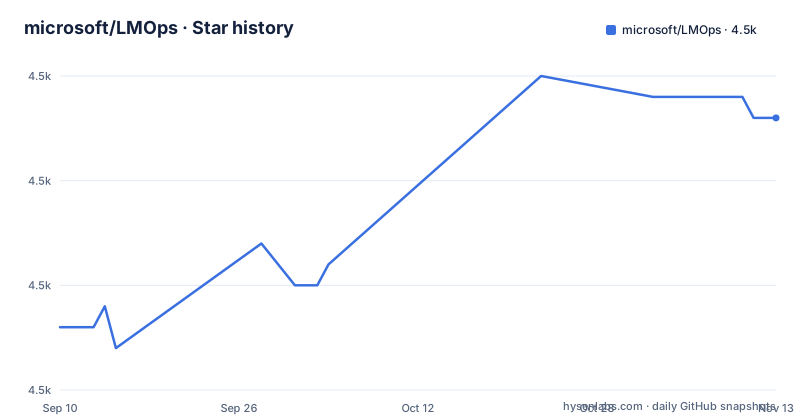
Star history
- microsoft/LMOps4,483 ★ · +10
| Repository | 2026-09-10 | 2026-11-13 |
|---|---|---|
| microsoft/LMOps | 4.5k | 4.5k |
10 Stars in the last 64 days, measured from the daily GitHub snapshot. Compare with other projects
Editorial analysis
What LMOps Actually Is
LMOps is a GitHub repository from Microsoft that serves as a landing page for a research initiative. It does not contain a single installable tool. Instead, it links to papers and describes several techniques, each with its own code and sometimes models. The README lists research areas: better prompts, longer context, LLM alignment, faster inference, and customization. The repository is a hub, pointing to subprojects that may live in separate folders or external links. For an engineer, this means the value is in the individual techniques, not in a unified package. The description says it is about 'general technology for enabling AI capabilities w/ LLMs and MLLMs,' but the actual content is a set of research contributions, mostly from 2022 and 2023.
The Core Techniques and Their Mechanisms
The repository highlights several distinct mechanisms. Promptist uses reinforcement learning to train a language model that optimizes user prompts for text-to-image generation. The idea is that the model acts as a 'prompt interface' that rewrites input into a form the generative model prefers. Structured Prompting addresses long prompts by organizing examples or retrieved documents in a structured way, allowing in-context learning to scale to 1,000 examples. X-Prompt extends prompts beyond natural language, introducing an extensible interface with 'imaginary words' learned for fine-grained control. LLMA, the accelerator, exploits the observation that LLM outputs often overlap with reference texts, such as retrieved documents. It copies and verifies spans from references, achieving 2 to 3 times speed-up without an additional model. These are distinct mechanisms, not a single framework.
How to Get Started: What the Repository Offers
The README does not provide installation commands or a quickstart. Each technique is announced with a paper link and sometimes a demo, like the Promptist demo at aka.ms/promptist. To use any technique, you must navigate to the specific subproject, likely within the repository or linked externally. For example, the LLMA paper describes a method that you would implement or find code for in a related folder. The repository does not list dependencies or Python package names. The primary language is Python, and the license is MIT, but the README only says the license is in the LICENSE file. To run anything, you would clone the repository, explore its directories for each technique, and follow the instructions in that subproject's own README, if present. The absence of a top-level setup means you must be comfortable digging into individual folders.
Where LMOps Falls Short
The most obvious limitation is that LMOps is not a maintained library. There are no GitHub releases, the last push was on 2026-09-15, and the README's news items stop in late 2023. The repository is now archived on GitHub. The README is a collection of paper abstracts and links, not a user guide. There is no unified API, no documentation on how the pieces fit together, and no examples that span multiple techniques. For an engineer looking to integrate prompt optimization or inference acceleration into a product, this is a research artifact, not a solution. Some techniques, like X-Prompt, are described conceptually but may not have readily available code. The repository also assumes you have access to large language models, which may not be feasible for all teams. It is the wrong tool if you need a supported, documented, and actively maintained software package.
Alternatives and How They Differ
A direct alternative for prompt optimization is to use general prompt engineering libraries like LangChain or DSPy, which offer prompt templates and optimization loops. These libraries are designed for production use and have active communities. In contrast, LMOps' Promptist is a research method that uses reinforcement learning. For inference acceleration, alternatives like vLLM or TensorRT-LLM provide optimized serving rather than the reference-based copying of LLMA. LLMA's approach is unique because it requires a reference document that overlaps with the output, which is common in retrieval-augmented generation. If you do not have such references, LLMA will not help. These alternatives are more mature, but they do not implement the specific research ideas in LMOps.
Maintenance, License, and Upgrade Cost
The repository is under the MIT license, which is permissive for both research and commercial use, but the README does not detail the license for each subproject. You should check each subfolder for its own license. Maintenance is a concern: the repository is archived, and the news and paper links are from 2022 and 2023. There is no mention of versioning, so upgrading is not a clear process. If you adopt a technique, you are likely to use the code as-is and must handle any bugs yourself. The contact information suggests submitting GitHub issues for help, but the repository is archived. The cost of maintaining a fork is on you. For a production system, this is a significant risk.
Who Should Use LMOps and What to Verify First
LMOps is for researchers who want to reproduce a specific paper's results or build on a technique like Structured Prompting or LLMA. It is also useful for engineers exploring novel approaches before they are integrated into larger frameworks. Before adopting any component, verify that the code for that technique exists in the repository, that it runs with your model and hardware, and that it is not a dead link. Check the LICENSE file in the root and in each subfolder. Look at the last commit dates for the specific folder you plan to use. If the code is stale and unmaintained, you may need to port it to current libraries. Do not assume the repository is a cohesive tool; treat it as a collection of research artifacts. The MIT license gives you freedom, but it also means you bear the responsibility for making the code work.
Editorial conclusion
Adopt LMOps if you are a researcher or engineer who wants to reproduce or build on specific techniques like Promptist for prompt optimization, Structured Prompting for longer contexts, or LLMA for lossless inference acceleration. Do not adopt it if you expect a single, unified, production-ready library; this is an archived collection of research artifacts with varying maturity and no GitHub releases. Before adopting, verify the specific subproject you need: check its folder for code, dependencies, and examples, and confirm that it supports your model and use case, as some components may be experimental or tied to particular models. The repository is a starting point for research, not a turnkey solution.
Frequently asked questions
What is the difference between LLMOps and MLOps, in microsoft/LMOps?
The README describes no MLOps work such as pipelines, deployment or monitoring, and its 25 top-level directories are research projects. What it holds is research code and paper links for prompting, longer context, alignment, inference acceleration, customization, and the mechanics of in-context learning.
What are the best tools for LLMOps, and does microsoft/LMOps answer that?
The repository does not rank or compare tools. It points sideways at two sibling projects, microsoft/unilm for large-scale self-supervised pre-training and microsoft/torchscale for transformers at any scale, and its own content is paper links beside separate code directories.
How do I get the code behind one specific LMOps technique?
Browse the top level and open the directory whose name matches the technique, for example llma/, promptist/, or uprise/. The landing page gives no install command, no package name, and no dependency list, so the files inside each directory are the only setup guidance, and questions about pre-trained models go to a GitHub issue.
Does microsoft/LMOps ship models, releases, or versioned artifacts?
No. The repository has no published releases, and the page names no checkpoint, tag, or download other than the demo link at aka.ms/promptist. Licensing is deferred to the LICENSE file in the root of the source tree.
Official sources
Add this badge to your README
If you maintain this project, the badge below links readers to this analysis and shows its maintenance status from the daily GitHub snapshot. Paste the markdown into your README; add ?metric=license or ?metric=stars to the image URL for a different field.

[](https://hysenlabs.com/projects/microsoft-lmops)Star history chart for your README
[](https://hysenlabs.com/projects/microsoft-lmops)Was this useful?