Millennium Dawn: A Paradox Mod Monorepo with a CC-BY-SA License Twist
Millennium Dawn and it's codebase.
At a glance
- What is it?
- Millennium Dawn is a large Paradox Hearts of Iron IV mod set in the modern era, and its GitHub repository is the full source tree. The project is notable for its scale, its permissive (for mods) license, and its structured contribution pipeline.
- Who is it for?
- Adopt this repository if you are a modder or contributor who wants to work on a large, actively developed HOI4 mod with a clear contribution process and a permissive license. Do not adopt it if you expect a standalone Python application or a tool that runs outside the Paradox engine; this is a mod source tree, not a library.
- Can I use it commercially?
- Yes, with credit. CC-BY-SA-4.0 allows commercial use as long as you credit the authors and indicate what you changed. It is written for creative content, so check how it applies to any code.
- Is it still maintained?
- Yes. The repository last received commits 18 days ago.
- What is it written in?
- Mainly Python, according to GitHub's language statistics.
Answers come from the project's GitHub data, last synced on October 4, 2026, and from our analysis. They are not legal advice.
Star history
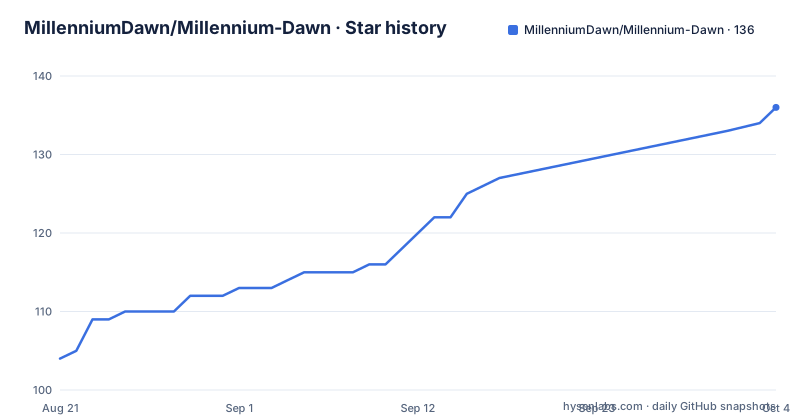
- MillenniumDawn/Millennium-Dawn136 ★ · +32
| Repository | 2026-08-21 | 2026-10-04 |
|---|---|---|
| MillenniumDawn/Millennium-Dawn | 104 | 136 |
32 Stars in the last 44 days, measured from the daily GitHub snapshot. Compare with other projects
Editorial analysis
What Millennium Dawn Actually Is
Millennium Dawn is a Hearts of Iron IV mod that resets the game to the year 2000 and extends into the modern day. The repo is not a standalone program. It is the full source tree for the mod, which is distributed on Steam. The primary language listed is Python, but that is misleading. Python appears only in the tools/ directory, where scripts support development. The bulk of the repository is Paradox script files: common/, events/, history/, map/, interface/, gfx/, and localisation/. The README describes the mod as a multi-mod project with economic systems, political mechanics, and content for over 150 nations. If you are an engineer looking for a reusable Python library, this is the wrong place. If you are a modder or a contributor to the mod, this is the canonical source.
The Repository Layout: More Than Game Data
The README gives a clear directory map. common/ holds focuses, ideas, events, and decisions. localisation/ contains language files. events/ is for event chains, history/ for country data, map/ for terrain and states, interface/ for UI, and gfx/ for graphics. The tools/ directory is where Python comes in. It contains scripts for validators, standardizations, and other utilities. That is a practical arrangement: game content stays in Paradox's script format, while developer automation lives in Python. The docs/ directory is not a wiki afterthought. It holds a code style guide, a modifiers and effects reference, and a game rules tutorial. The presence of a dedicated docs directory with specific resource files suggests the team treats maintainability as a real concern. For a mod of this scale, that matters. Without those validators, a contributor could easily break a focus tree and not notice until the game crashes.
How the Mod Works: Scripts, Events, and Economics
The mod's mechanism is not code in the traditional sense. It is a set of Paradox script files that hook into Hearts of Iron IV's engine. The README highlights economic systems: taxation, debt management, and international investment. Political mechanics include internal factions, influence, and party systems. These are implemented as ideas, decisions, and events, all defined in the common/ and events/ directories. The actual data flow is that the game engine reads those script files at load time. The mod does not ship a separate binary. That means the mod's behaviour is entirely constrained by what the base game exposes as scriptable. If the engine does not support a mechanic, the mod cannot add it. The README mentions realistic geopolitical organizations like the EU and NATO, which are likely implemented as custom factions or diplomatic mechanics. The scale is large: 150+ nations with focus trees. That is a content-heavy project, not an algorithmic one.
Getting It Running: From GitHub to Steam
The README does not provide a one-line install command. It links to a Git Setup Guide on Google Docs, which is external. That is a friction point. The repository itself is not the distribution channel. Players get the mod from Steam Workshop, as the README links to a Steam workshop item. Developers and contributors, however, clone the repo and set it up manually. The contribution guide lists steps: fork the repository, create a feature branch, make changes following style guidelines, run pre-commit hooks, update Changelog.txt, add yourself to AUTHORS.md, and submit a pull request. The pre-commit hooks are a notable part of the workflow. They likely run the Python validators from tools/ to check for script errors before a commit. The README points to a code style guide in docs/src/content/resources/code-stylization-guide.md. If you want to contribute, that is your starting point. There is no package manager or build system described. You edit files and run the mod through the game.
Where This Mod Is the Wrong Tool
This repository is not a general-purpose framework. It is a specific mod for a specific game. If you want to build a modern-day strategy game from scratch, this repo will not help you. It depends entirely on Hearts of Iron IV being installed and patched to a compatible version. The mod's content is tied to that engine. Another limitation is the license. The repository is under CC-BY-SA-4.0. That is a share-alike license. If you copy code or assets into your own project, you must release that project under the same license and give attribution. That is a real constraint for someone who wants to use snippets in a proprietary project. Also, the README notes that AI-assisted coding is allowed only if the developer can review the code. That is a policy, not a technical feature. It means the team is aware of AI-generated contributions and wants them reviewed. That is a governance decision, not a tool limitation.
The Alternative: A Traditional All-Rights-Reserved Mod
Most Hearts of Iron IV mods are not open source. They are distributed on Steam with no public repository. The typical alternative is a closed mod where you download a zip from the workshop and never see the source. Millennium Dawn differs by putting everything on GitHub under a permissive license. That is a real difference in approach. With a closed mod, you cannot inspect the code, you cannot fix bugs yourself, and you cannot reuse assets. With Millennium Dawn, you can fork the repo, read the history, and contribute. The trade-off is that an open repo exposes every development misstep. The team has to manage issues, pull requests, and pre-commit hooks. The README links to a separate Git Setup Guide on Google Docs, which is an extra dependency. A closed mod would not need that. But for a mod of this size, the open approach is more sustainable because it allows a community of contributors.
Maintenance and Upgrade Costs
The repository shows signs of active maintenance. The last push is dated 2026-08-01, and there is a release v2.0.0-beta.4 from that same date. There are also beta.3 and a bug-attachments release. That indicates a regular release cycle. The contribution guide requires updating Changelog.txt and adding yourself to AUTHORS.md. That is a low-cost but explicit process. The pre-commit hooks add a setup cost for contributors. You have to install them before your first commit. The docs directory suggests that the team invests in documentation, which reduces the learning curve but also requires upkeep. The license is a maintenance factor too. CC-BY-SA-4.0 means that if the mod ever incorporates third-party assets, those must be compatible. The README does not mention any external dependencies beyond the game itself. That is a positive sign. The biggest upgrade cost is likely the game engine. When Paradox updates Hearts of Iron IV, the mod may break. The team has to adapt scripts to new engine versions. That is an ongoing cost that the repository structure does not mitigate.
Editorial conclusion
Adopt this repository if you are a modder or contributor who wants to work on a large, actively developed HOI4 mod with a clear contribution process and a permissive license. Do not adopt it if you expect a standalone Python application or a tool that runs outside the Paradox engine; this is a mod source tree, not a library. Before contributing, verify the pre-commit hooks are set up per the Git Setup Guide, read the code style guide in docs/src/content/resources/code-stylization-guide.md, and check the CONTRIBUTING.md for the AI policy. If you plan to reuse assets or code, note the CC-BY-SA-4.0 license: you must share derivatives under the same terms and give attribution, but the license is more permissive than many mod projects that use all-rights-reserved. The repository is not a game itself; it only makes sense as a mod for Hearts of Iron IV.
Frequently asked questions
What is Millennium Dawn?
It is a multi-mod project for Hearts of Iron IV set in 2000 and continuing to the modern day and beyond, with its own tech trees, focus trees, events and decisions. The readme says the content covers taxation, debt management, international investment, internal factions and party systems, and more than 150 nations.
Is Millennium Dawn still being updated?
The repository is not archived, its last push to the main branch is dated September 17, 2026, and the three newest releases are quarterly bug attachments for the third quarter of 2026, published on September 29 and 30, 2026. The readme also says open contributions of any form are welcome, including localisation, code and content.
How do the Millennium-Dawn developer scripts run, and are they a package?
They are not a package, and the tooling configuration says so at the top. It exists to centralise settings for the test runner, linter, formatter and type checker so the command line, the pre-commit hooks and continuous integration read the same values. Test collection is limited to the tools tests directory and looks for file names ending in an underscore and the word test, and the type checker is pinned to Python 3.12.
What does the Millennium-Dawn repository contain?
Game data in a common directory holding focuses, ideas, events and decisions, plus directories for event chains, historical country data, terrain and states, interface definitions, graphics, localisation, developer tooling and documentation. The tree also carries directories the readme does not document, including portraits, music, sound, tutorial material and scenario tests.
Does Millennium Dawn allow AI-generated code in contributions?
Yes, on one condition. The readme states that the development team allows AI assisted coding if and only if the developer is capable and able to review the code it produces, with further detail in the contribution policy's AI section. The pull request checklist separately requires updating the changelog and adding yourself to the authors file.
Official sources
Add this badge to your README
If you maintain this project, the badge below links readers to this analysis and shows its maintenance status from the daily GitHub snapshot. Paste the markdown into your README; add ?metric=license or ?metric=stars to the image URL for a different field.

[](https://hysenlabs.com/projects/millenniumdawn-millennium-dawn)Star history chart for your README
[](https://hysenlabs.com/projects/millenniumdawn-millennium-dawn)