dLLM: pinned dependencies, a hidden disclaimer, and no releases
dLLM: Simple Diffusion Language Modeling
At a glance
- What is it?
- The library unifies training and evaluation for diffusion language models on top of the transformers Trainer and lm-evaluation-harness. What the README renders is only part of what the file contains, and the package metadata pins the stack hard while leaving torch to a manual step.
- Who is it for?
- dLLM is built for someone who already knows masked diffusion and wants working training and evaluation recipes rather than a polished package. Three things decide whether it fits.
- Can I use it commercially?
- Yes. Apache-2.0 is a permissive licence: you can use, modify and sell software built on it, as long as you keep its copyright and licence notices.
- Is it still maintained?
- Yes. The repository last received commits 129 days ago.
- What is it written in?
- Mainly Python, according to GitHub's language statistics.
Answers come from the project's GitHub data, last synced on November 23, 2026, and from our analysis. They are not legal advice.
Star history
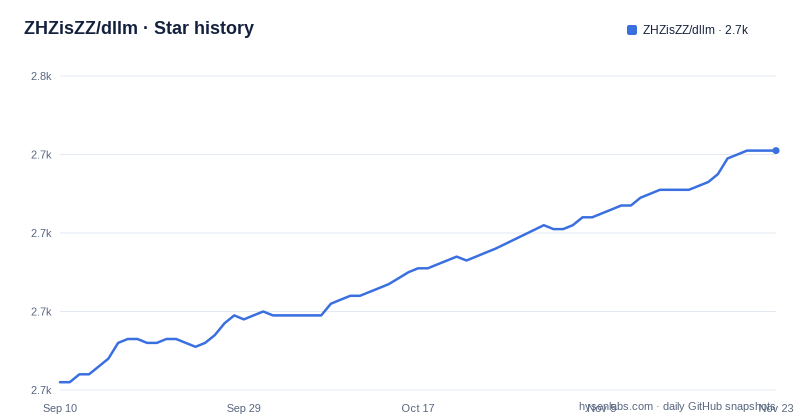
- ZHZisZZ/dllm2,741 ★ · +59
| Repository | 2026-09-10 | 2026-11-23 |
|---|---|---|
| ZHZisZZ/dllm | 2.7k | 2.7k |
59 Stars in the last 74 days, measured from the daily GitHub snapshot. Compare with other projects
Editorial analysis
The disclaimer about reproduction is written but never rendered
Several parts of this README exist in the file and do not appear on the page. The first is a NOTE callout telling readers that the repository is primarily for educational purposes and does not aim for 100 percent exact reproduction of official models, which it calls impossible. The whole callout sits inside an HTML comment, so it is invisible in the rendered file while remaining plain text in the source. The same trick hides the header div with the paper and model badges, the News line announcing the technical report for 2026/02, and two collapsed demo blocks: one for the BERT-Chat chat demo and one for an EditFlow sampling demo that would have colour coded insertions, substitutions and deletions. An empty centred paragraph is left behind where the badge block was. The practical consequence is that a reader who clones the repository sees more than a reader who arrives on GitHub, including the one sentence that sets expectations about fidelity to the published models.
torch is installed by hand and never declared as a dependency
The setup section builds the environment in three steps and the third one is where the library itself arrives:
# create and activate conda environment
conda create -n dllm python=3.10 -y
conda activate dllm

# install pytorch with CUDA 12.4 (other pytorch/cuda versions should also work)
conda install cuda=12.4 -c nvidia
pip install torch==2.6.0 torchvision==0.21.0 torchaudio==2.6.0 \
    --index-url https://download.pytorch.org/whl/cu124

# install dllm package
pip install -e .
The CUDA version arrives twice, once as a conda package from the nvidia channel and once as the cu124 wheel index the pip command points at, and the comment above them says other pytorch and cuda versions should also work without saying which are known to work. More consequential is what the package metadata does not contain. torch, torchvision and torchaudio appear nowhere in the dependencies of pyproject.toml, so pip install -e . installs the library and its own dependencies against whatever torch happens to be in the environment already. A machine without the manual pip step gets a working install of dllm and no tensor library at all.
Six exact pins, nine unpinned names, and an optional trio
The dependency block in pyproject.toml splits cleanly in two:
dependencies = [
    "transformers==4.57.0",
    "accelerate==1.11.0",
    "deepspeed==0.18.0",
    "peft==0.17.1",
    "datasets==4.2.0",
    "sentencepiece==0.2.0",
    "torchmetrics",
    "tyro",
    "wandb",
    "omegaconf",
    "tqdm",
    "matplotlib",
    "pytest",
    "rich",
]
The first six are the load bearing ones and each is frozen with an equality sign, down to the patch level of transformers and accelerate. The remaining nine are tooling with no version at all, which means a fresh resolve today and a fresh resolve next month can differ. The optional extra follows the opposite convention and pins three packages hard: bitsandbytes 0.48.1, vllm 0.8.5.post1 and flash-attn 2.8.3. So the environment is reproducible where it matters for the training code and loose everywhere else, with the caveat that a library pinned to transformers 4.57.0 will refuse to move until somebody edits the file.
The tests live under scripts and the vendored models are excluded from black
The pytest configuration points at an unusual place:
[tool.pytest.ini_options]
testpaths = ["scripts/tests"]
python_files = ["test_*.py"]
addopts = "-v -ra"
Test discovery is scoped to scripts/tests, and there is no tests directory at the repository root, so the suite lives next to the launch scripts rather than beside the package. Formatting is configured with a line length of 88 and, more interestingly, with an exclusion pattern that lists five vendored model trees by path, dllm/pipelines/llada/models, llada2, llada21, dream and a2d, plus the evaluation harness. That exclusion list is a map of where third party model code was copied in, which is more informative than the formatting rule itself: five model families were vendored under the pipeline package and the harness was vendored beside it, and none of them is expected to obey the project's own style.
Version 0.1.0, one package, and no release ever cut
The build metadata is minimal and honest about it: setuptools requiring 61 or newer with wheel, a single declared package, name dllm, version 0.1.0, readme README.md, requires-python >=3.10. The version has not moved off 0.1.0, and the repository has no GitHub releases at all, so there is no tag to pin, no changelog to read and no wheel to download. The documented install path is the editable one, pip install -e ., which means the working tree is the package. Everything else the project wants a reader to fetch lives outside the repository: the homepage field points at an arXiv PDF, and the links under the title go from a Report link to that same paper to a Models link to a Hugging Face collection. An assets directory sits in the root for whatever those links eventually point at. The licence is the one unambiguous file in the root listing, an Apache-2.0 LICENSE next to .gitignore, .gitmodules, AGENTS.md, README.md, assets, dllm, examples, lm-evaluation-harness, pyproject.toml and scripts.
The evaluation harness is a submodule, not a dependency
Evaluation is built on lm-evaluation-harness, and the copy of it lives inside this repository rather than in the environment. The root carries .gitmodules and an entry called lm-evaluation-harness, and the optional evaluation setup is two commands:
# initialize `lm-evaluation-harness` submodule
git submodule update --init --recursive

# install submodule in editable mode with IFEval & Math dependencies
pip install -e "lm-evaluation-harness[ifeval,math]"
The editable install with the ifeval and math extras is the harness's own entry point, so the submodule is modified in place rather than consumed as a wheel. That is consistent with two other details: the harness is not in the dependency list of pyproject.toml, and it is named in the black exclusion pattern alongside the vendored model trees. A reader who skips the submodule step gets a library whose evaluation pipelines have no harness underneath them, and the failure would surface as a missing package rather than as a message from dLLM. AGENTS.md sits in the same root listing with no mention of it anywhere in the README.
Nine example directories, two of them inference only
The examples directory holds nine subdirectories and the Features list gives one line for each. llada and dream are the full recipes, pretraining, finetuning and evaluation for those two open weight models, and llada also carries the MoE variant. llada2 and llada21 are narrower: inference of LLaDA2.0 and LLaDA2.1, with no training mentioned. Three of the recipes are converters rather than reproductions. examples/a2d finetunes any autoregressive model, naming Qwen, LLaMA and GPT-2, and its associated collection is described as small diffusion models at 0.5B and 0.6B adapted from AR models. examples/bert does the same for any BERT encoder, naming BERT, RoBERTa and ModernBERT, to produce chat models. examples/editflow is labelled an educational reference and covers insertion, deletion and substitution as edit operations. examples/fastdllm covers inference and evaluation with caching and confidence threshold decoding, and examples/rl covers diffu-GRPO training validated on five reasoning tasks: GSM8K, MATH, Countdown, Sudoku and Code. The last bullet in the list is More upcoming.
Editorial conclusion
dLLM is built for someone who already knows masked diffusion and wants working training and evaluation recipes rather than a polished package. Three things decide whether it fits. You need the pinned stack: transformers 4.57.0, accelerate 1.11.0, deepspeed 0.18.0 and peft 0.17.1 are exact pins, so a newer release of any of them will not be picked up. You need a CUDA box, because the setup installs torch 2.6.0 from a cu124 wheel index after putting cuda=12.4 into the conda environment. And you need a clone, since pyproject.toml still says 0.1.0, the repository has never cut a release, and the only install command is an editable install from the working tree. Worth knowing before you read anything else: the note about not reproducing official models exactly sits inside an HTML comment, so it does not appear on the rendered page.
Frequently asked questions
What is a dLLM?
It is a Python library that unifies the training and evaluation of diffusion language models. Its training pipelines are built on the transformers Trainer and its evaluation pipelines on lm-evaluation-harness, and it requires Python 3.10 or newer.
Does the dllm repository define what a diffusion language model is?
No, it treats the term as known and names what it implements instead: masked diffusion through MDLM, block diffusion through BD3LM, and Edit Flows, each linked to its paper. There is no definition section in the repository.
Which models does dllm ship recipes for?
Nine example directories: llada, llada2, llada21, dream, a2d, bert, editflow, fastdllm and rl. The llada2 and llada21 directories are inference of LLaDA2.0 and LLaDA2.1, while llada and dream cover pretraining, finetuning and evaluation.
How do you install dllm?
The setup section creates a conda environment on Python 3.10, adds cuda=12.4 from the nvidia channel, installs torch 2.6.0 with torchvision and torchaudio from the cu124 wheel index, and then runs pip install -e . for the package itself.
Does torch appear in the dllm dependency list?
No. The declared dependencies are transformers, accelerate, deepspeed, peft, datasets and sentencepiece with exact version pins, followed by unpinned tooling names, and torch is installed separately by hand in the documented setup.
Official sources
Add this badge to your README
If you maintain this project, the badge below links readers to this analysis and shows its maintenance status from the daily GitHub snapshot. Paste the markdown into your README; add ?metric=license or ?metric=stars to the image URL for a different field.

[](https://hysenlabs.com/projects/zhziszz-dllm)Star history chart for your README
[](https://hysenlabs.com/projects/zhziszz-dllm)Was this useful?