Morphia 2.4: A Java ODM with a Slowing Cadence
MongoDB object-document mapper in Java based on https://github.com/mongodb/mongo-java-driver
At a glance
- What is it?
- Morphia is a long-standing MongoDB object-document mapper for Java. This review covers its mechanism, setup, limitations, and the maintenance signals visible from its release history.
- Who is it for?
- Morphia suits Java teams that want a familiar annotation-driven mapper and can accept a slower release train. It is not for teams needing the latest MongoDB driver features or rapid bug fixes.
- Can I use it commercially?
- Yes. Apache-2.0 is a permissive licence: you can use, modify and sell software built on it, as long as you keep its copyright and licence notices.
- Is it still maintained?
- Yes. The repository last received commits 2 days ago.
- What is it written in?
- Mainly Java, according to GitHub's language statistics.
Answers come from the project's GitHub data, last synced on October 21, 2026, and from our analysis. They are not legal advice.
Star history
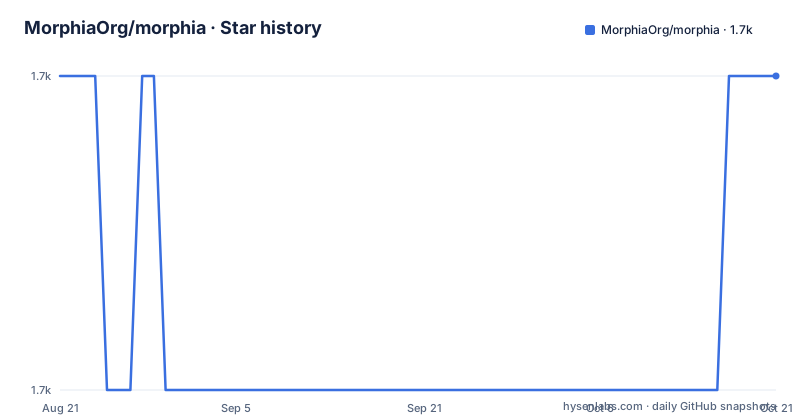
- MorphiaOrg/morphia1,676 ★ · +0
| Repository | 2026-08-21 | 2026-10-21 |
|---|---|---|
| MorphiaOrg/morphia | 1.7k | 1.7k |
0 Stars in the last 61 days, measured from the daily GitHub snapshot. Compare with other projects
Editorial analysis
What Morphia Solves and Who It Serves
Morphia is an object-document mapper (ODM) for Java and MongoDB. It sits on top of the official mongo-java-driver, so you do not write raw Document maps or manual BSON conversions. Instead, you annotate plain Java classes and let Morphia handle the mapping between your objects and MongoDB documents. This is for developers who prefer typed domain models over the driver's low-level API. The README points to morphia.dev for documentation, which suggests a mature project with a user base beyond a single repository. The target user is a Java developer already using MongoDB who wants to reduce boilerplate. It is not for polyglot teams or for projects that need a lightweight, dependency-free mapper, because Morphia brings its own abstractions and configuration model.
How Morphia Maps Documents: The Annotation Mechanism
The core mechanism is annotation-driven mapping. You mark a class with @Entity and its fields with @Id or @Property, and Morphia's mapping engine converts those annotations into the document structure. It uses the underlying mongo-java-driver for all network operations, so the data flow is: your Java object, then Morphia's mapper, then the driver, then MongoDB. The mapper handles type conversions, lifecycle events, and query building. One visible design choice is that Morphia has its own Query interface, separate from the driver's. That means you learn a second API on top of the driver. The README does not list specific annotations, but the documentation site does. This separation gives Morphia control over query semantics, but it also means you cannot always drop in driver-specific features without workarounds. The mapping is not automatic; you must annotate or configure fields, so plain POJOs without annotations will not map correctly.
Getting Started: What the Repository Shows
The README is sparse. It gives no quick-start code, no Maven coordinates, and no installation steps. That is a limitation for new users. You must go to morphia.dev for setup details. What the repository does show is a standard Maven layout: src/main and src/test directories, a pom.xml for dependency management, and a GitHub Actions workflow for tests. The project is built with Java, and the releases are tagged as v2.4.4, v2.3.8, and so on. To use it, you would add the Morphia dependency to your build, then configure a Datastore, likely with a MongoClient. The README mentions a Roadmap.md and a CHANGELOG.md, which are the places to check for configuration specifics. If you expect a copy-paste start, this README will disappoint. The official documentation is the real entry point, not the repository page.
The Release Cadence: A Maintenance Signal
The last push was September 9, 2023, and the latest release is v2.4.4 from the same day. There is also a v2.3.8 from the same period. That means no commits or releases for over a year from the point of this review. The project is not archived, but the activity has stopped. This is a genuine concern. MongoDB's driver evolves, and an ODM that does not track it can fall behind on server version support and bug fixes. The README shows a Discord server and a Commonhaus copyright, which indicates a governance structure, but governance does not guarantee commits. For a team evaluating adoption, this cadence is a red flag unless you are prepared to fork or contribute. The CHANGELOG might show resolved issues, but the absence of recent entries is itself a fact you must weigh.
Where Morphia Is the Wrong Tool
If your project uses MongoDB features that are new or niche, Morphia may not support them. The mapper's abstraction layer means you are one level removed from the driver, and any driver feature that Morphia does not expose becomes inaccessible without raw access. The README does not document how to bypass the mapper, but the architecture implies you can fall back to the driver's collection API. That is a workaround, not a feature. Also, if you prefer reactive or asynchronous programming, Morphia's model is based on the synchronous driver, so it is a poor fit. The documentation does not mention reactive support, and the repository layout shows no reactive modules. For a small project with simple mappings, Morphia adds complexity without much gain; the driver's own POJO codec might suffice. For a large project with complex inheritance or custom types, the annotation model can become tedious.
A Real Alternative: The MongoDB Java Driver's POJO Support
The most direct alternative is not another ODM, but the mongo-java-driver itself, which includes a POJO codec that can map Java objects to documents without a separate mapper. The driver's approach is codec-based: you register a CodecRegistry and pass your class to a collection, and the driver handles conversion. Morphia builds on the driver, but it adds its own mapping layer, annotations, and query API. The difference is control versus convenience. With the driver, you are closer to the database and have full access to all features. With Morphia, you get a higher-level abstraction but lose some flexibility. The driver is maintained by MongoDB, Inc., so it receives regular updates. For teams that value long-term support and feature parity, the driver's native POJO support is a safer bet. For teams that want a richer ODM with lifecycle events and advanced mapping, Morphia offers that, but at the cost of a third-party dependency with a stalled release train.
Licence and Upgrade Costs
Morphia is licensed under Apache-2.0, which permits commercial use, modification, and redistribution without copyleft obligations. That is a permissive licence, so legal friction is low. The upgrade cost comes from the release history. Moving from 2.3.x to 2.4.x likely involves breaking changes, as is common with major.minor bumps in ODMs. The README does not list migration notes, but the CHANGELOG.md is the place to look. Since the project is dormant, upgrading to a newer version may not be possible, and you might need to stay on an old version or fork. The maintenance cost is therefore not just the licence, but the effort to track API changes and the risk of unpatched bugs. The Commonhaus copyright suggests a foundation, but that does not change the practical reality: no recent commits means no active maintenance.
Editorial conclusion
Morphia suits Java teams that want a familiar annotation-driven mapper and can accept a slower release train. It is not for teams needing the latest MongoDB driver features or rapid bug fixes. Before adopting, verify that your MongoDB server version and driver features align with Morphia 2.4.x, and check the CHANGELOG for unresolved issues. The last push in September 2023 means you should plan for your own maintenance overhead or a migration path.
Frequently asked questions
What is Morphia in this repository?
A MongoDB object-document mapper in Java, described as based on the MongoDB Java driver, licensed under Apache-2.0 and developed on the master branch. The README is 86 words long and points to morphia.dev for documentation, so the API itself is not described in the repository.
Is morphia here the same thing as morphea or morphine?
No. In this repository the name belongs to a Java MongoDB object-document mapper, and the spelling collides with unrelated medical and dictionary terms. Check that a result describes a mapper built on the MongoDB Java driver before reading it as documentation for this project.
What is the most recent Morphia release?
Of the three newest tags, v2.4.4 and v2.3.8 were both tagged on 2023-09-09, the 2.3.8 tag 26 minutes after 2.4.4, and v2.4.3 on 2023-09-07. The last recorded push to the master branch is dated 2026-10-02, later than any of those tags.
Where do I find the Morphia roadmap and migration notes?
The roadmap is Roadmap.md in the repository root, resolved issues are in CHANGELOG.md or in the milestone section on GitHub, and migration material is split between Migration.md and the upgrading directory. The API documentation is on morphia.dev, and there is a Discord server linked from the README.
What does the Morphia repository actually contain?
Thirty top-level entries, including fifteen module directories: annotations, audits, build-plugins, config, core, critter, design, docs, examples, kotlin, reports, rewrite, upgrading, util and validation. Alongside them sit the Maven wrapper files, pom.xml, a .sdkmanrc, two test scripts named test-all.sh and test-all-versions.sh, and the licence, contributing and code of conduct files. The README describes none of the modules.
Official sources
Add this badge to your README
If you maintain this project, the badge below links readers to this analysis and shows its maintenance status from the daily GitHub snapshot. Paste the markdown into your README; add ?metric=license or ?metric=stars to the image URL for a different field.

[](https://hysenlabs.com/projects/morphiaorg-morphia)Star history chart for your README
[](https://hysenlabs.com/projects/morphiaorg-morphia)