MovingPandas: Python Analysis for Trajectory Data
MovingPandas - a Python library for movement data exploration and analysis
At a glance
- What is it?
- MovingPandas adds trajectory structures and movement-analysis functions to the Pandas and GeoPandas Python stack. It fits analysts who need stop detection, generalization, cleaning, aggregation, and spatial visualization.
- Who is it for?
- MovingPandas is a sensible choice for Python analysts who already work with GeoPandas and need trajectory-specific operations such as stop detection, generalization, smoothing, or aggregation. It is less suitable for projects requiring only point and line geometry, or teams unwilling to manage its Pandas, GeoPandas, Shapely, and plotting dependencies.
- Can I use it commercially?
- Yes. BSD-3-Clause is a permissive licence: you can use, modify and sell software built on it, as long as you keep its copyright and licence notices.
- Is it still maintained?
- Yes. The repository last received commits 38 days ago.
- What is it written in?
- Mainly Python, according to GitHub's language statistics.
Answers come from the project's GitHub data, last synced on November 7, 2026, and from our analysis. They are not legal advice.
Star history
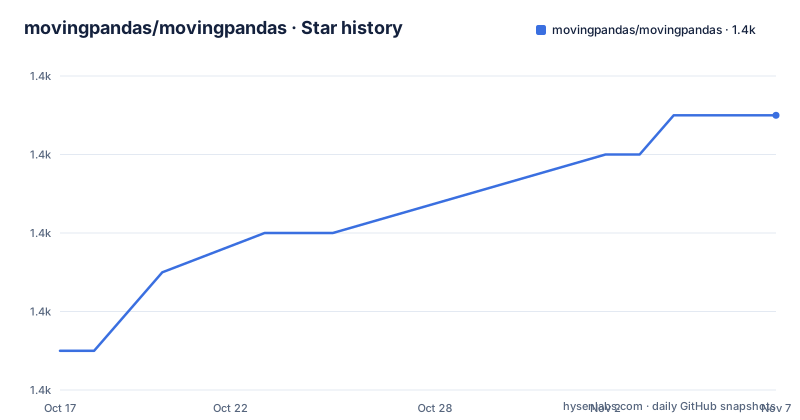
- movingpandas/movingpandas1,425 ★ · +6
| Repository | 2026-10-17 | 2026-11-07 |
|---|---|---|
| movingpandas/movingpandas | 1.4k | 1.4k |
6 Stars in the last 21 days, measured from the daily GitHub snapshot. Compare with other projects
Editorial analysis
MovingPandas Targets Ordered Movement Observations
MovingPandas addresses a specific gap in ordinary spatial analysis. GeoPandas can represent points, lines, and other geometries, while Pandas provides tabular operations. Movement data adds another requirement: observations belong to trajectories and are normally interpreted through their time and space order. MovingPandas builds trajectory data structures and analysis functions on those two foundations, giving Python users an interface designed for movement rather than treating every tracked object as an unrelated geometry.
The intended users are GIS practitioners, data scientists, and domain analysts working with movement records. The README gives bird migration, vessel tracking, and video-based bicycle trajectories as examples. Those cases differ in scale and sensor format, but all require operations on tracked paths. A route line by itself may be enough for basic mapping. MovingPandas becomes relevant when an analysis must detect stops, generalize a path, clean noisy observations, combine trajectories, or inspect several linked views of the same movement.
The library is not a standalone geospatial engine. Its project metadata identifies Pandas and GeoPandas as foundations, and the dependency list includes `matplotlib`, `geopandas`, `geopy`, and `shapely>=2.0`. This design makes sense for teams with an existing Python geospatial workflow, but it also means installation and compatibility are part of the decision. The repository supports Python 3.9 and newer.
Trajectory Collections and GeoPandas Data Flow
The visible architecture is a Python package that extends the dataframe and geospatial data model rather than replacing it. Based on the repository layout and project metadata, trajectory operations live in `movingpandas`, supporting tools live in `movingpandas.tools`, and tests live in `movingpandas.tests`. Tutorials under `tutorials/` and the larger documentation site demonstrate how this layer is used. The exact class hierarchy and internal buffers are not described in the README, so a lower-level claim about storage would go beyond the documented information.
At the data flow level, users bring movement observations into a familiar geospatial table, organize them as trajectories, and then apply trajectory-specific operations. The README identifies trajectory plots, stop detection, generalization, cleaning and smoothing, and aggregation as distinct workflow areas. Each changes the analytical representation of movement. Stop detection can produce stops as points or segments and can split trajectories. Generalization offers spatial, temporal, and spatiotemporal methods. Cleaning can remove outliers, while smoothing can apply Kalman filters. Aggregation supports analysis at a broader pattern level.
Plotting follows the same integration model. The project documents interactive output through Folium and Geoviews, and the `viz` extra also lists `bokeh`, `cartopy`, `hvplot`, and `mapclassify>=2.6.0`. Custom projections are explicitly documented in an iceberg example. This is useful when coordinate handling and visual context matter, but it also shows that visualization is a separate dependency layer rather than a mandatory part of the base installation.
Installing MovingPandas from conda-forge
The README directs Python users to conda-forge for MovingPandas and all dependencies. For an existing conda environment, install the package with the documented channel specification:
conda install -c conda-forge movingpandasThe README describes this as the standard conda installation route. The reader should see conda resolve MovingPandas and its required geospatial dependencies from `conda-forge`.
MovingPandas also documents `mamba` as the faster installation route:
mamba install -c conda-forge movingpandasUse the second block when mamba is already available in the environment. The repository metadata declares Python `>=3.9`, so Python 3.9 or newer is required. It also makes `shapely>=2.0` a direct dependency, which is a concrete version boundary to check before deployment.
The installation section in the README ends with a warning about an unspecified installation method. It does not provide a complete pip command or explain the remainder of that warning. This review therefore does not substitute a guessed PyPI command. For environments not managed by conda or mamba, the documented starting point is the project homepage at `http://movingpandas.org` and its documentation on ReadTheDocs.
A First Stop Detection Workflow in the Tutorials
MovingPandas does not need local installation for an initial evaluation because the README points to MovingPandas examples running on MyBinder. Those examples use the latest MovingPandas release version. The project also provides a separate development-version Binder notebook linked from the README. The release examples are the more appropriate starting point for judging the published package, while the main-branch notebook is explicitly a development version.
A concrete first exercise is stop detection. Open the “Detecting stops” tutorial from the official tutorial notebooks. The documented operation detects stops in trajectories and can extract those stops as points or segments. It can also use detected stops to split a trajectory. Follow the notebook with one tracked dataset whose timestamps are regular enough to understand its sampling behavior. The expected outcome is not a single static summary. It is a set of trajectory-level products suitable for plotting or further analysis.
The README does not show a complete trajectory-collection construction snippet or a complete stop-detection call, so no unverified API example is included here. For the first real use, follow the linked notebook rather than translating an assumed class name into code. That sequence also avoids skipping required conversion steps between a source dataset, a GeoDataFrame, and MovingPandas structures. A second useful exercise is the trajectory-cleaning tutorial, which demonstrates outlier removal and Kalman filtering. Its smoothing dependency is optional and must be installed separately when that feature is selected.
Stop Detection, Generalization, and Cleaning Trade-offs
The feature set addresses distinct data problems, but each method changes the trajectory and therefore requires parameter choices that the library cannot decide for the analyst. Stop detection is useful when temporary presence near a location matters. Extracting stops as points gives a location-oriented result, while extracting them as segments preserves the movement occupied during the stop. Splitting trajectories changes the unit of downstream analysis, so detection thresholds can affect every subsequent group.
Generalization serves a different purpose. Spatial, temporal, and spatiotemporal methods reduce or transform trajectory detail according to the question being asked. A route that is appropriate at vessel scale may contain excessive points for a regional map, while shortening a path without a matching analytical objective can hide meaningful movement. The README documents the available method families but does not prescribe universal thresholds.
Cleaning and smoothing also require restraint. Removing outliers can eliminate erroneous fixes, but a genuinely fast movement may resemble an error under a poorly chosen rule. Kalman filtering can reduce noise, yet the result is a modeled trajectory rather than an untouched sensor record. The optional `smoothing` extra installs `stonesoup`, so projects that do not smooth data can avoid that dependency. MovingPandas is a poor fit when every original observation must remain unaltered or when detection and generalization rules must be fixed by a library without analyst review.
Plain GeoPandas Versus Trajectory-Aware Operations
GeoPandas is the clearest practical alternative because MovingPandas depends on it. The difference is not that GeoPandas cannot handle movement observations. It can perform standard geospatial table operations and represent trajectory geometry. MovingPandas adds a vocabulary and set of operations centered on trajectories, including stops, generalization, smoothing, aggregation, and movement-oriented plots.
Working directly in GeoPandas may be enough when the task is a one-off geometry calculation, map layer, or spatial join. It avoids introducing a separate trajectory abstraction when no repeated movement operation is needed. For a dataset that must be cleaned, segmented at stops, generalized and visualized consistently across many tracks, MovingPandas provides a more direct API surface. That convenience comes with an extra abstraction layer and the package requirements already listed in `pyproject.toml`.
HoloViz-based output is another distinction, but it is part of the project’s visualization integrations rather than a competing general analysis library. The `viz` extra shows that plotting breadth is purchased through optional dependencies. An analyst with an established static mapping pipeline may continue to export geometry to that pipeline, while a notebook user can follow the documented Folium, Geoviews, and linked-plot examples.
Release Activity, Dependency Cost, and BSD-3-Clause
Maintenance status is supported by the repository record rather than by the project status badge alone. The last push was on 2026-09-30, and the repository is not archived. The recent release history includes v0.23.0 on 2026-08-09, v0.22.4 on 2025-07-16, and v0.22.3 on 2025-05-12. This indicates continued release and repository activity, while it does not remove the need to test upgrades against a deployed geospatial stack.
The base package has a meaningful dependency cost. Installing it also introduces the Python geospatial stack represented by GeoPandas and `shapely>=2.0`, plus `matplotlib` and `geopy`. Visualization can require several additional packages under the `viz` extra, while smoothing adds `stonesoup`. Conda and mamba are documented routes because resolving this collection is part of setup. Teams that already standardize those environments can reduce environment uncertainty, but upgrades may still affect interactions among MovingPandas, GeoPandas, Pandas, and plotting libraries.
The project metadata identifies the license as `BSD-3-Clause`, with the repository’s `LICENSE.txt` as the license file. This permits use and modification under the license’s stated conditions, including its notice and disclaimer provisions. This is a repository fact, not legal advice. Distribution arrangements, attribution obligations, and dependency licenses should be reviewed separately for the intended deployment.
Editorial conclusion
MovingPandas is a sensible choice for Python analysts who already work with GeoPandas and need trajectory-specific operations such as stop detection, generalization, smoothing, or aggregation. It is less suitable for projects requiring only point and line geometry, or teams unwilling to manage its Pandas, GeoPandas, Shapely, and plotting dependencies. Before adoption, verify that the official tutorial workflow matches your input schema and inspect the optional `viz` and `smoothing` dependencies. For v0.23.0, confirm compatibility with your deployed Python and GeoPandas versions through your own environment setup.
Frequently asked questions
How do I install MovingPandas?
For Python 3.9 or newer, the README documents `conda install -c conda-forge movingpandas` or the faster `mamba install -c conda-forge movingpandas` route. The repository metadata also requires `shapely>=2.0` and declares GeoPandas among the project dependencies.
Can I detect stops and split MovingPandas trajectories?
Yes. The README documents stop detection as a supported analysis, with stops extractable as points or segments. Detected stops can also be used to split trajectories.
Which extra dependencies does MovingPandas need for visualization and smoothing?
The `smoothing` extra adds `stonesoup`. The `viz` extra adds `bokeh`, `cartopy`, `folium>=0.12`, `geoviews`, `hvplot`, `mapclassify>=2.6.0`, and `matplotlib>=3.7.5`.
Official sources
Add this badge to your README
If you maintain this project, the badge below links readers to this analysis and shows its maintenance status from the daily GitHub snapshot. Paste the markdown into your README; add ?metric=license or ?metric=stars to the image URL for a different field.

[](https://hysenlabs.com/projects/movingpandas-movingpandas)Star history chart for your README
[](https://hysenlabs.com/projects/movingpandas-movingpandas)Was this useful?