neerazz/FAANG: Java Interview Preparation Repository
Competitive programming questions.
At a glance
- What is it?
- A repository-based study collection for coding interviews covering Java solutions, algorithm patterns, company question lists, system design, and object-oriented design. It is best treated as a curated reference library, not an interactive learning platform.
- Who is it for?
- Adopt neerazz/FAANG if you want a broad, repository-based checklist for Java coding interviews and can evaluate solutions independently. Do not adopt it as your only preparation source if you need adaptive exercises, tested submissions, automated feedback, or a guaranteed sequence.
- Can I use it commercially?
- Not without permission. GitHub finds no licence file in the repository, and without a licence all rights are reserved by default: you may read the code but not reuse it. Check the README, or ask the authors, before using it.
- Is it still maintained?
- Yes. The repository last received commits 104 days ago.
- What is it written in?
- Mainly Java, according to GitHub's language statistics.
Answers come from the project's GitHub data, last synced on November 7, 2026, and from our analysis. They are not legal advice.
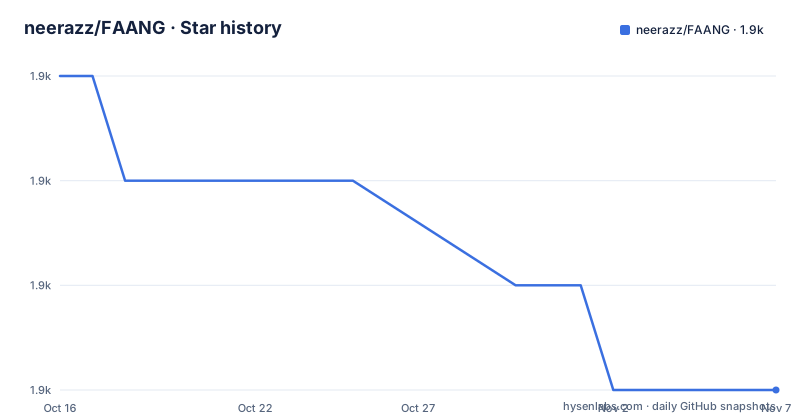
Star history
- neerazz/FAANG1,898 ★ · -3
| Repository | 2026-10-16 | 2026-11-07 |
|---|---|---|
| neerazz/FAANG | 1.9k | 1.9k |
-3 Stars in the last 22 days, measured from the daily GitHub snapshot. Compare with other projects
Editorial analysis
What neerazz/FAANG Covers for Technical Interview Preparation
neerazz/FAANG addresses the preparation problem created by the breadth of modern software engineering interviews. A candidate may need arrays, data structures, algorithmic reasoning, system design, object-oriented design, and company-specific question lists at the same time. The repository organizes those subjects into browsable directories rather than requiring every topic to be discovered through search.
The intended audience is explicit in the repository metadata and README. Its topics include `algorithm`, `algorithms`, `data-structures`, `coding-interviews`, `interview-practice`, `interview-preparation`, `leetcode`, `system-design`, `faang`, and `maang`. The README also positions the collection for candidates preparing at major technology companies. Although its name retains FAANG, the introduction broadens the company set to the Magnificent Seven and other leading technology firms.
The collection contains documented Java solutions and explanations for what the README calls hundreds of classic and trending problems. It also includes lists organized by LeetCode frequency, topic, and company. Directories such as `blind75/`, `interviewDrills/`, `dataStructures/`, and `topAmazonQuestions/` give the repository a study-index structure. The collection is designed for candidates who can move among files and choose problems themselves.
Repository Structure and the Path Through an Interview Problem
This is a static collection rather than an application with a runtime data pipeline. A learner enters through the README or a top-level question list, selects a company, topic, frequency group, or drill, and opens a solution under the corresponding directory. Useful indexes include `All_Topics_top_leetcode_by_frequency.md`, `Top_LeetCode_Questions_By_Topic.md`, and `Top_LeetCode_Questions_By_Company.md`.
The exercise model is conventional. A problem leads to a Java implementation and an accompanying explanation. The README says the solutions include comments, step-by-step approaches, and complexity analysis. That structure encourages the candidate to state the input assumptions, describe the algorithm, implement it in Java, and then analyze time and space costs.
The Big O section establishes the vocabulary used across the collection. It covers constant, logarithmic, linearithmic, quadratic, cubic, and factorial growth, with examples such as hash-table lookup, binary search, merge sort, bubble sort, Floyd-Warshall, and traveling-salesman permutations. The README also points out that interviewers expect candidates to identify the case being analyzed and explain trade-offs. This is preparation for defending an algorithm during an interview, not simply obtaining accepted code.
The top-level layout also shows that interview preparation is broader than Java exercises. `Algorithms/`, `AlgoExpert/`, `dataStructures/`, `database/`, `pramp/`, `tools/`, and interview-drill material sit beside company-specific directories. System design and OOPS are presented through dedicated README sections and linked resources. The repository therefore works as a map across several preparation categories.
Getting Started With the Java Question Lists
The repository does not present a package installation command, build-and-run workflow, or application startup sequence. The README points users to the project pages at `https://neerazz.github.io/` and describes the GitHub repository as the place to find the collection. Because it is primarily Markdown, Java source files, and linked study resources, there is no documented CLI command to copy into this tutorial.
A first practical use begins by opening the README and choosing one of its routes. For a company-focused session, inspect `Top_LeetCode_Questions_By_Company.md`, then use a matching directory such as `topAmazonQuestions/`, `topMicrosoftQuestions/`, or `topFacebookQuestions/`. For broad exposure, use `blind75/` or the frequency-based index. For structured practice, begin with `interviewDrills/`. A candidate studying foundational implementations can inspect `dataStructures/` and `Algorithms/`.
The first session should produce an answer rather than a page visit. Read one question, write the Java approach without opening its solution, state the expected time and space complexity, and then compare the implementation with the repository explanation. The README does not document whether every answer has automated tests, whether submissions are verified against a judge, or how solutions are automatically scored. This absence matters because the repository should not be treated as if it provided LeetCode-style validation.
Big O Analysis as the Repository's Common Review Language
Complexity analysis is the strongest organizing principle documented in the README. It links to the Big O Cheat Sheet and explains why candidates should compare how algorithms behave as inputs grow. The table maps notation to algorithms and common use cases rather than treating optimization as an abstract requirement.
For a repository solution, the useful review sequence is visible from the README's examples. Constant time appears with hash-table lookup and direct array access. Logarithmic time appears with binary search. Linearithmic time appears with merge sort and heap sort. Quadratic and cubic growth correspond to nested loops, while factorial growth maps to permutation-based brute force. A learner can use that vocabulary to decide whether an implementation fits the intended data shape.
The material also calls out amortized analysis through dynamic-array resizing. That distinction matters because a single append may not always cost the same amount, even when an operation has a familiar average or amortized bound. The documentation's advice to clarify which case is being analyzed can prevent a candidate from claiming a stronger result than the implementation provides.
The README excerpt does not show a uniform complexity table for each problem. It describes complexity analysis as part of the solutions, but it does not confirm the consistency or depth of every file. Candidates should verify this themselves before treating the whole collection as a standardized review checklist.
System Design and OOPS Resource Dependencies
The repository does not present system design as another LeetCode-style function. Instead, the README groups it with books and courses intended for intermediate and advanced preparation. Linked resources include `System Design Interview An Insider’s Guide by Alex Yu`, `Designing Data Intensive Applications`, and `Scalability System Design for Developers`. The README does not summarize the chapters or show exercises completed through the repository.
Object-oriented design follows a similar resource-based model. The README links `Grokking the Object-Oriented Design Interview` under a section devoted to OOD. Top-level directories and README categories provide entry points, but the available description does not claim that neerazz/FAANG itself supplies a complete system-design curriculum.
This distinction affects adoption. The repository is strongest as an index and question bank for code preparation. For architecture interviews, a learner still needs to know what the linked books and courses cover and how their examples differ. The README identifies resources, but it does not state that links are permanently available, that editions are synchronized, or that every linked resource is redistributed under the repository's own terms.
A candidate should also notice the licensing boundary. The repository metadata says the license is unknown, while several linked books and PDFs are external or copyrighted resources. The repository does not grant a general license for those resources and does not specify reuse rights for the bundled content. Code reuse should be limited to what the repository's actual license file permits once that status is verified.
Where This Repository Differs From an Interactive Practice Platform
The clearest alternative is a LeetCode-style practice workflow. The repository metadata names LeetCode because its lists and LeetCode FAQ address those questions, but the README does not establish that solutions are submitted or checked through LeetCode.
Another alternative is working systematically from one paid or institutional course. A course usually imposes a lesson sequence and exercises its own methodology. neerazz/FAANG instead lets the learner jump between frequency rankings, company directories, drills, data structures, and broad algorithm collections. That flexibility can fit a candidate with a targeted weakness, but it can also make prioritization a burden.
The repository also differs from a single reference book. The README collects multiple external resources, including `Elements of Programming Interviews in Java`, `Grokking the Coding Interview`, and `Cracking the Coding Interview`. It is therefore an index as much as a solution collection. The trade-off is discoverability versus depth: a learner can find several routes to a topic, but the repository does not claim that every route uses the same teaching style or exercise difficulty.
Maintenance Signals and Limits of the Published Release History
The repository is not archived, and the recorded last push was on 2026-07-27. That is recent enough to avoid describing it as abandoned. However, recent repository activity does not guarantee that every algorithm explanation, company list, external link, or interview guide has been checked against current expectations. Those quality checks must be made per file.
The release history listed for this project contains one release, `v1.0`, named "Pandemic Preparation" and dated 2022-08-17. No later tagged release is listed. A repository can receive commits without producing new releases, so the release history should not be treated as a complete record of content changes. It does show that there is no documented sequence of versioned upgrades through which a user could migrate.
The unknown license is another concrete adoption constraint. The README discusses third-party books and PDFs, but the repository metadata does not identify the project's license. Users who only need to study locally may have a different decision from maintainers who intend to copy or redistribute portions of the repository. The absence of documented automated tests and review criteria also means solution correctness must be checked against a trusted compiler or judge before an interview session.
Editorial conclusion
Adopt neerazz/FAANG if you want a broad, repository-based checklist for Java coding interviews and can evaluate solutions independently. Do not adopt it as your only preparation source if you need adaptive exercises, tested submissions, automated feedback, or a guaranteed sequence. Before committing, inspect the contents of the relevant solution directories, confirm that Java examples match your target interview format, and check whether the resource pages and question lists remain current. The repository is not archived, and its last push was on 2026-07-27, but its only published release is v1.0 from 2022-08-17.
Frequently asked questions
What programming language is used in neerazz/FAANG?
Java is the repository's primary language. The README also links Java-specific resources such as `Elements of Programming Interviews in Java`.
How should I start using neerazz/FAANG for interview preparation?
Choose a route such as `blind75/`, `interviewDrills/`, a company-specific directory, or one of the top-level LeetCode question lists. The README does not provide an installation command because the project is presented as repository content and linked resources.
Does neerazz/FAANG automatically check Java solutions?
The README does not document automated solution checking or a submission workflow. Verify each implementation with a trusted compiler or an appropriate problem platform before relying on it.
Official sources
Add this badge to your README
If you maintain this project, the badge below links readers to this analysis and shows its maintenance status from the daily GitHub snapshot. Paste the markdown into your README; add ?metric=license or ?metric=stars to the image URL for a different field.

[](https://hysenlabs.com/projects/neerazz-faang)Star history chart for your README
[](https://hysenlabs.com/projects/neerazz-faang)Was this useful?