WHC_ConfuseSoftware Review for iOS and Cross-Platform Obfuscation
iOS代码混淆工具,Uniapp代码混淆工具,react-native代码混淆, iOS代码混淆助手,Android代码混淆助手,Uniapp代码混淆助手,过机器审核,辅助过4.3, other审核,android、ios、uniapp、u3d、cocos2dx、flutter、代码翻新(WHC_ConfuseSoftware)是一款运行在MAC OS平台的App、完美支持Objc和Swift、U3D、Flutter、Cocos2dx项目代码的自动翻新(混淆)、支持文件夹名称、文件名、修改资源文件hash值、类名、方法名、属性名、添加混淆函数方法体、添加混淆属性、自动调用生成的混淆方法、字符串混淆加密等...功能强大而稳定。
At a glance
- What is it?
- WHC_ConfuseSoftware is a paid macOS application for renaming and restructuring code across iOS, Android, Flutter, Unity, Cocos2dx, UniApp, React Native and related projects. It offers broad language coverage, but requires VIP access and does not guarantee app review approval.
- Who is it for?
- Developers should consider WHC_ConfuseSoftware when they need a commercial, multi-language source and resource transformation tool and can obtain the current package from the author. Teams should not adopt it as a guaranteed way to pass App Store review, hide unauthorized code reuse, or replace normal build and regression testing.
- Can I use it commercially?
- Not without permission. GitHub finds no licence file in the repository, and without a licence all rights are reserved by default: you may read the code but not reuse it. Check the README, or ask the authors, before using it.
- Is it still maintained?
- Yes. The repository last received commits 26 days ago.
- What is it written in?
- Mainly Swift, according to GitHub's language statistics.
Answers come from the project's GitHub data, last synced on November 7, 2026, and from our analysis. They are not legal advice.
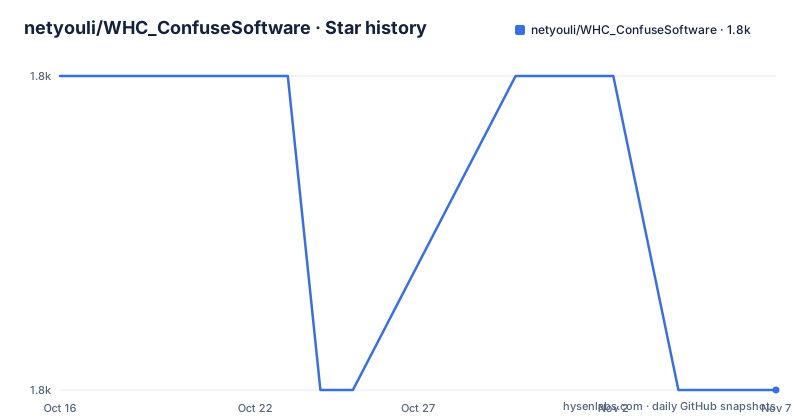
Star history
- netyouli/WHC_ConfuseSoftware1,799 ★ · -1
| Repository | 2026-10-16 | 2026-11-07 |
|---|---|---|
| netyouli/WHC_ConfuseSoftware | 1.8k | 1.8k |
-1 Stars in the last 22 days, measured from the daily GitHub snapshot. Compare with other projects
Editorial analysis
What WHC_ConfuseSoftware Changes
WHC_ConfuseSoftware addresses source-level duplication and project fingerprinting across several mobile and game codebases. The README describes transformations for identifiers, filenames, folders, resources and executable or source structure. The stated targets include Objective-C, Swift, C#, Lua, C, C++, Dart, Java, Kotlin, JavaScript, TypeScript, Vue, JSX and TSX. The documented project types include iOS App, Android, Flutter, UniApp, React Native, H5, Unity3D, Cocos2dx and WeChat Mini Programs. This is a broad transformation tool rather than a narrowly scoped obfuscator for one language.
The tool also includes more invasive operations. It can change class names, function names, property names, protocol names, enum names and local variable names. It can modify filenames and resource-related values, including identifiers in Xib and Storyboard files. The README lists support for changing resource file hash values for formats including png, jpg, jpeg, mp3, mp4 and caf, as well as transformations involving assets and audio files. It further describes inserting generated code, adding calls to generated functions and adding garbage properties.
The intended users are developers working on mobile applications, games and cross-platform projects who want to produce a materially different source or resource representation. The README presents the tool as a way to reduce code repetition or similarity and to assist with machine review outcomes such as 4.3, 2.1, 2.3.1 and other. That positioning is important. The documented function is code transformation, not an independent review process, and the README explicitly says the software does not promise that any app package will pass review.
Transformation Model and Project Scope
Based on the repository layout, the main product is a packaged macOS application, not a command-line library that can be integrated through a documented Swift package or package manager. The repository contains `App.swift`, a `ConfuseSoftware/` directory, macOS disk images and separate IPA upload helper archives. The README identifies version `v1.9.9.6.0.1` and says the latest version installation package is obtained from the author. The repository has no GitHub releases, so the commit history and README are the available version references.
The documented processing model appears to operate on a project as a whole. It can clone a project with a specified name, change code file UUIDs, copy code dependencies and configuration, and generate an Xcode project. It also reports support for multiple processing threads selected according to the computer configuration. The README further claims that the latest version can alter call order inside functions and can split Objective-C functions into multiple child functions while preserving execution results. Those are substantial source transformations. They require language-aware handling because a mechanical rename or statement reorder can break reflection, selectors, serialization, dependency injection, resource lookup, generated code or runtime assumptions.
The tool is therefore best understood as a batch project rewriting system with optional generated code and resource changes. The README does not document the internal parser architecture, rollback format, test suite, integration API or a reproducible command-line invocation. It also does not explain how it handles platform-specific generated files or project-specific exceptions. A developer would need to inspect the output rather than assume that every successful transformation preserves application semantics.
Installation and First Real Use
The repository does not document a conventional installation sequence for the main application through Homebrew, npm, Swift Package Manager or a GitHub release. It states that the latest installation package must be obtained from the author. The repository does include macOS disk images named `代码混淆v1.9.9.6.0.1-intel.dmg` and `代码混淆v1.9.9.6.0.1.dmg`, but the README does not provide a verified installation command or explain which image is appropriate for a particular Mac.
The separate IPA upload helper is linked directly from the README. The Mac archive is identified as `IPA上传助手-mac-1.0.5.app.7z`, and the Windows archive as `IPA上传助手-win-1.0.5.exe.7z`. These are downloadable files, but they are not the same component as the main obfuscation application. The README says that current use requires purchasing VIP access, so downloading an archive does not establish that the complete application is usable or that the reader has a current license.
A responsible first use would begin with a disposable copy of a small project, not an application archive that must pass production review. After obtaining the current package through the stated author channel, confirm the product version, macOS compatibility and license status. Then create a clean checkout, run only the transformations relevant to that project, and compare the generated source and resource names before building. No verified command, configuration file or first-run workflow is provided in the README, so the repository alone cannot support a reproducible command tutorial.
What the README Can and Cannot Verify
The README contains a large capability list, but most entries describe intended features rather than test results. It states that the software has been used by many people and projects, yet it supplies no reproducible test corpus, benchmark output, compiler matrix or before-and-after build log. It also uses promotional statements about stability and error rates without supplying a versioned technical report. Those statements should not be treated as compatibility evidence.
The documentation identifies several specific risks. Generated garbage code is described as reaching tens of thousands of lines per file. Such files can increase compile time, source size and review complexity. Code splitting and call-order changes can alter observable behavior when functions have side effects, depend on evaluation order or are referenced through runtime metadata. Identifier renaming can break string-based lookup, Objective-C selectors, Swift reflection, serialization keys or native integrations. Resource hash changes can invalidate caches, signatures, stores or content-addressed references. The README does not describe safeguards for these cases.
The separate IPA upload assistant is also presented as a way to address computer association and review problems. That is a different function from source obfuscation, and the README gives no technical description of its upload behavior. It should not be treated as evidence that the obfuscator can solve account association, guideline 4.3 or other review decisions.
Cost, Maintenance and License Boundaries
This is not an open-source license project in the sense presented by the README. It says that the software is not free and open source, that a VIP purchase is currently required, and that the VIP payment is non-refundable. The repository metadata does not identify a license, so users should not assume permission to modify, redistribute or incorporate the proprietary application into another product. The repository includes packaged binaries and compressed applications, which makes source availability and redistribution rights unclear.
The repository is not archived. Its last push was on 2026-10-12. That indicates recent repository activity, but it does not prove that every listed language combination is continuously tested. There are no GitHub releases, so version comparison is not documented through release notes. Historical details are pointed to in `history_readme.md`, but the README does not describe an upgrade policy, migration path, compatibility guarantee or rollback process.
The maintenance burden falls mainly on the adopter. Because the application changes source and resources, an upgrade should be evaluated by running it against a known-good project and reviewing the resulting diff. The README's broad support matrix is useful for scoping a trial, but it is not a substitute for project-specific compilation and runtime verification. A commercial VIP fee also does not remove the need to retain clean source, build artifacts and test evidence.
WHC_ConfuseSoftware Compared with Source-Level Alternatives
A real alternative is a source-level transformation approach built with language-aware tools and version control. For example, a team could maintain a controlled rename map, use language-specific refactoring tools for identifiers, and use its own resource pipeline for changing asset names or hashes. Compared with WHC_ConfuseSoftware, that approach requires more project-specific engineering, but it gives the team visible configuration, reviewable diffs and a clear opportunity to exclude reflection-sensitive code.
WHC_ConfuseSoftware's difference is breadth and convenience. It presents one macOS product for many languages and project types, including generated functions, folder changes, resource changes and project cloning. A custom pipeline can offer more precise control over a single codebase, while the commercial tool may reduce the number of one-off scripts for a team already working across several of the listed platforms. The README does not provide an API, output specification or independent comparison data, so the claimed convenience cannot be quantified.
For a small Swift application, a refactoring tool plus version control may be easier to audit. For a multi-platform product with many generated assets and a repeatable obfuscation process, WHC_ConfuseSoftware offers more features in one package. The deciding factor is not the feature count. It is whether the generated project still builds, preserves runtime behavior and remains maintainable after every tool update.
Editorial conclusion
Developers should consider WHC_ConfuseSoftware when they need a commercial, multi-language source and resource transformation tool and can obtain the current package from the author. Teams should not adopt it as a guaranteed way to pass App Store review, hide unauthorized code reuse, or replace normal build and regression testing. Verify the current license terms, supported project version, generated diff, build result and application behavior on a disposable copy before applying changes to a production project.
Frequently asked questions
What is WHC_ConfuseSoftware used for?
It is a macOS application for changing identifiers, filenames, folders, resources and generated code across iOS, Android, Flutter, Unity, Cocos2dx, UniApp, React Native and other supported project types. The README presents code obfuscation and code renewal as its main purposes.
Does WHC_ConfuseSoftware support Swift and Objective-C?
Yes. The README lists Objective-C and Swift among the supported languages and describes renaming classes, functions, properties and local variables, as well as inserting generated functions and properties.
Can I install WHC_ConfuseSoftware from GitHub Releases?
The repository has no GitHub releases, and the README says that the latest installation package must be obtained from the author. The repository does contain macOS disk images and separate IPA upload helper archives, but it does not provide a verified package-manager installation command.
Does WHC_ConfuseSoftware guarantee App Store review approval?
No. The README says the software provides code obfuscation services and does not promise that an app package will pass review.
Official sources
Add this badge to your README
If you maintain this project, the badge below links readers to this analysis and shows its maintenance status from the daily GitHub snapshot. Paste the markdown into your README; add ?metric=license or ?metric=stars to the image URL for a different field.

[](https://hysenlabs.com/projects/netyouli-whc-confusesoftware)Star history chart for your README
[](https://hysenlabs.com/projects/netyouli-whc-confusesoftware)Was this useful?