Walrus Distributed Log Streaming Architecture and Setup
🦭 Distributed log streaming engine built from first principles
At a glance
- What is it?
- Walrus combines a Rust write-ahead log with Raft-coordinated metadata, segment leadership, and lease-based write fencing. It is aimed at developers building small distributed streaming clusters, but its pre-1.0 release history and undocumented production limits warrant caution.
- Who is it for?
- Walrus fits developers who need to inspect or build around a segmented distributed WAL and can accept an early project with a small documented command set. It is a poor fit for teams requiring a mature Kafka-compatible ecosystem, established operational runbooks, or confirmed production support.
- Can I use it commercially?
- Yes. MIT is a permissive licence: you can use, modify and sell software built on it, as long as you keep its copyright and licence notices.
- Is it still maintained?
- Yes. The repository last received commits 18 days ago.
- What is it written in?
- Mainly Rust, according to GitHub's language statistics.
Answers come from the project's GitHub data, last synced on November 7, 2026, and from our analysis. They are not legal advice.
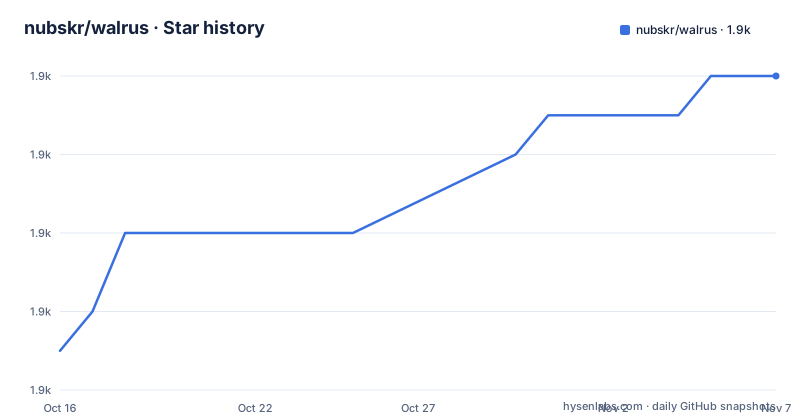
Star history
- nubskr/walrus1,942 ★ · +7
| Repository | 2026-10-16 | 2026-11-07 |
|---|---|---|
| nubskr/walrus | 1.9k | 1.9k |
7 Stars in the last 22 days, measured from the daily GitHub snapshot. Compare with other projects
Editorial analysis
What Walrus Distributed Message Streaming Adds
Walrus addresses the gap between a local write-ahead log and a multi-node streaming service. The repository exposes two connected layers: `walrus-rust`, described in `Cargo.toml` as a Write-Ahead Log implementation, and `distributed-walrus`, which adds cluster routing, metadata coordination, and segment leadership. That structure makes the project relevant to Rust developers who want to examine the machinery beneath a distributed log rather than only consume an existing client library.
The intended cluster has at least three nodes, according to the README. Producers and consumers may connect to any node or place a load balancer in front of the cluster. Topics are divided into segments, and one node acts as leader for each active segment. Leadership moves around the cluster as segments roll over. Clients do not need to discover that leader themselves because the node controller forwards requests to the remote leader when necessary.
Walrus does not replicate the message data path through Raft. Instead, Raft coordinates metadata, including topic, segment, and leader mappings. Actual entries are stored in WAL files on disk. This separation avoids placing every payload write through the consensus layer, but it makes lease ownership, storage fencing, and recovery behavior the important parts to inspect before relying on the system.
The project is aimed more at engineers working directly with its Rust code, TCP commands, and Make targets than at application teams looking for a drop-in Kafka replacement. The README does not claim Kafka protocol compatibility, consumer groups, transaction support, schema management, or a production deployment guide.
How Walrus Routes Metadata and WAL Data
Each Walrus node contains four documented components: the Node Controller, the Raft Engine called Octopii, a replicated Cluster Metadata state machine, and Bucket Storage backed by the Walrus engine with write fencing. The Node Controller handles client-facing routing and maintains write leases synchronized from Cluster Metadata every 100ms. It also tracks logical offsets so the monitor can decide when a segment needs to roll over.
Octopii replicates metadata changes through Raft and performs leader election with `AppendEntries` RPCs. Its replicated state maps topics to segments and leaders, records sealed-segment entry counts, and stores node addresses used for routing. The state machine is described as identical across nodes. Payload writes do not travel through this Raft log.
A client sends a length-prefixed UTF-8 command over TCP. The frame begins with a four-byte little-endian length and is followed by the command text. `REGISTER` creates a topic when it does not exist, while `PUT` appends a payload. `GET` reads the next entry through a shared cursor. `STATE` returns topic metadata as JSON, and `METRICS` returns Raft metrics as JSON.
Write safety depends on more than ordinary Raft leader ownership. The segment leader obtains a lease from replicated metadata, and Bucket Storage accepts writes only while the node holds that lease. When rollover occurs, the monitor checks segment sizes every 10 seconds by default. It proposes a metadata change through Raft, seals the old segment, and transfers leadership. The README says the original leader retains sealed data for reads, while any replica holding the data may serve it.
Walrus includes a TLA+ specification for the distributed data plane. The documented invariants include one writer per segment, no writes to closed segments, stable sealed counts, and synchronization between metadata, WAL entries, and reader cursors. A formal specification is useful for reviewing the intended model, although the README does not say that every runtime configuration is mechanically checked against that model.
Bootstrapping a Three-Node Walrus Cluster
The README presents the following path for running a three-node cluster from the `distributed-walrus` directory. The bootstrap target is the documented entry point. The client address in the example points to the first node's exposed client service.
cd distributed-walrus
make cluster-bootstrap
cargo run --bin walrus-cli -- --addr 127.0.0.1:9091
After the CLI starts, `REGISTER logs` creates the `logs` topic if needed. A successful `PUT` should return an `OK` response with any response payload, while a successful `GET` with no available record returns `EMPTY`. Errors use the `ERR <message>` form.
REGISTER logs
PUT logs "hello world"
GET logs
STATE logs
METRICS
The server exposes separate client and Raft interfaces. Defaults include a client port of `8080`, a Raft port of `6000`, and loopback bind addresses. The documented CLI quick start uses port `9091`, which may reflect a bootstrap configuration rather than the default server flags. The README does not explain that difference, so a reader should inspect the cluster bootstrap target before assuming all examples use `8080`.
Node configuration requires `--node-id`, `--data-dir`, `--raft-port`, `--raft-host`, `--raft-advertise-host`, `--client-port`, `--client-host`, and optionally `--join`. A joining node receives an existing node address through `--join`. The README does not provide complete multi-node shell commands, a Docker workflow, or cloud deployment configuration.
Segment Limits, io_uring, and Operational Variables
Walrus defaults to one million entries per segment, controlled by `WALRUS_MAX_SEGMENT_ENTRIES`. The README estimates roughly 100MB per segment depending on payload size, so the actual rollover point is driven by entry count rather than a fixed byte budget. A monitor runs every 10,000ms through `WALRUS_MONITOR_CHECK_MS`. Rollover is therefore periodic and threshold-driven, not necessarily immediate after the millionth write.
Linux nodes use `io_uring` by default according to the feature description and platform-specific dependency. `WALRUS_DISABLE_IO_URING` switches to `mmap`, which can help on systems where the default backend is unsuitable. The root Cargo manifest also includes `memmap2` for the general Rust crate. The repository has benchmark targets for forcing either the fd/io_uring path or mmap on Linux through the `BACKEND` Make variable.
Durability is configurable rather than represented as one fixed behavior. The Makefile describes an asynchronous fsync default, a synchronous per-write mode, and a 100ms fast mode. The `FSYNC` variable accepts schedules such as `sync-each` or `500ms`. Those options trade write completion behavior against storage work, but the Makefile does not define crash windows, recovery guarantees for each mode, or the interaction between fsync schedules and distributed replication.
The shared `GET` cursor also deserves attention. The command description identifies it as a shared cursor rather than naming independent consumers or consumer groups. Teams needing per-application offsets, acknowledgements, replay control, or consumer rebalancing should not assume those features merely because the engine is called a message streaming platform.
Failure Boundaries and the RocksDB Comparison
Walrus has several explicit constraints. Raft fault tolerance is documented for clusters of three or more nodes, so a smaller deployment does not meet the stated target. There is one active writer per segment. A segment is immutable after rollover. The monitor checks rollover on a 10-second interval by default, and lease metadata is synchronized every 100ms, but the README does not explain the exact behavior during a partition when a former leader cannot immediately stop accepting requests.
The repository contains node failure, restart persistence, rollover, stress, and multi-topic tests, with Make targets for each. Those targets show intended test categories, not production certification. The README does not state the tested operating systems beyond the Linux-specific io_uring path, provide cluster sizing guidance, or give recovery time and data-loss objectives.
For storage-oriented evaluation, the repository includes a RocksDB comparison benchmark. Its actual difference in approach is visible in the project layout: Walrus uses its own Rust WAL and exposes mmap and Linux io_uring backends, while the benchmark builds a separate RocksDB WAL path for comparison. The Makefile defines `bench-walrus-vs-rocksdb` and output variables for both systems. The README does not publish benchmark results or establish feature parity. RocksDB is therefore a benchmark comparator here, not a documented replacement for Walrus's distributed routing and Raft metadata layer.
For applications needing a mature client ecosystem, a conventional broker may be the safer operational choice, but the Walrus README does not describe the feature differences of a specific broker. It likewise does not claim Kafka wire compatibility, despite Kafka appearing in repository topics and benchmark-related variables.
Release, Licence, and Upgrade Surface
The repository is not archived, but its last push was on 2026-05-13. Recent activity should not be assumed because that date is more than six months before the present date. Recent releases listed for the project are v0.3.0 on 2025-11-27, v0.2.0 on 2025-10-19, and v0.1.0 on 2025-10-06. These dates and the pre-1.0 sequence describe an early release history, not a maintenance guarantee.
There is also a version distinction to resolve during adoption. The root `Cargo.toml` identifies `walrus-rust` as version `0.2.0`, while the release list includes `v0.3.0`. The README does not explain whether the distributed component, the crate, or both changed in that release. An engineer should inspect the v0.3.0 changelog and package contents before assuming that the root crate and distributed binary are aligned.
The project uses the MIT licence, which is recorded in both the repository metadata and `Cargo.toml`. That licence permits broad use, modification, and redistribution subject to its notice requirements. This is not legal advice. Upgrade work may involve Rust edition and dependency changes, WAL compatibility across versions, segment metadata, and changes to the CLI protocol. The README does not provide a WAL format compatibility policy or an explicit rolling-upgrade procedure.
The root package uses Rust 2024 edition and includes `rand`, `memmap2`, `libc`, `rkyv`, `rkyv_derive`, `bytecheck`, and `tracing`. Linux adds `io-uring = "0.7.10"`. These dependencies confirm the low-level systems focus, but the README does not document dependency upgrade policy or support windows.
Editorial conclusion
Walrus fits developers who need to inspect or build around a segmented distributed WAL and can accept an early project with a small documented command set. It is a poor fit for teams requiring a mature Kafka-compatible ecosystem, established operational runbooks, or confirmed production support. Evaluate the current v0.3.0 behavior first, then verify segment rollover, node recovery, and lease fencing before adopting it.
Frequently asked questions
How do I start a three-node Walrus cluster?
The README directs users to run `make cluster-bootstrap` from `distributed-walrus`, then start `walrus-cli` with `cargo run --bin walrus-cli -- --addr 127.0.0.1:9091`. It does not provide the complete command for launching and joining each node.
What storage backends does Walrus support?
Linux uses io_uring by default, and setting `WALRUS_DISABLE_IO_URING` selects mmap instead. The repository manifest includes `io-uring` only for Linux and `memmap2` for the Rust crate.
Does Walrus provide Kafka-compatible clients or consumer groups?
The README describes a length-prefixed TCP text protocol with commands such as `REGISTER`, `PUT`, `GET`, `STATE`, and `METRICS`. It does not claim Kafka wire compatibility or document consumer groups, acknowledgements, or per-consumer offsets.
Official sources
Add this badge to your README
If you maintain this project, the badge below links readers to this analysis and shows its maintenance status from the daily GitHub snapshot. Paste the markdown into your README; add ?metric=license or ?metric=stars to the image URL for a different field.

[](https://hysenlabs.com/projects/nubskr-walrus)Star history chart for your README
[](https://hysenlabs.com/projects/nubskr-walrus)Was this useful?