Napkin Math, a table of deliberately rounded limits and the harness behind it
Techniques and numbers for estimating system's performance from first-principles
At a glance
- What is it?
- Napkin Math is a Rust repository of rounded latency and throughput numbers for estimating what a system will do from first principles, rounded for memorization rather than faux precision, and last measured in October-November 2026 on GCP c4-standard-48-lssd and AWS m8id.12xlarge / m8gd.12xlarge (Graviton4).
- Who is it for?
- Napkin Math is for the engineer at the whiteboard stage, sizing a cache, a disk or a logging bill before anything is built, and its value is that the numbers are rounded so they can be held in your head and composed with each other. It is the wrong source for a capacity commitment, a service level objective or a procurement argument.
- Can I use it commercially?
- Yes. MIT is a permissive licence: you can use, modify and sell software built on it, as long as you keep its copyright and licence notices.
- Is it still maintained?
- Yes. The repository last received commits 14 days ago.
- What is it written in?
- Mainly Rust, according to GitHub's language statistics.
Answers come from the project's GitHub data, last synced on November 24, 2026, and from our analysis. They are not legal advice.
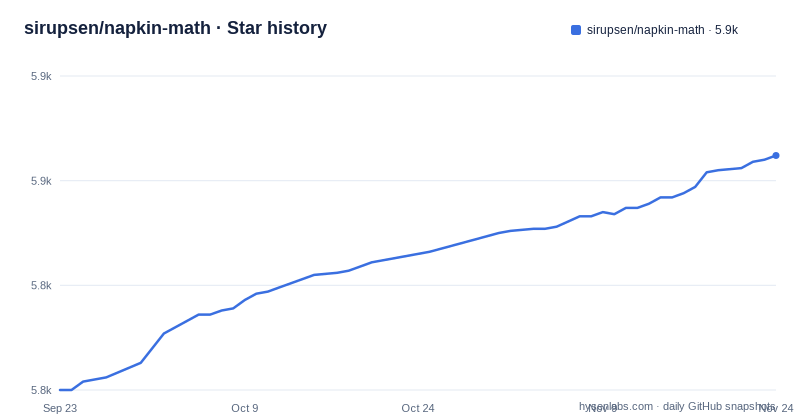
Star history
- sirupsen/napkin-math5,862 ★ · +112
| Repository | 2026-09-23 | 2026-11-24 |
|---|---|---|
| sirupsen/napkin-math | 5.8k | 5.9k |
112 Stars in the last 62 days, measured from the daily GitHub snapshot. Compare with other projects
Editorial analysis
The table is rounded on purpose and says so twice
The repository collects software, numbers and techniques for estimating what a system will do from first principles, and it defines its own scope with two ordinary questions: how quickly can you read 1 GB of memory, and how much storage cost should you expect to pay for logging an application with 100,000 RPS.
The table that follows is not a benchmark report and does not present itself as one. Its heading note says the numbers are rounded for memorization, not faux precision, and points to BENCHMARKING.md for running them yourself.
That note matters more than any individual row. Lifting one row out of context into a design document drops the caveat that made the row usable.
One machine class covers every row that can be refreshed
The numbers were last measured in October-November 2026 on GCP c4-standard-48-lssd and AWS m8id.12xlarge / m8gd.12xlarge (Graviton4) instances.
Each row carries a latency, a throughput, or both. L1 cache read is given 1 ns at 200 GiB/s, while memory sequential read on all cores carries only a throughput of 200 GiB/s.
Several rows give no throughput figure. The blob storage and network rows give a latency and mark throughput as NW Limit, the network limit, rather than a figure. A deliberate blank is more useful here than an invented number, because it tells you which part of your estimate is still missing.
Adding fsync moves an SSD write by two orders of magnitude
Storage is where the table earns its keep, because the write rows separate what a device can buffer from what a device can persist.
| SSD Sequential Read, 1 thread                                  |            | 5 GiB/s    |
| SSD Random Read (8 KiB), 2 threads                             | 100 μs     | 5 GiB/s    |
| SSD Sequential Write, 1 thread                                 |            | 3 GiB/s    |
| SSD Random Write (8 KiB), 1 thread                             | 30 μs      | 3 GiB/s    |
| SSD Sequential Durable Write (64 KiB), 1 thread†               | 50 μs      | 2 GiB/s    |
| Blob Storage, Zonal Read (128 KiB)                             | 50 ms      | NW Limit   |
| Blob Storage, Regional Read (128 KiB)                          | 100 ms     | NW Limit   |
| Blob Storage, Regional Write (128 KiB)                         | 100 ms     | NW Limit   |
| Blob Storage, Zonal Write (128 KiB)                            | 100 ms     | NW Limit   |
| HDD Sequential Read                                            |            | 200 MiB/s  |
| HDD Sequential Write                                           |            | 200 MiB/s  |
A durable 64 KiB sequential SSD write is listed at 50 μs and 2 GiB/s, against 3 GiB/s for a plain sequential SSD write, while network disk durable writes are listed at 1 ms zonal and 2 ms regional.
The blob storage rows give 50 ms for a zonal 128 KiB read and 100 ms for a regional read and for writes, with throughput at the network limit. HDD sequential read and write are listed at 200 MiB/s.
The run wrapper wants sudo and one sysctl
The numbers come out of a harness, and the harness states its setup requirements plainly.
./run --bench napkin_mathThe Makefile bench target runs this same command, and the README points to BENCHMARKING.md for running the numbers yourself.
That is the right frame for the whole repository: it is a working estimate with the holes marked, not a standard to certify against.
Criterion and the older ad hoc harness both still ship
The benchmark code is partway through a migration and the file layout shows it. Criterion is a dev-dependency and the benchmarks live under benches/.
The top level carries script/, newsletter/, benches/ and a run script, which is more moving parts than a single crate benchmark usually needs.
Cargo.toml leaves most dependencies on a wildcard
The manifest pins every dependency to a version.
brotli = "9"
flate2 = "1"
lz4_flex = "0.14"
snap = "1"
zstd = "0.14"
The compression crates are regular dependencies, the encoding crates sit behind an optional encodings feature, and benchmark-only crates such as criterion and tikv-jemallocator are dev-dependencies.
Two other choices are visible. The release profile keeps debug information and disables overflow checks, which suits a profiler more than a correctness argument.
[profile.release]
debug = true
overflow-checks = false
And the benchmark is declared once, with the default harness switched off.
[[bench]]
name = "napkin_math"
harness = false
The package sits at version 0.1.0 on edition 2021, and io-uring is pulled in as a dev-dependency only for Linux targets.
No releases at all, and the last commit was in March 2026
This repository publishes no GitHub releases at all. The last push was on 2026-10-29, and the numbers were last measured in October-November 2026.
That is the picture to plan around. There is no version to pin from a release feed, only a crate version of 0.1.0, sitting next to a table whose heading note names the machines it was measured on.
The project also points outside its own repository twice. The introduction offered is an SRECON talk, which is also the repository homepage. The practice problems, whose solutions arrive in a newsletter a few weeks apart, live at sirupsen.com/napkin. A newsletter cadence is an odd place to look for maintenance signals, which is one more reason to read the dates printed beside the numbers rather than assume the table still reflects the state of the art.
Editorial conclusion
Napkin Math is for the engineer at the whiteboard stage, sizing a cache, a disk or a logging bill before anything is built, and its value is that the numbers are rounded so they can be held in your head and composed with each other. It is the wrong source for a capacity commitment, a service level objective or a procurement argument. Three things to check before you lean on it. The rows were last measured in October-November 2026 on GCP c4-standard-48-lssd and AWS m8id.12xlarge / m8gd.12xlarge (Graviton4), so a row does not transfer to your hardware. The numbers are rounded for memorization, not faux precision. And there are no GitHub releases to pin: the crate version is 0.1.0, and the last push was on 2026-10-29, so treat the table as a dated snapshot rather than a current fact.
Frequently asked questions
What does napkin math mean here?
It means estimating a system's expected performance from first principles by composing rounded numbers, rather than measuring the system in front of you. The repository defines its scope with two questions: how quickly you can read 1 GB of memory, and how much storage cost to expect for logging an application with 100,000 RPS.
What are napkin calculations?
They are the estimates that fall out of composing those numbers. The table pairs each operation with a latency, a throughput, or both, and the numbers are rounded for memorization, not faux precision.
what is napkin math
A Rust repository, MIT licensed, collecting software, numbers and techniques for estimating system performance quickly. Its introduction is an SRECON talk, and an archive of practice problems with solutions in a newsletter is kept at sirupsen.com/napkin.
What does back of the napkin math mean, and how far can you trust it?
The same idea: a rough estimate assembled from remembered constants. Here the trust boundary is stated in the repository itself. The numbers were last measured in October-November 2026 on GCP c4-standard-48-lssd and AWS m8id.12xlarge / m8gd.12xlarge (Graviton4), they are rounded for memorization, not faux precision, and BENCHMARKING.md explains how to run them yourself.
Official sources
Add this badge to your README
If you maintain this project, the badge below links readers to this analysis and shows its maintenance status from the daily GitHub snapshot. Paste the markdown into your README; add ?metric=license or ?metric=stars to the image URL for a different field.

[](https://hysenlabs.com/projects/sirupsen-napkin-math)Star history chart for your README
[](https://hysenlabs.com/projects/sirupsen-napkin-math)Was this useful?