RTX Remix Runtime and Toolkit for DX8 and DX9 Games
Combined repo for the RTX-Remix runtime and toolkit
At a glance
- What is it?
- NVIDIA RTX Remix is an Omniverse-based platform for remastering DirectX 8 and 9 games with upgraded assets, RTX path tracing, DLSS, and Reflex. This repository coordinates its open source runtime and toolkit components rather than serving as the main contribution repository.
- Who is it for?
- Experienced modders should adopt RTX Remix when the source game uses a supported fixed-function DirectX pipeline and the available documentation covers its capture and runtime setup. Projects outside that scope, or teams that expect this combined repository to accept core changes directly, should choose a different workflow.
- Can I use it commercially?
- Yes. MIT is a permissive licence: you can use, modify and sell software built on it, as long as you keep its copyright and licence notices.
- Is it still maintained?
- Yes. The repository last received commits 17 days ago.
- What is it written in?
- GitHub does not report a main language for this repository.
Answers come from the project's GitHub data, last synced on November 6, 2026, and from our analysis. They are not legal advice.
Star history
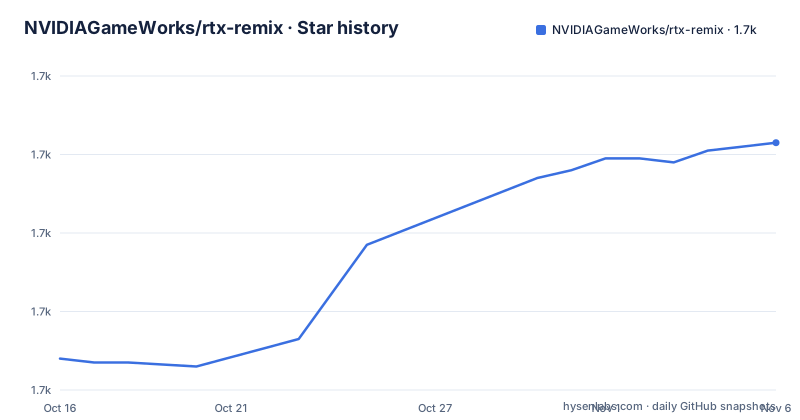
- NVIDIAGameWorks/rtx-remix1,723 ★ · +55
| Repository | 2026-10-16 | 2026-11-06 |
|---|---|---|
| NVIDIAGameWorks/rtx-remix | 1.7k | 1.7k |
55 Stars in the last 21 days, measured from the daily GitHub snapshot. Compare with other projects
Editorial analysis
RTX Remix targets classic fixed-function game scenes
RTX Remix addresses a specific problem in classic PC game preservation and visual modernization: DirectX 8 and DirectX 9 titles built around fixed-function pipelines generally lack the scene assets and lighting controls expected by modern RTX workflows. NVIDIA positions the platform for experienced modders who want to replace original textures and game assets with more detailed assets, define lighting in a dedicated application, and return those changes to the game through a runtime.
The platform is built on NVIDIA Omniverse and groups several capabilities into one remastering workflow. The README identifies AI-assisted texture upgrades, asset replacement, RTX path tracing, DLSS, and Reflex as the intended outcomes. That scope matters because RTX Remix is not a general game engine conversion system. It is aimed at classic game scenes for which a capture, asset authoring, and runtime playback chain can be established.
This target audience needs some technical familiarity. The README calls its users experienced modders, while its support links point to a runtime user guide, video tutorials, a Discord community, and community-maintained ModDB compatibility resources. The repository does not offer a compatibility claim for every DirectX 8 or DirectX 9 title, nor does it state that the DirectX version alone guarantees compatibility.
The combined repository pins the runtime release
The `NVIDIAGameWorks/rtx-remix` repository is an integration point rather than the main source tree for implementation work. Its top-level structure contains `dxvk-remix` and `toolkit-remix`, and the README explains that these are component repositories included through Git submodules. The superproject pins them to commits that form the current stable release.
That arrangement gives consumers one place to identify the component versions associated with a release. It also limits what changes belong here. Contributions should be directed to the individual `dxvk-remix` or `toolkit-remix` repository, after which accepted component changes can eventually enter a public release for modders. This makes the combined repository useful for release coordination, but a poor primary target for patch submissions.
The distinction also affects local development expectations. The README does not provide build prerequisites, compiler settings, a submodule initialization command, or a complete developer build procedure. Based on the documented layout, obtaining the release is not the same as cloning this repository and building the platform. The former is handled through the release and application links, while component-level source development occurs in the submodule repositories.
Capture, authoring, injection, and relighting form the runtime flow
The documented architecture separates creative work from runtime playback. The RTX Remix application is used to create lights and add remastered assets to a game scene. At playback, the runtime captures the classic scene, injects the remade assets, and relights the scene with RTX path tracing. DLSS and Reflex are also listed among the technologies the platform can inject.
This division suggests a scene-replacement model rather than a request to rebuild the entire game in an engine. The original game continues to supply the playable scene, while the Remix application supplies authored lighting and upgraded assets. The runtime is the bridge between those environments: it handles the captured game scene and makes the prepared content available when that scene is rendered.
The README names `dxvk-remix` and `toolkit-remix` as the component repositories but does not map each internal module to a particular stage of that flow. It also does not specify capture formats, memory behavior, thread synchronization, asset search paths, or compatibility boundaries in its root documentation. Those implementation questions need answers from the component repositories, the runtime user guide, and the release documentation rather than inference from the combined repository.
Obtaining RTX Remix and preparing a first game use
The README directs users to the NVIDIA RTX Remix homepage for the application and to the GitHub releases page for runtime releases. It does not give a command-line installation procedure for the combined repository, so there are no documented clone or build commands to include here. For an end user, the documented starting points are the application download and the runtime release corresponding to the game being remastered.
A first practical use would begin in the RTX Remix application with a supported classic game scene. From the README's description, that stage involves creating lights and placing remastered assets. During playback, the runtime captures the game scene, injects those assets, and relights the scene with RTX path tracing.
The root README stops short of naming the exact menu command, capture trigger, game configuration file, or runtime launch option. Consequently, a complete click-by-click tutorial cannot be derived from it. The runtime user guide is the relevant document for those procedural details, while ModDB's community resources are described as providing a compatibility table and configuration files for compatible games. Those community files should be treated as external game-specific configuration, not as behavior guaranteed by this repository.
Game coverage and authoring requirements narrow where RTX Remix fits
The clearest limitation is that RTX Remix is designed for DirectX 8 and DirectX 9 games using fixed-function pipelines. A project outside that class lacks a documented path through this platform. The README also requires an application workflow for lights and remastered assets, so simply deploying the runtime does not create a complete remaster.
The platform is also not a drop-in universal compatibility layer. Although the README links to ModDB compatibility resources and configuration files, the root repository does not provide a title-by-title support matrix itself. The availability of a community configuration is not the same as a guarantee from NVIDIA for every patch or distribution of a game.
A practical failure mode is incomplete preparation. If a modder cannot capture or identify the intended game scene, or cannot author suitable lights and replacement assets in the RTX Remix application, the runtime's injection and relighting stage cannot produce the intended result. The README does not document automatic fallback behavior, rollback commands, or recovery steps for failed captures. Teams needing those guarantees should not assume they are part of the current release.
For comparison, a conventional engine port replaces or rebuilds game logic and scenes in a target engine, while RTX Remix preserves a classic game scene as the basis for capture, authored asset replacement, and runtime relighting. A conventional port can suit projects that need broader engine changes. RTX Remix instead targets a narrower class of classic games that fit its capture and fixed-function pipeline workflow.
Release cadence, component upgrades, and MIT terms
The repository is not archived, and its last push was on 2026-10-13. Recent releases listed in the repository metadata are `remix-1.5.2` on 2026-06-16, `remix-1.4.2` on 2026-04-21, and `remix-1.3.6` on 2026-01-27. These dates indicate a release series extending across several numbered patch releases, although the README does not state a support window or compatibility policy for older runtime versions.
Upgrade cost comes partly from the superproject design. Because the combined repository references component repositories at specific commits, moving to a newer stable release can change more than the top-level README. A user must account for runtime and toolkit component versions as a set, then check game-specific compatibility and release notes. The README links to official release notes, but it does not provide migration notes for authoring projects between `1.5.2`, `1.4.2`, and `1.3.6`.
The repository is licensed under MIT. That identifies the repository's stated licensing model, while the README says the runtime is open source. The root README does not separately explain per-asset licensing, rights to original game content, or the permissions attached to remastered assets. Anyone using the code must review `LICENSE.txt`; anyone distributing game assets must resolve separate rights questions that the repository documentation does not answer.
Editorial conclusion
Experienced modders should adopt RTX Remix when the source game uses a supported fixed-function DirectX pipeline and the available documentation covers its capture and runtime setup. Projects outside that scope, or teams that expect this combined repository to accept core changes directly, should choose a different workflow. Before adoption, verify the release notes and runtime user guide for the specific game, capture workflow, and released component version.
Frequently asked questions
What is NVIDIA RTX Remix used for?
It is used to remaster DirectX 8 and DirectX 9 games with fixed-function pipelines by upgrading textures, replacing assets, authoring lights, and adding RTX path tracing, DLSS, and Reflex during runtime playback.
Can I contribute runtime changes directly to NVIDIAGameWorks/rtx-remix?
No. The README says this combined repository only ties the components together, and contributions should be directed to the individual `dxvk-remix` or `toolkit-remix` repository.
Does every DirectX 8 or DirectX 9 game work with RTX Remix?
The README does not claim universal compatibility. It identifies those API generations and fixed-function pipelines as the target, while pointing modders to the community-maintained ModDB compatibility table for game-specific information.
Official sources
Add this badge to your README
If you maintain this project, the badge below links readers to this analysis and shows its maintenance status from the daily GitHub snapshot. Paste the markdown into your README; add ?metric=license or ?metric=stars to the image URL for a different field.

[](https://hysenlabs.com/projects/nvidiagameworks-rtx-remix)Star history chart for your README
[](https://hysenlabs.com/projects/nvidiagameworks-rtx-remix)Was this useful?