Nzyme WiFi, Bluetooth and Ethernet threat detection review
WiFi, Bluetooth and Ethernet Threat Detection.
At a glance
- What is it?
- Nzyme is a Java project for observing WiFi, Bluetooth and Ethernet activity to support threat detection. Its alpha release status and sparse setup documentation make it more suitable for evaluation than immediate production adoption.
- Who is it for?
- Nzyme fits engineers who already have a lawful monitoring environment and need a Java-based project covering WiFi, Bluetooth and Ethernet threat detection. It is a poor first deployment for someone who needs documented installation, stable production releases or a clear migration path.
- Can I use it commercially?
- Check first. The repository uses a licence we do not classify automatically, so read its LICENSE file before any commercial use.
- Is it still maintained?
- Yes. The repository last received commits 1 day ago.
- What is it written in?
- Mainly Java, according to GitHub's language statistics.
Answers come from the project's GitHub data, last synced on November 7, 2026, and from our analysis. They are not legal advice.
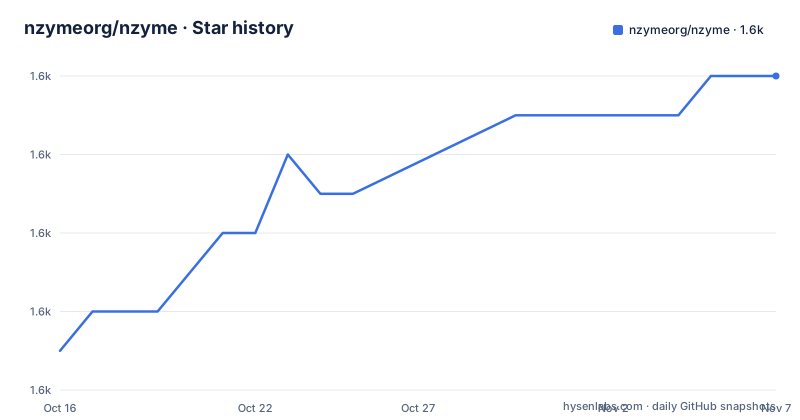
Star history
- nzymeorg/nzyme1,590 ★ · +7
| Repository | 2026-10-16 | 2026-11-07 |
|---|---|---|
| nzymeorg/nzyme | 1.6k | 1.6k |
7 Stars in the last 22 days, measured from the daily GitHub snapshot. Compare with other projects
Editorial analysis
What Nzyme covers and who should evaluate it
Nzyme addresses a specific visibility problem across WiFi, Bluetooth and Ethernet networks. The repository description labels it "WiFi, Bluetooth and Ethernet Threat Detection," so its stated scope is threat detection rather than general network administration, packet decryption or an application security platform. Its primary language is Java, which makes it relevant to engineers looking for a service or system that fits a Java-oriented operational environment.
The README does not describe particular detectors, rule formats, alert schemas or supported hardware interfaces. That omission matters when evaluating the project. A system named for three network types may still require separate collection points, protocol support and deployment assumptions. The README directs readers to the Nzyme website for more information, but it does not document the event pipeline or the actions performed after suspicious activity is identified.
Nzyme should therefore be evaluated as a specialist detection project, not as a complete security operations platform. The repository contains `src/`, `web-interface/`, `openapi/`, `tap/`, `nzyme-util/` and several test-related directories. Based on that layout, the project includes an application source area, a web interface, an API definition area, a `tap/` component and utility code. The README does not explain how those components communicate, so the exact deployment model remains unconfirmed.
Repository structure and observable Java architecture
The repository layout provides more architectural signal than the short README. The top-level `src/` directory is consistent with the reported Java primary language, while `web-interface/` indicates that a browser-facing interface is part of the project. The presence of `openapi/` suggests that API definitions are maintained separately from the main Java source, although the README does not state whether that interface is generated, served directly or maintained only as a contract.
The `tap/` directory is another meaningful boundary. Its name may refer to a capture or collection component, but the README does not define its role. It would be unsafe to claim that it handles packet capture, sensor traffic or protocol forwarding without a file-level description. The `nzyme-util/` directory appears to contain shared utility code, while `crypto_test/`, `plugin_test/` and `test_data_dir/` indicate areas for cryptographic tests, plugin tests and test data. Those directory names identify test categories, but they do not establish the project's test coverage.
The web interface and `openapi/` directory together suggest that the project may expose results through a UI and an API, but the README does not confirm authentication, authorization, retention, query formats or transport security. Engineers who need to integrate Nzyme with a SIEM or ticketing system should inspect those files before selecting it. A repository-level directory name is not enough to establish a stable integration contract.
Nzyme installation and first use
The README does not provide installation commands, Java version requirements, build instructions, configuration steps or a first-use walkthrough. It directs readers to learn more at `https://www.nzyme.org/`, but the repository excerpt does not include that website's setup documentation. This review therefore cannot present an invented command such as `mvn package`, a container invocation or a configuration example.
The repository includes `pom.xml`, which is consistent with a Maven-based Java build, but the file's presence alone does not establish the supported Java version, required services, target operating systems or correct build goals. It also includes `nzyme.conf.example`, which appears intended as an example configuration file. The README does not show its keys or explain which values must be changed. Treating that filename as a complete setup guide would risk producing an invalid deployment.
For a first real use, an evaluator would need to obtain installation instructions from the project website or inspect the build and configuration files directly. The README also states that version 2.0.0 is under development and that alpha releases are available. That status means an installation tutorial should not present the project as a documented, stable production release.
Alpha releases, verification and upgrade risk
Nzyme publishes alpha releases under the 2.0.0 line. The listed releases include `2.0.0-alpha.17` on 2025-04-12, `2.0.0-alpha.16` on 2025-04-10 and `2.0.0-alpha.15` on 2024-10-31. The README explicitly states that version 2.0.0 is under development and that alpha releases are available. This is the clearest operational warning in the repository documentation.
The README lists a SHA256 hash for the official ALPHA public key and links to a release verification page. That gives users a stated verification route for downloaded releases, which is more useful than relying on a binary filename alone. The README does not explain the complete signature or checksum procedure, so operators should follow the linked verification instructions rather than infer them from the hash table.
The repository is not archived. Its last push was on 2026-10-12. That recent push does not remove the alpha designation or establish compatibility between releases. Upgrade planning must account for alpha software, undocumented breaking changes and the possibility that configuration or stored data may require migration. No migration guide is identified in the README.
Licensing and the unencrypted-data boundary
The repository includes a legal notice instructing operators to comply with local laws, especially laws concerning wiretapping. It also states that Nzyme never decrypts data and only reads unencrypted data. That boundary narrows the project's stated data-handling behavior, but it does not authorize interception in every jurisdiction.
The README's license badge identifies SSPL, while the repository metadata classifies the license as other because the custom license could not be classified by GitHub. The top-level repository includes `COPYING`, so an adopter should check that file directly for the applicable terms. This review does not interpret those terms or provide legal advice. Organizations should verify obligations concerning redistribution, modification, hosted use and source availability before including Nzyme in a product or internal distribution process.
The legal notice does not replace an organization's policy review. A deployment that reads unencrypted traffic may still be subject to consent, notification, employment, privacy and evidence-handling requirements. Those concerns are separate from Nzyme's technical features, and the README does not document compliance controls for them.
Limits of the documented threat-detection claim
The repository description gives Nzyme a broad detection scope, but the README contains no list of threats, detection methods, attack signatures, false-positive controls or supported protocols. It also does not state whether Nzyme performs active probing, passive observation, device fingerprinting or correlation across WiFi, Bluetooth and Ethernet sources. Those distinctions affect deployment design and operational expectations.
A real limitation follows from this documentation gap. An engineer cannot determine from the README whether a sensor needs privileged network access, whether Bluetooth and Ethernet monitoring require separate adapters, or whether the web interface can be used without a connected backend. The `tap/` directory may be relevant to collection, but its purpose is not defined.
Nzyme should not be selected as a drop-in replacement for a fully documented enterprise monitoring suite unless these missing details are resolved. The project may fit a specialized Java environment, but the repository does not establish production readiness, alert delivery integrations, data retention policy or disaster recovery procedures.
Nzyme and conventional monitoring stacks
Nzyme's stated approach is threat detection across WiFi, Bluetooth and Ethernet, whereas conventional monitoring stacks often focus on one transport or collect data for a larger platform. The repository does not identify a specific competing product, so the useful comparison is architectural. A conventional packet-analysis tool may expose captured traffic and protocol details, while Nzyme is presented as a detection-oriented system. The README does not say whether Nzyme retains packets, stores derived metadata or sends alerts through an external service.
Compared with a broad security information and event management platform, Nzyme's repository layout suggests a self-contained Java application with a web interface and utility components. That may suit an organization seeking a focused detection service, but the adoption decision still needs verified alert formats, API behavior, authentication and integration points. The project should not be assumed to replace a SIEM without evidence of supported ingestion or export mechanisms.
Editorial conclusion
Nzyme fits engineers who already have a lawful monitoring environment and need a Java-based project covering WiFi, Bluetooth and Ethernet threat detection. It is a poor first deployment for someone who needs documented installation, stable production releases or a clear migration path. Verify the applicable licensing terms, inspect `nzyme.conf.example`, confirm interface requirements and assess the current alpha release before adoption.
Frequently asked questions
What is Nzyme used for?
Nzyme is described as a threat detection project for WiFi, Bluetooth and Ethernet networks. The repository description names those three technologies, while the README does not document specific detection rules or integrations.
Is Nzyme available as a stable release?
The README does not identify a stable release for version 2.0.0. It says that the version is in development and lists alpha releases, including `2.0.0-alpha.17` on 2025-04-12.
How do I install Nzyme?
The README does not include installation commands, Java version requirements or configuration instructions. It directs readers to `https://www.nzyme.org/`, while the repository includes `pom.xml` and `nzyme.conf.example` without documenting their exact setup steps.
Does Nzyme decrypt network traffic?
The README states that Nzyme never decrypts data and only reads unencrypted data. It also tells operators to comply with local laws, particularly wiretapping laws.
How can Nzyme releases be verified?
The README lists a SHA256 hash for the official ALPHA public key and links to `https://go.nzyme.org/release-verification`. It does not include the complete verification procedure.
Official sources
Add this badge to your README
If you maintain this project, the badge below links readers to this analysis and shows its maintenance status from the daily GitHub snapshot. Paste the markdown into your README; add ?metric=license or ?metric=stars to the image URL for a different field.

[](https://hysenlabs.com/projects/nzymeorg-nzyme)Star history chart for your README
[](https://hysenlabs.com/projects/nzymeorg-nzyme)Was this useful?