OctoTools is built from tool cards, a two level planner and a requirements file that does not match its own news log
OctoTools: An agentic framework with extensible tools for complex reasoning
At a glance
- What is it?
- A training-free agentic framework published on PyPI under the name octotoolkit while the import package is octotools, with a single dependency file that pins vLLM and EasyOCR and comments out three announced backends. The evaluation numbers on the project page are its own claims, tied to an arXiv preprint.
- Who is it for?
- OctoTools fits a research group that wants to add a tool by writing a card and then read the same planner and executor loop, and it does not fit a production service that needs a light install, because there is no extras switch for the heavy backends and three of the announced providers are commented out in the only dependency file.
- Can I use it commercially?
- Yes. MIT is a permissive licence: you can use, modify and sell software built on it, as long as you keep its copyright and licence notices.
- Is it still maintained?
- Yes. The repository last received commits 9 days ago.
- What is it written in?
- Mainly Python, according to GitHub's language statistics.
Answers come from the project's GitHub data, last synced on November 22, 2026, and from our analysis. They are not legal advice.
Star history
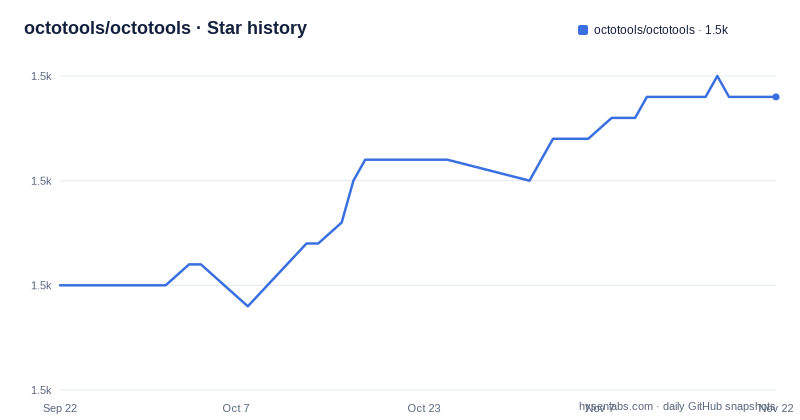
- octotools/octotools1,499 ★ · +9
| Repository | 2026-09-22 | 2026-11-22 |
|---|---|---|
| octotools/octotools | 1.5k | 1.5k |
9 Stars in the last 61 days, measured from the daily GitHub snapshot. Compare with other projects
Editorial analysis
The distribution is octotoolkit, the import package is octotools
The two names diverge at the packaging level. `pyproject.toml` names the distribution `octotoolkit`, and the project links point readers to pypi.org/project/octotoolkit, while the package that gets imported is the `octotools` directory at the repository root. Anyone writing a requirements line has to use the distribution name, and anyone writing an import has to use the other one. The manifest sets `requires-python` to `>=3.10` and carries only two classifiers, one for Python 3 and one for an operating system independent install, so nothing in the metadata states a tested upper bound on the interpreter. The version string is 0.3.6, and the repository publishes no GitHub releases at all, which means the manifest is the only place a version number appears. There is also no tag list to compare it against, so a mismatch between a published artifact and the repository state would not be visible from the project page.
One dependency file drives the install, and three announced backends sit commented out in it
Dependencies are declared as dynamic and read straight out of `requirements.txt` at build time, so that file is the install list. Three of the providers announced in the news section have their lines commented out.
# google-generativeai==0.8.5
google-genai
# litellm==2.1.1
# ollama==0.5.1
A plain install therefore brings in `anthropic==0.40.0`, `openai==1.75.0`, `together==1.5.4`, `google-genai` and `transformers`, plus the heavy extras that the task mix implies: `vllm==0.8.5`, `easyocr==1.7.2`, `metapub==0.5.12`, `pymed==0.8.9`, `wikipedia==1.4.0`, `exa-py`, `sympy`, `tenacity` and `diskcache`. There is no extras mechanism to leave them out. The single optional group is `dev`, which holds `black` and `isort` and nothing else, so the only supported way to skip a backend is to edit the requirement file yourself. For LiteLLM and Ollama, both announced as supported in mid 2025, the project page gives no install step of its own.
Every roadmap box is ticked and the one open item is inside a comment
The project keeps a TODO checklist under the news log, and all ten entries carry a checked box: Anthropic, Together AI, DeepSeek, Gemini, Grok, the PyPI release, vLLM, Azure OpenAI, LiteLLM and Ollama. The entry that is not done, support for MCP tools, is not left visible. It sits inside an HTML comment, so it does not appear when the file is rendered, and a reader browsing the page sees a list with nothing outstanding in it. A checklist that cannot be updated downward is a weak planning signal, and here the single remaining idea has to be edited out of its own comment marker to show up. The list also predates the recent history: the newest news entry is an April 2026 note about the paper being accepted at ACL 2026, and no checklist item was added for it.
The news log stops about a month before the last commit
The change log is dated rather than versioned. The first entry is a February 2025 arXiv preprint, followed by the PyPI release in April 2025, a community tutorial in May, a best paper award at a NAACL 2025 workshop, a third party re-implementation built on AutoGen, and then a run of backend additions through July 2025. The last entry is the April 2026 acceptance note. The last recorded commit on the default branch is dated 2026-05-02, so roughly a month of commits after the newest news item produced no log entry, and no release tag accompanies either. The 2026 acceptance is the project's own claim, and it points to the preprint at arxiv.org/abs/2502.11271 rather than to proceedings. The AutoGen re-implementation is a separate project by another author, which is useful context for reading the design but is not part of this package.
Training-free by declaration, with one component that learns a tool subset
The framework is described as training-free, and the architecture has three named parts. Tool cards encapsulate heterogeneous tools along with their usage metadata, and that is what makes a new tool addable without retraining or changing the framework. A planner works at two levels, one for the global objective and one for refining the next action. An executor turns a chosen tool into an executable command and writes the structured result into the context, and the final answer is summarized from the whole trajectory held there. The tension sits in the fourth item, a task specific toolset optimization algorithm that learns a beneficial subset of tools for a downstream task. Adding a tool needs no training, but selecting a subset is described as something learned, and the project page does not say whether that happens with gradient updates or at inference time.
The engine table and the news section describe different sets of models
The engine table has a multi-modal column and a text-only column per provider. OpenAI lists ten entries in the first column, including `o1`, `o3`, `o1-pro` and `o4-mini`, and four in the second. The Azure row repeats the OpenAI row minus `gpt-4-turbo` and otherwise identical, including the same text-only entries. The Anthropic row puts seven dated Claude models, from `claude-3-haiku-20240307` through `claude-3-7-sonnet-20250219`, in the multi-modal column and leaves the text-only column empty. The newest dated Claude entry is from February 2025, more than a year before the last commit, and the TogetherAI row stops partway through a model name. The paragraph above the table names GPT-4o, Claude 3.5 Sonnet and Gemini 1.5 Pro, while Gemini does not appear in the rows that are visible. The accuracy figures, 9.3 percent average gain over GPT-4o across 16 tasks and up to 10.6 percent over AutoGen, GPT-Functions and LangChain given the same tools, are stated on the project page and belong to the preprint.
The wheel carries one package and a license glob that matches two files
Package discovery is set to look in the repository root and include only names starting with `octotools`, so the `tasks`, `examples`, `tutorials` and `assets` directories stay out of the distribution. The license declaration is a glob, `LICEN[CS]E*`, and the repository root holds both `LICENSE` and `LICENSE-TASKS`, so both files match and both are declared, while the metadata still names a single MIT license and the packaging metadata contains nothing about which terms cover the `tasks` directory. That directory therefore has its own license file inside the repository and no statement of its terms in the published metadata. Two more files are worth noticing: `.env.template` sits at the root instead of a filled environment file, and `python-dotenv==1.0.1` is pinned in the requirements, so credentials are expected to arrive from the environment at run time. Formatting is fixed by configuration rather than by convention, with black at line length 88 targeting py310 and isort on the black profile.
Editorial conclusion
OctoTools fits a research group that wants to add a tool by writing a card and then read the same planner and executor loop, and it does not fit a production service that needs a light install, because there is no extras switch for the heavy backends and three of the announced providers are commented out in the only dependency file. Two things to verify before adopting it: the published version is 0.3.6 with no GitHub release to compare it against, and the accuracy figures on the project page come from a preprint, not from anything a reader can rerun here. If you are evaluating the tool subset optimization component, note that the framework is described as training-free while that component learns a subset, and the page does not settle how.
Frequently asked questions
What is the PyPI package name for OctoTools?
The distribution is named octotoolkit and the project links point to pypi.org/project/octotoolkit, while the importable package directory is octotools. The manifest version is 0.3.6 and the repository publishes no GitHub releases.
Does installing OctoTools pull in vLLM?
Yes. Dependencies are read from requirements.txt at build time, and that file pins vllm==0.8.5 and easyocr==1.7.2 as ordinary requirements. The only optional dependency group is dev, which contains black and isort, so there is no extras switch for the heavy backends.
Which OctoTools backends have their dependency lines commented out?
google-generativeai, litellm and ollama appear as commented lines in requirements.txt, while google-genai is active. The active pins also cover anthropic, openai and together.
How does OctoTools add a new tool?
A new tool is added by writing a tool card that holds the tool usage metadata, and the page describes this as integration without additional training or framework refinement. A planner picks the action at two levels and an executor generates the executable command and stores the structured result in the context.
What is the maintenance state of the OctoTools repository?
The repository is not archived and the last recorded commit on the default branch is dated 2026-05-02. It has no GitHub releases, and the newest entry in its news log is dated 2026-04-06.
Official sources
Add this badge to your README
If you maintain this project, the badge below links readers to this analysis and shows its maintenance status from the daily GitHub snapshot. Paste the markdown into your README; add ?metric=license or ?metric=stars to the image URL for a different field.

[](https://hysenlabs.com/projects/octotools-octotools)Star history chart for your README
[](https://hysenlabs.com/projects/octotools-octotools)Was this useful?