claude-elixir-phoenix: 26 agents and 26 Iron Laws, projected onto five agent runtimes
Claude Code plugin for Elixir/Phoenix/LiveView — 26 specialist agents, Iron Laws enforcement, and Tidewave MCP integration. Plan features with parallel research agents, execute with automatic verification, review with 4-agent parallel audits, and capture learnings as reusable knowledge.
At a glance
- What is it?
- The Elixir and Phoenix plugin for Claude Code, with the update trap that unloads all 36 commands, the five generated runtimes that each drop different features, and a Python scoring harness driving markdown skills from npm script names.
- Who is it for?
- Adopt this plugin if your team writes Elixir with Phoenix, LiveView, Ecto or Oban and wants the three failure modes it names, assign_new skipping on reconnect, floats in money fields and non-idempotent jobs, checked mechanically before they reach review.
- Can I use it commercially?
- Yes. MIT is a permissive licence: you can use, modify and sell software built on it, as long as you keep its copyright and licence notices.
- Is it still maintained?
- Yes. The repository last received commits 2 days ago.
- What is it written in?
- Mainly Python, according to GitHub's language statistics.
Answers come from the project's GitHub data, last synced on November 15, 2026, and from our analysis. They are not legal advice.
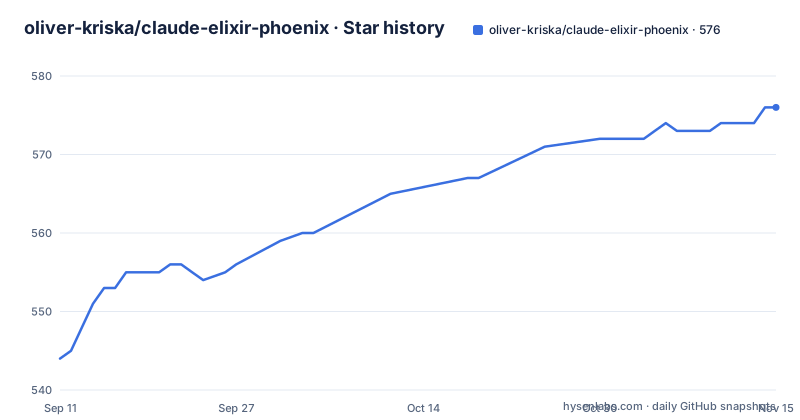
Star history
- oliver-kriska/claude-elixir-phoenix576 ★ · +32
| Repository | 2026-09-11 | 2026-11-15 |
|---|---|---|
| oliver-kriska/claude-elixir-phoenix | 544 | 576 |
32 Stars in the last 65 days, measured from the daily GitHub snapshot. Compare with other projects
Editorial analysis
Updating by itself unloads every /phx command and the fix is an order
The upgrade note is the most useful paragraph in the page. v3 declared two compatibility plugins, ecto and lv, that v2 never declared, and `claude plugin update` does not install dependencies a new version newly declares. The result is not a partial degradation: the updated plugin fails to load entirely, and you lose all 36 `/phx:*` commands rather than just the two compatibility namespaces that were missing. The documented recovery is four commands in a fixed sequence, marketplace update, then the ecto plugin, then the lv plugin, and only then the update of elixir-phoenix itself.
claude plugin marketplace update oliver-kriska
claude plugin install ecto@oliver-kriska
claude plugin install lv@oliver-kriska
claude plugin update elixir-phoenix@oliver-kriska
Claude Code has to be restarted afterward, and in an already-open session `/reload-plugins` is what picks up new skills, agents and hooks. The verification the page asks for is concrete: check that `/phx:help`, `/ecto:n1-check` and `/lv:assigns` all appear before going further.
The install name is elixir-phoenix while every command stays under /phx
The naming split is deliberate and documented. The plugin installs as `elixir-phoenix`, yet its public workflow commands remain `/phx:*`, because Claude Code namespaces commands by the manifest name and not by the install name. Anyone scripting against command names has to know both. A fresh install also drags in two small compatibility namespaces for `/ecto:*` and `/lv:*` without a separate install step, which is the same pair that the v3 upgrade note asks you to install by hand. The stated floor is Claude Code 2.1.110 or newer, and after any update `/reload-plugins` is a prerequisite for the commands appearing in a session that is already open. The workflow surface itself is three commands in the common path: `/phx:plan` writes a plan into a directory under .claude/plans/, `/phx:work` takes that plan file and implements it task by task, compiling after each change, and `/phx:review` runs four specialist audits in parallel over idioms, security, tests and compilation.
Five runtimes get the same 51 skills and a different subset of everything else
v3.0.0 generated distributions for five hosts from one canonical tree, and the page is careful to separate skills from capabilities. All 51 skills, covering Elixir, Phoenix, LiveView, Ecto, Oban, testing and security, are projected to Amp, Codex, Pi, OpenCode and DeepSeek Harness. What varies is everything around them. Codex ships a trust-gated destructive-command safeguard but intentionally omits custom agents and leaves Tidewave MCP registration external. Pi omits extensions, prompt templates, MCP and custom agents entirely for now, and works with Tidewave only when the host exposes it on its own. DeepSeek Harness also drops hooks and custom agents, loads a skill when a `/phx-investigate` or `/phx-review` token appears anywhere in the message, and reads CLAUDE.md natively. OpenCode is described from a tested 1.17.2 setup where the skills also appear as slash commands. Amp is the broadest non-Claude target, adding 40 deterministic workflow wrappers, five read-only agents and native PR watch handling. The stated caveat is that only nine workflows are fully adapted, the six flagship lifecycle ones plus phx-trace, phx-audit and phx-research.
The root package.json is the Pi target's manifest and it is marked private
The manifest sitting at the repository root is not the Claude Code plugin manifest. Its name is `pi-elixir-phoenix`, its description says generated skills for Pi, and it registers a single entry pointing at `./targets/pi/skills` under a `pi` key. The Claude Code manifest lives under .claude-plugin/ instead, so there are two packaging identities in one tree and only one of them is the file most tooling looks at. It also carries `"private": true`, which closes off npm publishing for that target regardless of intent. Version 3.1.3 in this file matches the v3.1.3 tag dated 2026-09-29, whose release note is about readiness for the Anthropic plugin directory, and the version before it, v3.1.2, is named for Claude Code 2.1.284 and 5.5-model compatibility. One dependency override is pinned here: js-yaml is forced to 5.4.1 underneath markdownlint-cli, so a transitive pin is being corrected in the root manifest rather than upstream.
Markdown skills are scored by a Python harness reached through npm script names
The payload is prose, but the test suite is Python, which is why requirements.txt exists in a plugin repository. It holds exactly two entries for the lab/eval scoring framework, PyYAML and pytest, and the test script is `python3 -m pytest lab/eval/tests/ scripts/tests/ -v`, run through npm rather than make. Around it sit eight eval scripts that are all thin wrappers over one shell entry point, differing only in the flag passed: `--changed` for the quick lint plus score of changed skills and agents, then `--all`, `--skills`, `--agents`, `--triggers`, `--fix` and `--ci`. The Makefile describes what those flags mean, and its eval-full target is the one with a number attached: structural plus a fresh behavioral gate where every skill must reach 75%, described as taking roughly sixty minutes. Its help target greps its own .PHONY list to print the commands, and that list also carries a runtime-smoke target per host, from amp-runtime-smoke through dsh-runtime-smoke, plus snapshot, security and budget targets.
The 26 laws are named after three production bugs, and work halts on them
The pitch is specific about which mistakes it is trying to catch, and the three it names are all invisible at compile time: `assign_new` silently skipping on reconnect, a `:float` corrupting money fields, and an Oban job that is not idempotent. The count summary at the top of the page puts the plugin at 26 specialist agents, 51 skills, 140 references, 30 hook registrations and 26 Iron Laws, so the laws are roughly one per agent. The workflow behaviour is stated as a hard stop rather than a warning: `/phx:work` implements the plan task by task and compiles after each change, and it stops cold if the code violates an Iron Law, which means a rule breach ends the run instead of producing a note for later. Hooks are the mechanism that makes the rules apply to files nobody is currently editing, with 30 registrations doing that work and HOOKS.md holding the reference; the generated runtimes that omit hooks lose exactly that part, which is why Amp is described as carrying native edit and verification guards.
Tidewave MCP is the capability that survives in the fewest hosts
Of everything the plugin carries, the Tidewave MCP integration is the piece with the widest spread of outcomes. On Claude Code it is part of the plugin. On Codex and on DeepSeek Harness the page says registration remains external, meaning the plugin will not perform it for you. On Pi, MCP is one of the capabilities intentionally not included yet, with Tidewave usable only when the Pi host exposes it independently. The generated skill distributions therefore cover the same 51 skills everywhere, and the surrounding runtime story has to be read host by host. The page points at docs/runtime-support.md as the canonical matrix for comparing native invocation, installation and deferred capabilities, and states in the same breath that support for generated skills does not imply feature parity with the full Claude Code plugin. Two lines of the repository reinforce the pattern: SECURITY.md sits next to CHANGELOG.md and HOOKS.md at the root, and CLAUDE.md is what the DeepSeek Harness target reads natively.
Editorial conclusion
Adopt this plugin if your team writes Elixir with Phoenix, LiveView, Ecto or Oban and wants the three failure modes it names, assign_new skipping on reconnect, floats in money fields and non-idempotent jobs, checked mechanically before they reach review. Treat the runtimes other than Claude Code as skill distributions rather than equivalents, because the same page states that custom agents, hooks and MCP registration vary and that nine workflows are fully adapted out of the larger set. Before you install over an existing setup, read the v3 upgrade note, because the update command on its own leaves you with a plugin that loads no commands at all, and install the ecto and lv compatibility plugins in the documented order first.
Frequently asked questions
How do you install the claude-elixir-phoenix plugin into Claude Code?
Add the marketplace with `/plugin marketplace add oliver-kriska/claude-elixir-phoenix`, then run `/plugin install elixir-phoenix`. Claude Code 2.1.110 or newer is required, the install name stays elixir-phoenix while the commands stay under `/phx:*`, and two compatibility namespaces for `/ecto:*` and `/lv:*` arrive with a fresh install.
Why did claude plugin update break the Elixir Phoenix plugin?
v3 declared two compatibility plugins, ecto and lv, that v2 never had, and `claude plugin update` does not install dependencies a new version newly declares. The plugin then fails to load entirely and all 36 `/phx:*` commands disappear. The recovery order is marketplace update, install ecto, install lv, then update elixir-phoenix.
How many agents, skills and rules does claude-elixir-phoenix ship?
The count summary on the page lists 26 specialist agents, 51 skills, 140 references, 30 hook registrations and 26 Iron Laws, with the skills spanning Elixir, Phoenix, LiveView, Ecto, Oban, testing and security.
Does claude-elixir-phoenix work outside Claude Code?
It generates skill distributions for Amp, Codex, Pi, OpenCode and DeepSeek Harness, all 51 skills each. Custom agents, hooks and MCP vary by runtime, only nine workflows are fully adapted, being the six flagship lifecycle ones plus phx-trace, phx-audit and phx-research, and the page states that skill support does not imply feature parity.
What happens to Tidewave MCP in the Codex, Pi and dsh targets?
On Codex and DeepSeek Harness, Tidewave MCP registration remains external and the plugin does not perform it. On Pi, MCP is not included yet and Tidewave works only when the host exposes it independently.
Official sources
Add this badge to your README
If you maintain this project, the badge below links readers to this analysis and shows its maintenance status from the daily GitHub snapshot. Paste the markdown into your README; add ?metric=license or ?metric=stars to the image URL for a different field.

[](https://hysenlabs.com/projects/oliver-kriska-claude-elixir-phoenix)Star history chart for your README
[](https://hysenlabs.com/projects/oliver-kriska-claude-elixir-phoenix)Was this useful?