Onsen UI builds hybrid apps and PWAs on Web Components, but its newest tagged release dates from December 2022
Mobile app development framework and SDK using HTML5 and JavaScript. Create beautiful and performant cross-platform mobile apps. Based on Web Components, and provides bindings for Angular 1, 2, React and Vue.js.
At a glance
- What is it?
- Onsen UI is a framework agnostic mobile UI library with iOS flat and Android Material styling and bindings for React, Angular, Vue and AngularJS. The component model is sound; the release cadence, the browser matrix and the license metadata need checking before you commit to it.
- Who is it for?
- Onsen UI suits teams building a Cordova hybrid app or a PWA that must look native on both iOS and Android from one codebase, especially if they already work in React, Vue or Angular. Teams that need recent tagged releases, a confirmed license for the published package, or tested support beyond Chrome, Safari, Android 4.4.4+ and iOS 9+ should verify those points first, because the newest tagged release is 2.12.8 from 2022-12-27.
- Can I use it commercially?
- Not without permission. GitHub finds no licence file in the repository, and without a licence all rights are reserved by default: you may read the code but not reuse it. Check the README, or ask the authors, before using it.
- Is it still maintained?
- Yes. The repository last received commits 151 days ago.
- What is it written in?
- Mainly JavaScript, according to GitHub's language statistics.
Answers come from the project's GitHub data, last synced on November 15, 2026, and from our analysis. They are not legal advice.
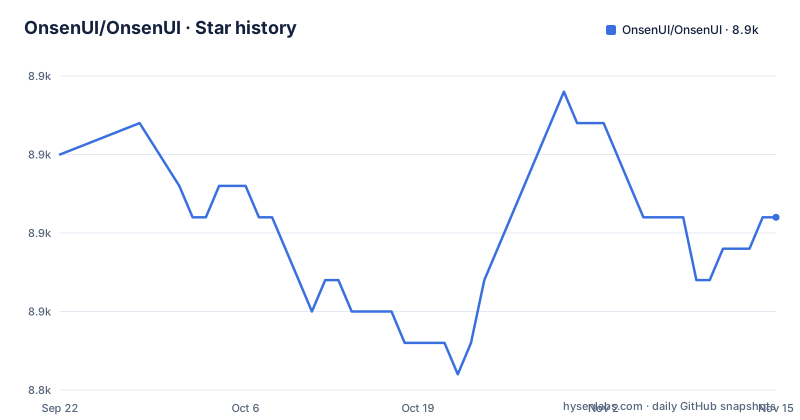
Star history
- OnsenUI/OnsenUI8,853 ★ · -2
| Repository | 2026-09-22 | 2026-11-15 |
|---|---|---|
| OnsenUI/OnsenUI | 8.9k | 8.9k |
-2 Stars in the last 54 days, measured from the daily GitHub snapshot. Compare with other projects
Editorial analysis
Pure CSS components with custom elements layered on top
Onsen UI splits its widgets into two layers. The CSS components, offered in both flat (iOS) and Material Design variants, are plain CSS with no JavaScript behavior. Interactive details such as dragging and the ripple effect come from Onsen UI custom elements, which are written in pure JavaScript on top of Web Components. Because that core does not depend on a framework, the same elements work in a page with no framework at all, and the official guides include a core guide (no framework) and a jQuery guide next to the framework ones. Styling can follow the platform automatically: the components are optionally auto-styled, so one source tree renders as flat on iOS and Material on Android. If you only want the look and not the behavior, the CSS layer can be used on its own, but then gestures and ripples are your job.
Each framework binding is a separate npm package
The core library installs from npm:
npm install onsenuiThat pulls only the core. Framework support is a second install: react-onsenui, vue-onsenui, ngx-onsenui for Angular 2+, or angularjs-onsenui for AngularJS 1.x. The same files are also served from unpkg, jsDelivr and cdnjs, and the package is published to jspm as well. Tagged builds with a changelog live in a separate distribution repository, OnsenUI/OnsenUI-dist, rather than in this monorepo. A project that mixes a CDN script tag for the core with an npm install of a binding has to keep the two versions aligned by hand, since they arrive through different channels.
The monorepo treats Vue 2 and Angular differently from React and Vue 3
The root package.json is a private package named onsenui-monorepo. Its workspaces are onsenui, react-onsenui, react-onsenui-examples, vue3-onsenui, vue3-onsenui-examples, vue-onsenui-examples and css-components-previewer. The Vue 2 bindings in vue-onsenui are not a workspace; a postinstall hook runs cd vue-onsenui && npm install, and the build:vue and watch:vue scripts also cd into that folder instead of using --prefix. ngx-onsenui sits at the top level but appears in neither the workspaces nor any root script, so contributors patching the Angular bindings get no root shortcut for building or testing them. The root test script only runs npm run --prefix onsenui test, with test:react as the one binding that has its own entry. No angularjs-onsenui folder appears among the top-level entries at all.
Commits continue while tagged releases stopped at 2.12.8
The three most recent tagged releases are 2.12.6 on 2022-10-17, 2.12.7 on 2022-12-27 at 07:58 UTC, and 2.12.8 about half an hour later the same day. The last push to the master branch was on 2026-06-17, so work landed in the repository long after the last tag. The consequence for users is a choice between two imperfect options. Pinning to 2.12.8 gives you a release with a changelog that is close to four years old. Taking the latest development build from onsenui.github.io/latest-build gets you newer code, but the project itself warns that it might be unstable sometimes, even if most of it is already tested. Anyone who needs a fix that landed after December 2022 should read the CHANGELOG.md on master and decide whether a development build is acceptable in production.
The tested browser list is short and old
Onsen UI states that it is tested on Android 4.4.4 and later, iOS 9 and later, Chrome and Safari. That is the whole list. Firefox, Edge and other engines are not named, which means a PWA aimed at desktop users on those browsers has no stated coverage and you carry the testing yourself. The minimum versions also describe a floor rather than a ceiling: the list does not say which recent iOS or Android releases were verified against 2.12.8. For a hybrid app wrapped in Cordova the target is the platform WebView, so the Android and iOS lines matter most; for a PWA served to the open web, the gaps in the list matter more.
Aurelia and Ember bindings come from outside the core team
The four first party bindings are React, Angular 2+, Vue and AngularJS 1.x. Aurelia and EmberJS support exists through community packages, aurelia-onsenui and ember-onsenui on npm, which the project marks as not tested or implemented by the core team. If your app is on either framework, the binding's quality and compatibility with the current core rest with the package author rather than with the Onsen UI team. Teams on those stacks can still use the core custom elements directly, since the core is framework agnostic, and skip the community wrapper.
Monaca wraps the Cordova build and debug loop
The Onsen UI team also builds Monaca, a toolkit for PhoneGap and Cordova apps with Onsen UI templates, a debugging suite, push notifications, remote build, back-end services, encryption, version control and continuous integration. It comes as a Cloud IDE, a Localkit GUI and a CLI:
$ [sudo] npm -g install monaca
$ monaca create helloworld # And choose the starter template
$ monaca preview # Preview on the browser
$ monaca debug # Preview on a real device
$ monaca remote build --browser # Production build on the cloud
The last command sends the production build to Monaca's cloud, so teams with rules about where source code may be built need to clear that step first. Monaca is installed on its own with npm -g, separately from the onsenui package.
The license is not visible from the repository metadata
The repository metadata reports no recognized license. The only license field in view is "ISC" in the root package.json, and that file describes the private onsenui-monorepo wrapper, which is never published. Before shipping Onsen UI inside a commercial app, check the license terms that ship with the onsenui package you install from npm or the distribution repository, rather than relying on the monorepo field.
Editorial conclusion
Onsen UI suits teams building a Cordova hybrid app or a PWA that must look native on both iOS and Android from one codebase, especially if they already work in React, Vue or Angular. Teams that need recent tagged releases, a confirmed license for the published package, or tested support beyond Chrome, Safari, Android 4.4.4+ and iOS 9+ should verify those points first, because the newest tagged release is 2.12.8 from 2022-12-27.
Frequently asked questions
What is Onsen UI?
Onsen UI is an open source framework for building native-feeling Progressive Web Apps and hybrid apps. Its core is pure JavaScript on Web Components, with binding packages for React, Angular 2+, Vue and AngularJS 1.x.
What can replace Onsen UI or sit beside it?
The Onsen UI README does not compare itself with other frameworks. Its CSS components can be used without the custom elements, and community packages cover Aurelia and EmberJS, though the core team does not test those.
Is Onsen UI a good UI library for mobile?
Onsen UI fits mobile web and hybrid apps that need iOS flat and Android Material designs from one source tree. It is tested on Android 4.4.4+, iOS 9+, Chrome and Safari, and its newest tagged release is 2.12.8 from 2022-12-27.
Official sources
Add this badge to your README
If you maintain this project, the badge below links readers to this analysis and shows its maintenance status from the daily GitHub snapshot. Paste the markdown into your README; add ?metric=license or ?metric=stars to the image URL for a different field.

[](https://hysenlabs.com/projects/onsenui-onsenui)Star history chart for your README
[](https://hysenlabs.com/projects/onsenui-onsenui)Was this useful?