Tart: Apple Silicon VMs that travel through an OCI registry
macOS and Linux VMs on Apple Silicon to use in CI and other automations
At a glance
- What is it?
- Tart is a Swift virtualization toolset from OpenAI for building, running and managing macOS and Linux VMs on Apple Silicon, aimed at CI automation. The parts that decide whether it fits your fleet are the host requirement, the 25 GB image, and the Packer plugin.
- Who is it for?
- Tart fits teams whose CI already runs on Apple Silicon Macs and whose macOS or Linux test jobs should arrive as a versioned artifact rather than a hand built image. It does not fit Intel Macs, non-Mac hosts, or pipelines that need to bake their own guest without adding the Packer plugin.
- Can I use it commercially?
- Check first. The repository uses a licence we do not classify automatically, so read its LICENSE file before any commercial use.
- Is it still maintained?
- Yes. The repository last received commits 3 days ago.
- What is it written in?
- Mainly Swift, according to GitHub's language statistics.
Answers come from the project's GitHub data, last synced on November 15, 2026, and from our analysis. They are not legal advice.
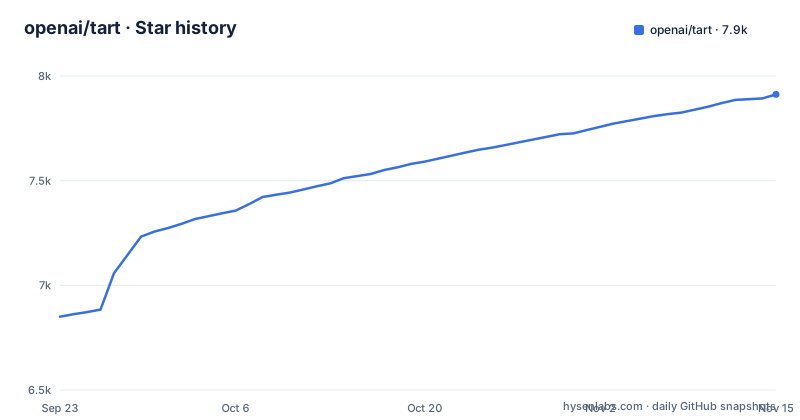
Star history
- openai/tart7,912 ★ · +1,062
| Repository | 2026-09-23 | 2026-11-15 |
|---|---|---|
| openai/tart | 6.9k | 7.9k |
1,062 Stars in the last 53 days, measured from the daily GitHub snapshot. Compare with other projects
Editorial analysis
Apple Silicon and macOS 13.0 are hard prerequisites
Tart opens with a host requirement that eliminates most machines before any feature discussion. The README asks for an Apple Silicon device running macOS 13.0 (Ventura) or later, and the three commands it offers assume that machine is already in front of you:
brew install openai/tools/tart
tart clone ghcr.io/cirruslabs/macos-tahoe-base:latest tahoe-base
tart run tahoe-base
Intel Macs and non-Mac hosts are not part of that picture. For a CI team the consequence is direct: the runner that executes a Tart job has to be a Mac on Apple silicon, which is why the tool is described as built by CI engineers for automation needs rather than as a desktop hypervisor for everyone. Note also that macOS 13.0 is the host floor, and it is a separate thing from the guest image you clone later.
The 25 GB image is the first cost a clean runner pays
The first run is dominated by a download, and the README flags its size rather than hiding it. The clone step pulls a base image from a container registry, and that image is 25 GB. In CI this is not a one time cost on a laptop, it is a per machine or per job cost on fresh macOS runners, so image caching or a pre-warmed runner pool matters more here than it would for a small tool.
The tag in the example is :latest, so what a job receives is whatever the registry serves at clone time rather than a fixed digest you can trace. The destination name, tahoe-base, is local to your run: the registry path and the local name are separate arguments, so a pipeline can clone under whatever name its stages agree on without renaming the upstream image.
Virtualization.framework is both the performance story and the ceiling
Everything rests on one framework. Tart uses Apple's Virtualization.framework, and the README backs its near-native performance claim by linking a Geekbench v5 comparison page instead of quoting a figure in prose.
Two consequences follow. First, the same tool handles both guest families the project names, macOS and Linux virtual machines, because the virtualization layer belongs to Apple rather than to a bundled third party hypervisor. Second, that dependency is also the ceiling. Tart targets Apple Silicon only, so a benchmark link that reads as a portable performance argument belongs to a tool that cannot leave the platform. The repository reflects how seriously that is taken: benchmark/ and PROFILING.md both sit at the top level, next to Tests/ and integration-tests/, so measurement is part of the tree rather than an afterthought.
Pulling VMs from a registry puts someone else's tag on your critical path
Distribution is the part that changes how a fleet is built. Virtual machines can be pushed and pulled from any OCI-compatible container registry, so the machine image becomes an artifact you version and move with the same machinery you already use for containers. The example leans on a public one, ghcr.io/cirruslabs/macos-tahoe-base.
For a team, that moves the registry onto the critical path. A runner needs credentials and network reach to pull a base before anything runs, and the base itself is a shared dependency you did not build. A new tag published upstream reaches your jobs without a code review on your side, which is exactly why pinning the example's :latest to something immutable is the first adjustment most pipelines need.
Image creation is delegated to a Packer plugin, not to Tart itself
Building machines is split off from running them. One of the four highlights is a Tart Packer Plugin to automate VM creation, which keeps two jobs apart: Tart runs and manages machines, while the plugin bakes them.
Read the quickstart against that split and the gap is visible. Install, clone, and run are all Tart commands, and none of them constructs a guest image. If your workflow needs a customized guest, the README's route is the Packer plugin, which adds a tool to the chain and another version that can drift from the Tart binary. For a new user the honest reading is that the documented path assumes a base image already exists in a registry, and leaves every customization decision to the plugin.
A Swift tree with goreleaser plumbing and Cirrus as its CI
The layout tells you where the effort goes. The source is Swift: Package.swift and Package.resolved sit beside Sources/, Tests/, and Resources/, with actool.sh at the top level. Release plumbing is .goreleaser.yml, the Go tool, which is how a Swift project gets binaries out to installers.
Continuous integration is Cirrus, visible in .cirrus.yml and a .ci/ directory, and the example base image also sits under the cirruslabs registry namespace, so the same ecosystem supplies the CI and the image. Documentation has a home in docs/ with mkdocs.yml publishing tart.run, and the official documentation plus GitHub discussions are the two places the README sends remaining questions. CONTRIBUTING.md is in the top-level tree.
Four days, three releases, and a license nobody states
Two things deserve a decision before adoption, and they are the release rhythm and the license.
The rhythm is fast. Version 2.40.1 shipped on 2026-09-30, 2.41.0 on 2026-10-13, and 2.41.1 on 2026-10-15, with the last push to main landing on 2026-10-30. Three releases in about two weeks means a floating version in a CI definition will change under you between runs, so pin an exact release. The license is quieter: repository metadata records it as unasserted, the README carries no license section at all, and a LICENSE file does sit at the top level of the tree. The README's company list, from Atlassian and Figma to Mullvad and Cirrus CI, tells you who uses Tart in their internal setups but not the terms, so read that file yourself before pointing it at anything sensitive.
Editorial conclusion
Tart fits teams whose CI already runs on Apple Silicon Macs and whose macOS or Linux test jobs should arrive as a versioned artifact rather than a hand built image. It does not fit Intel Macs, non-Mac hosts, or pipelines that need to bake their own guest without adding the Packer plugin. Before you commit, read the LICENSE file, since the README states no terms and the license field on GitHub comes back unasserted, and pin an exact Tart version, because 2.40.1, 2.41.0 and 2.41.1 landed within about two weeks.
Frequently asked questions
How to install tart?
Run brew install openai/tools/tart, then tart clone ghcr.io/cirruslabs/macos-tahoe-base:latest tahoe-base followed by tart run tahoe-base. The clone step pulls a 25 GB image from the registry.
What is macOS tart?
Tart is a virtualization toolset to build, run and manage macOS and Linux virtual machines on Apple Silicon. It runs on Apple's Virtualization.framework and was built by CI engineers for automation needs.
What hardware does Tart need to run a VM?
An Apple Silicon device running macOS 13.0 (Ventura) or later. Tart is built on Apple's Virtualization.framework, and the README links a Geekbench v5 comparison page for the near-native performance claim.
How does Tart move virtual machines between machines?
Tart pushes and pulls virtual machines from any OCI-compatible container registry. The quickstart pulls a public base image from ghcr.io/cirruslabs/macos-tahoe-base.
Does Tart build its own VM images?
The README points to a Tart Packer Plugin to automate VM creation. The three documented commands cover install, clone and run, so image building sits outside that flow in the plugin.
How often does Tart ship new releases?
Version 2.40.1 landed on 2026-09-30, 2.41.0 on 2026-10-13 and 2.41.1 on 2026-10-15, and the last push to the main branch was 2026-10-30.
Official sources
Add this badge to your README
If you maintain this project, the badge below links readers to this analysis and shows its maintenance status from the daily GitHub snapshot. Paste the markdown into your README; add ?metric=license or ?metric=stars to the image URL for a different field.

[](https://hysenlabs.com/projects/openai-tart)Star history chart for your README
[](https://hysenlabs.com/projects/openai-tart)Was this useful?