OpenIPC: rebuilding IP camera firmware on Buildroot, one chip vendor at a time
Alternative IP Camera firmware from an open community
At a glance
- What is it?
- An open firmware alternative for consumer IP cameras that ports the same Linux stack onto fifteen SoC families, distributed as nightly builds with a web interface checksum.
- Who is it for?
- OpenIPC is for someone who bought an IP camera on the promise of local video and watched the vendor page go dead, or who needs an RTSP stream that does not depend on a cloud account. The same firmware lineage now spans fifteen chip vendors because each `br-ext-chip-*` directory carries one vendor's toolchain, bootloader and defconfig, and that repetition is the real maintenance cost.
- Can I use it commercially?
- Yes. MIT is a permissive licence: you can use, modify and sell software built on it, as long as you keep its copyright and licence notices.
- Is it still maintained?
- Yes. The repository received new commits within the last day.
- What is it written in?
- Mainly C, according to GitHub's language statistics.
Answers come from the project's GitHub data, last synced on October 23, 2026, and from our analysis. They are not legal advice.
Star history
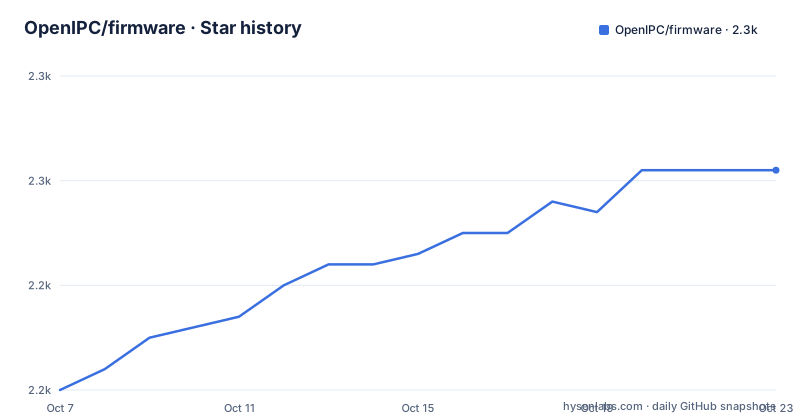
- OpenIPC/firmware2,251 ★ · +21
| Repository | 2026-10-07 | 2026-10-23 |
|---|---|---|
| OpenIPC/firmware | 2.2k | 2.3k |
21 Stars in the last 16 days, measured from the daily GitHub snapshot. Compare with other projects
Editorial analysis
The tree is a list of chip vendors, which is the whole design
Most firmware projects have one port layer. OpenIPC has fifteen. The repository root is almost entirely vendor directories named `br-ext-chip-*`: allwinner, ambarella, anyka, fullhan, goke, grainmedia, hisilicon, ingenic, novatek, rockchip, sigmastar, ti and xiongmai, alongside `general/` for shared configuration and `contrib/` for additional pieces.
The naming convention is the documentation. `br-ext-` means Buildroot external tree, which is Buildroot's mechanism for holding out-of-tree package recipes and board definitions. Each vendor directory supplies the pieces that differ per silicon: a cross toolchain, a bootloader or U-Boot configuration, and defconfigs naming the exact boards that vendor's parts appear on.
The history in the README explains why the list grew. OpenIPC originally supported only HiSilicon, the vendor behind a large share of the cheap cameras sold in the 2010s, and the community added vendors one at a time as people reported working hardware. That progression, from one SoC family to fifteen, is the clearest statement of what this project actually is: not a camera application but a way to put the same Linux userland onto whatever chip a camera happened to ship with.
The topic list on the repository matches those directories, and adds `fpv` and `flyrouter`, which are the hobbyist communities that arrive with entirely different requirements from a home security user.
Selecting a board through the Makefile before anything builds
The Makefile pins Buildroot to a specific release and makes the board a required input. It defines the Buildroot version as 2024.02.10, downloads the matching tarball, and passes `BR2_EXTERNAL` pointing at the `general/` directory so that OpenIPC's packages and board definitions are visible to the build system.
Board discovery is done by listing defconfigs and filtering. With no `BOARD` set, the Makefile searches for defconfig files under the vendor directories, sorts them, and formats the vendor and board name for display:
LIST := $(shell find ./br-ext-*/configs/*_defconfig | sort | \
	sed -E "s/br-ext-chip-(.+).configs.(.+)_defconfig/'\2' '\1 \2'/")
CONFIG := $(shell find br-ext-*/configs/*_defconfig | grep -m1 $(BOARD))
If neither the goal nor `BOARD` is set, it falls back to a `whiptail` dialog titled Available boards, which is a curses-based TUI selector. So there are two ways in: pass `BOARD` for scripted or CI builds, or run the target with no arguments and pick from the menu.
Once a config is found, the Makefile includes it, and the `repack` goal additionally includes the vendor defconfig. The `build` target depends on `defconfig` and then invokes Buildroot's own `all`, which is where the cross-compilation actually happens. The output directory defaults to `output` in the working tree.
A comment in the Makefile that documents a real compiler breakage
The clearest sign that this repository is maintained by people who build it is the comment above the host compiler flags. It explains that GCC 15 changed the default dialect to `gnu23`, where an empty parameter list means a function takes no arguments rather than an unspecified argument list.
Several host packages that Buildroot pins predate that change, and their configure probes stop compiling. The example given is gmp 6.3.0, which fails its compiler test with a `too many arguments to function 'g'` error. The visible symptom is far less helpful: the build reports that it could not find a working compiler and halts any `make toolchain` on a current distribution.
The fix is to pin the dialect rather than bump every affected host package:
HOST_CFLAGS ?= -O2 -std=gnu17The comment is careful about scope. It applies only to host C builds, is overridable from the environment, and is a no-op on hosts whose GCC still defaults to `gnu17`. It also notes the specific reason the `prepare:` rule has to enforce that boundary, because Buildroot appends `HOST_CFLAGS` to `HOST_CXXFLAGS` wholesale, so the setting leaks unless it is handled deliberately.
This is the kind of comment that saves a newcomer an afternoon. It states the failure, the misleading error, the cause, and the constraint on the fix, which is more than most project documentation manages for a single compiler flag.
Nightly releases that carry a commit, a timestamp and a checksum
The release naming is unusual and worth reading carefully, because it changes what a version number means. Alongside tags called `nightly` and `latest`, the project publishes dated tags of the form `nightly-20260928-c06dd2b`.
The body of a nightly tag is machine-readable rather than prose. The `nightly-20260928-c06dd2b` tag, published 2026-09-28, records the full commit SHA, a short SHA of `c06dd2b`, a `built_at` timestamp of 2026-09-28T17:36:09Z, and a `webui` key holding a SHA-256 digest of the bundled web interface.
short=c06dd2b built_at=2026-09-28T17:36:09Z webui=sha256:5dbbec9550b6f41e80b091bb635e72a11a09f899945aaf34b8ebc32ff7003e16 ```
Two things follow from that. There is no semantic version, so there is no compatibility promise between releases; a nightly is whatever the build produced at that commit. And the web interface digest means the bundled web UI can be verified independently of the firmware image, which matters because the UI is the part people most often want to replace or upgrade.
The `latest` tag is the odd one out. It was published on 2021-04-17 and has no body at all, which suggests it is a stable pointer that stopped moving years ago, while the dated nightly tags carry the real cadence. The last push was on 2026-09-28, the same day as the most recent dated nightly, so the build pipeline and the source tree are running together.
If you are pinning a camera in production, pin a dated nightly by SHA and record the digest. Do not rely on `latest`.
Community support, commercial support, and where the money goes
The README describes a two-tier support model explicitly. The first is free community support through the project's chat channel on Telegram. The second is paid commercial support from the team of developers, positioned for people using OpenIPC in a product, with the promise that bug reports and feature requests from paying customers get prioritised attention and expedited solutions.
This is worth reading as a design constraint rather than a sales page. Flashing firmware onto hardware that has no recovery path, for fifteen different chip vendors, is expensive to support. The community tier covers the hobbyist case; the paid tier funds the per-vendor porting work that keeps a fifteen-vendor project alive.
There is also an Open Collective for financial contributions, a PayPal link in the link definitions, and a mailto address at [email protected] for commercial enquiries. The project has a website at openipc.org and a separate wiki repository at github.com/openipc/wiki, which is where per-model instructions live rather than in the firmware repository.
The licence is MIT, which is a permissive choice that matters if you are building a product on top of a flashed camera. That is a point about redistribution rights rather than a recommendation, and it says nothing about the legality of modifying the firmware on hardware you own in your jurisdiction.
Contribution rules written for humans and coding agents alike
The repository contains `CLAUDE.md` and an identical `AGENTS.md`, plus `best_practices.md` and a machine-readable `pr_compliance_checklist.yaml`. The README explains the arrangement: `CLAUDE.md`, also readable as `AGENTS.md`, explains how the tree is put together, which changes belong in this repository and which belong in another one, and how to check your work, for contributors and for any AI assistant coding alongside them.
That last clause is unusual and informative. It tells you the maintainers hit the problem where an automated assistant confidently files a change against the wrong repository, because OpenIPC spans several: the firmware tree here, the wiki, the separate `.github` organisation holding assets, and the website. The distinction between what belongs where is the kind of institutional knowledge that only lives in a project's head until somebody writes it down.
The review standards live in `best_practices.md` and the enforcement shape is a `pr_compliance_checklist.yaml` checked by the pull request tooling, with a `.pr_agent.toml` configuring it. For a fifteen-vendor porting project, this is the mechanism that keeps a change to one vendor's defconfig from quietly breaking another.
There is also an `.editorconfig`, which is a small signal about how much of the tree is shared between fifteen vendor directories. Consistent whitespace across that much duplication is not a nicety; it is what makes a cross-cutting change reviewable at all.
Editorial conclusion
OpenIPC is for someone who bought an IP camera on the promise of local video and watched the vendor page go dead, or who needs an RTSP stream that does not depend on a cloud account. The same firmware lineage now spans fifteen chip vendors because each `br-ext-chip-*` directory carries one vendor's toolchain, bootloader and defconfig, and that repetition is the real maintenance cost. Two practical notes before you start. Flashing is a hardware action on a device with no undo, so read the wiki page for your exact model rather than treating this as a generic Buildroot project. And the release tags are machine-shaped: `nightly` and dated builds carry a commit SHA, a build timestamp and a web interface checksum, which means you can verify what you installed if you record the tag. Begin by identifying your SoC, then use the Makefile's board selector, which needs a `BOARD` variable or falls back to an interactive whiptail menu.
Frequently asked questions
What does OpenIPC do for an IP camera?
It provides alternative open source firmware for consumer IP cameras, built on Buildroot, so the camera runs a Linux userland you control instead of the vendor image. Once flashed, you get local network access and RTSP streaming without depending on the vendor's cloud service staying online.
Which camera chipsets does OpenIPC support?
Support started with HiSilicon and expanded to Ambarella, Anyka, Fullhan, Goke, GrainMedia, Ingenic, MStar, Novatek, SigmaStar and XiongMai. The repository root carries one br-ext-chip directory per vendor, each holding that vendor's toolchain, bootloader configuration and board defconfigs, and the README expects the list to keep growing.
How do I know which OpenIPC nightly build I installed?
Dated nightly tags such as nightly-20260928-c06dd2b carry a body recording the full commit SHA, the short SHA, the build timestamp and a SHA-256 digest of the web interface. Record that tag when you flash, since the project publishes dated nightlies rather than semantic versions and there is no compatibility promise between them.
Official sources
Add this badge to your README
If you maintain this project, the badge below links readers to this analysis and shows its maintenance status from the daily GitHub snapshot. Paste the markdown into your README; add ?metric=license or ?metric=stars to the image URL for a different field.

[](https://hysenlabs.com/projects/openipc-firmware)Star history chart for your README
[](https://hysenlabs.com/projects/openipc-firmware)Was this useful?