OpenNebula for Private Cloud and Edge Workload Management
The open source Cloud & Edge Computing Platform bringing real freedom to your Enterprise Cloud 🚀
At a glance
- What is it?
- OpenNebula is an Apache-2.0 cloud management platform for private clouds, edge infrastructure, distributed deployments, and AI workloads. Its documented interfaces and multi-site model suit organizations that need centralized control over VMs, Kubernetes clusters, and GPU-based workloads.
- Who is it for?
- OpenNebula is a candidate for organizations operating private, edge, or multi-site infrastructure and needing one management plane for VMs, Kubernetes clusters, and GPU workloads. It is less suitable for an engineer seeking a documented one-command first use or a lightweight tool for a single host.
- Can I use it commercially?
- Yes. Apache-2.0 is a permissive licence: you can use, modify and sell software built on it, as long as you keep its copyright and licence notices.
- Is it still maintained?
- Yes. The repository last received commits 9 days ago.
- What is it written in?
- Mainly JavaScript, according to GitHub's language statistics.
Answers come from the project's GitHub data, last synced on October 23, 2026, and from our analysis. They are not legal advice.
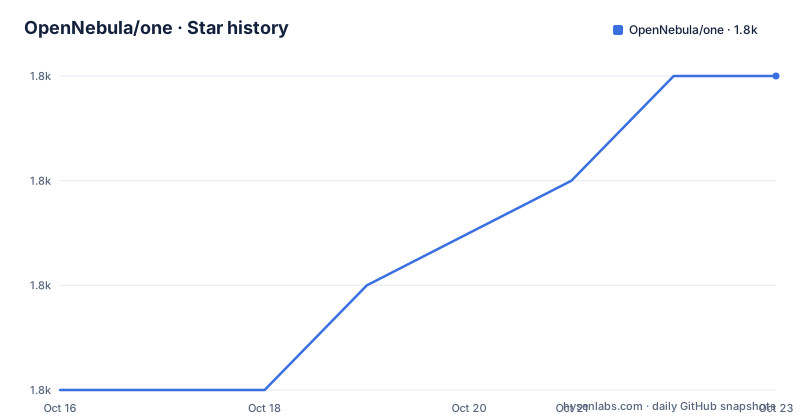
Star history
- OpenNebula/one1,760 ★ · +3
| Repository | 2026-10-16 | 2026-10-23 |
|---|---|---|
| OpenNebula/one | 1.8k | 1.8k |
3 Stars in the last 7 days, measured from the daily GitHub snapshot. Compare with other projects
Editorial analysis
OpenNebula's scope across private and edge clouds
OpenNebula addresses the operational problem of managing several classes of infrastructure behind one cloud model. The README identifies private clouds, edge infrastructures, distributed cloud deployments, hybrid environments, and AI Factories as deployment contexts. This is a broad scope. The documented workload set includes Virtual Machines, Kubernetes Clusters, and GPU-accelerated workloads, so the platform is not limited to managing traditional virtual machines.
The intended user is an organization that needs control over infrastructure located on premises, across regions, or closer to an edge deployment. Its multi-tenancy features include role-based access control, quotas, isolation, and governance. Its marketplace is described as providing virtual appliances and service templates, which may matter when an operator wants to package prepared infrastructure rather than build every service definition from the beginning.
The repository's primary language is listed as JavaScript, but the visible top-level files include `src/`, `include/`, `share/`, `SConstruct`, and `install.sh`. That layout suggests a larger codebase than a small JavaScript library. The README does not describe the internal relationship between those directories, so the implementation language mix should not be inferred beyond the repository metadata.
How OpenNebula models heterogeneous infrastructure
The central architectural idea is a unified control plane for virtualized, containerized, and AI workloads. OpenNebula exposes a Web UI, CLI, REST API, Terraform provider, and automation tools. The README does not show API endpoints, request formats, or CLI commands, so an engineer cannot confirm the exact workflow from the repository summary alone. It does establish that the platform is designed for both interactive administration and programmatic automation.
The documented feature set also describes a federated architecture for distributed infrastructures across multiple sites and regions. That matters for an edge deployment because the control surface is not limited to one local host. Built-in high availability is listed as a capability intended to reduce operational downtime, but the README does not specify the supported failure modes, failover timing, quorum model, or database requirements.
Kubernetes integration is described as providing deployment and scaling of Kubernetes Clusters with integrated lifecycle management. This places Kubernetes under the same management platform as VM resources rather than treating it as a completely separate operational system. The README does not identify supported Kubernetes distributions, container runtimes, cluster API versions, or GPU scheduling behavior. Those omissions matter for adoption decisions because broad workload support is not the same as compatibility with a particular cluster stack.
Evaluating miniONE before production deployment
The README names miniONE as the fastest way to evaluate OpenNebula. It states that miniONE automatically deploys a complete OpenNebula environment on a single server in a few minutes. That gives evaluators a specific starting point without implying that the README contains a local installation recipe for the main repository.
The evaluation path is:
https://github.com/OpenNebula/minioneOpen that repository, then follow its own deployment instructions. The OpenNebula README does not document the miniONE commands, configuration files, host prerequisites, or cleanup procedure, so this article cannot provide a command without inventing one. After deployment, the README indicates that OpenNebula can be accessed through its Web UI, CLI, REST API, Terraform provider, and automation tools. The first real use should therefore be selected from those documented interfaces after checking the miniONE output for a reachable installation.
For production, the README links to an installation guide, an upgrade guide, and architecture documentation. It does not provide a short production command sequence, package manager invocation, operating system matrix, hardware requirement, or configuration file example. Those details must be taken from the linked official documentation rather than inferred from `install.sh`.
OpenNebula's multi-site and multi-tenant operating boundaries
Multi-tenancy is one of OpenNebula's clearest differentiators in the README. Role-based access control can restrict actions by identity, while quotas can govern consumption. Isolation and governance are also named as platform capabilities. These features are more relevant to a shared cloud platform than to a simple local VM launcher, where one administrator may already control every resource.
Federation extends the same control concept across sites and regions. A potential adoption case is an organization that wants a consistent administration model for data-centre VMs and edge resources. The README does not explain whether sites share one identity store, how credentials cross site boundaries, how local failures affect control-plane operations, or whether remote sites can operate independently. Those are architectural questions that the README does not answer.
The feature list includes automated infrastructure provisioning and the ability to create and expand cloud environments on demand. It also describes a marketplace for ready-to-use virtual appliances and service templates. Together, these suggest a platform intended to standardize service definitions, but the README does not document image formats, template lifecycle, marketplace ownership, or rollback behavior. An operator should not assume that importing a template is equivalent to updating an existing production workload.
Operational limits and undocumented compatibility
OpenNebula is broad, and that breadth creates evaluation work. The repository topics mention KVM and LXC, but the README does not state which versions are supported, which storage backends are available, or which network drivers are required. It also does not document rollback for VM, cluster, or provisioning operations. The upgrade guide is linked, but its contents are not present in the repository summary.
High availability is listed as a built-in feature, yet the README does not define what remains available during a control-plane or data-plane failure. AI workloads are supported in principle, including GPU workloads, model training, LLM inference, and AI services. No GPU model, driver, runtime, scheduler, resource isolation, or quota behavior is specified. Those details are likely to determine whether the stated AI Factory capability fits a particular workload.
The repository has no GitHub releases listed. It is not archived, and the last push was on 2026-10-14. That is a maintenance signal, but it does not replace release notes or a compatibility matrix. Operators who need a predictable upgrade path must inspect the linked upgrade guide and the repository's `install.sh`, `package-lock.json`, and daemon configuration documentation before changing a production deployment.
OpenNebula compared with a single-purpose virtualization interface
A real alternative is a single-purpose virtualization management interface, such as a tool centered only on local virtual machines. The difference is scope. OpenNebula presents one platform for VM management, Kubernetes cluster lifecycle, containerized workloads, GPU workloads, multi-tenancy, federation, provisioning, and a marketplace. A simpler local interface may expose fewer concepts for a small deployment, but it does not, based on the documented OpenNebula feature set, provide the same unified control plane across those workload types.
The trade-off is operational breadth. OpenNebula's feature list can fit organizations with shared infrastructure and multiple sites, while its documentation leaves important implementation choices outside the README. A single-purpose tool may be easier to reason about when the only requirement is running VMs on one cluster, but this comparison cannot claim a performance or simplicity advantage without project-specific documentation for the alternative.
OpenNebula also offers a Terraform provider and REST API. That differs from a UI-only administration model because automation can be integrated with existing infrastructure workflows. The README does not document provider version support, API compatibility, or migration behavior, so those points require direct verification.
OpenNebula licensing and maintenance considerations
The repository is licensed under the Apache License, Version 2.0. The README identifies the copyright as 2002-2026 for the OpenNebula Project and OpenNebula Systems. Apache-2.0 is the stated license for the repository, but the repository also contains `LICENSE.onsla` and `LICENSE.onsla-nc`. An organization reviewing deployment should determine which license applies to each component rather than assuming that every file follows the main `LICENSE`.
The repository is not archived, and the last push was on 2026-10-14. There are no GitHub releases listed in the repository information. That combination means recent repository activity exists, but it does not establish a release cadence, semantic versioning policy, or long-term support window. The linked upgrade guide is the relevant document for determining migration steps and compatibility.
Upgrade cost will depend on the deployment topology, workload types, and configuration management. The README identifies service configuration and logging as operational areas, including the main OpenNebula daemon configuration file. It does not specify automated migration, rollback, or downtime behavior, so those factors cannot be quantified from the repository summary.
Editorial conclusion
OpenNebula is a candidate for organizations operating private, edge, or multi-site infrastructure and needing one management plane for VMs, Kubernetes clusters, and GPU workloads. It is less suitable for an engineer seeking a documented one-command first use or a lightweight tool for a single host. Verify first that miniONE or the production installation path matches the required hypervisor, storage, networking, tenancy, and upgrade process.
Frequently asked questions
What is OpenNebula used for?
OpenNebula is an open source cloud management platform for private clouds, edge infrastructures, distributed deployments, hybrid environments, and AI Factories. The README says it manages Virtual Machines, Kubernetes Clusters, and GPU-accelerated workloads.
How can I evaluate OpenNebula on one server?
The README identifies miniONE as the fastest evaluation option. It says miniONE automatically deploys a complete OpenNebula environment on a single server in a few minutes.
Does OpenNebula provide automation interfaces?
Yes. The documented access interfaces are a Web UI, CLI, REST API, Terraform provider, and automation tools. The README does not provide endpoint or command examples.
Official sources
Add this badge to your README
If you maintain this project, the badge below links readers to this analysis and shows its maintenance status from the daily GitHub snapshot. Paste the markdown into your README; add ?metric=license or ?metric=stars to the image URL for a different field.

[](https://hysenlabs.com/projects/opennebula-one)Star history chart for your README
[](https://hysenlabs.com/projects/opennebula-one)Was this useful?