beat-ai: the README is a list of recent posts, and the site is a Create React App with its toolchain in dependencies
An AI primer that skips jargon and elitism, easy enough for students and engineers alike. Covers everything from neural networks to large models, top-level design to low-level principles, and engineering implementation to algorithmic foundations. By the end you'll understand why next-token prediction, a seemingly small ability, can change the world, and see that AI is not as mysterious or unapproachable as it seems. Let's just beat it!
At a glance
- What is it?
- origin-brain/beat-ai is the source of beatai.org, a Chinese-language collection of AI explainers. Its package manifest pins Create React App, keeps its build tools in runtime dependencies, and points rehype-raw and rehype-sanitize at the same MDX pipeline.
- Who is it for?
- beat-ai is worth reading as a curation project rather than as software: the value is in the article list, which covers context engineering, agent economics, tracing for agents, mixture-of-experts models and a from-scratch attention implementation, with the newest entries surfaced on the repository's front page. Three things to know if you plan to build on it.
- Can I use it commercially?
- Not without permission. GitHub finds no licence file in the repository, and without a licence all rights are reserved by default: you may read the code but not reuse it. Check the README, or ask the authors, before using it.
- Is it still maintained?
- Yes. The repository last received commits 87 days ago.
- What is it written in?
- Mainly JavaScript, according to GitHub's language statistics.
Answers come from the project's GitHub data, last synced on November 15, 2026, and from our analysis. They are not legal advice.
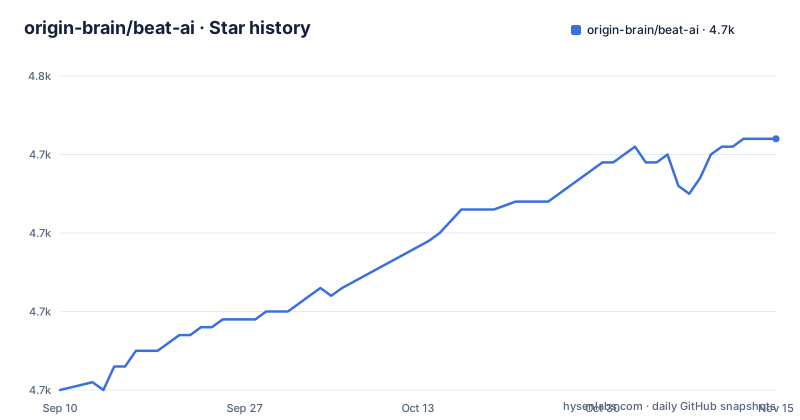
Star history
- origin-brain/beat-ai4,742 ★ · +32
| Repository | 2026-09-10 | 2026-11-15 |
|---|---|---|
| origin-brain/beat-ai | 4.7k | 4.7k |
32 Stars in the last 66 days, measured from the daily GitHub snapshot. Compare with other projects
Editorial analysis
The repository is a website, and the README is its front page
What you have here is not a library but the source of a site, and the README behaves like the site rather than like documentation. After the title it carries a line saying the entries are those published in the last thirty days, with a link to a full listing page on the site, and then it lists articles under date headings. The visible headings are 2026-08-20, 2026-08-06 and 2026-07-29, each with a handful of links and a one line summary in Chinese. So the repository's front page is a feed of recent posts. The package manifest contains a script called update-changelog that runs a Node script of the same name, and another called register-markdown-book. The repository's last push was 2026-08-20, the same day as the newest heading in the README. There are no GitHub releases, so the commit history is the only history.
The project describes itself in Chinese and states no licence
The repository description positions the project as an introductory AI manual for everyone from students to engineers, refusing to be obscure, and covering neural networks through large models, top level design through microscopic principles, and engineering implementation through algorithmic basics. It ends with the exclamation Let's just beat it! The README itself is written in Chinese, which is consistent with a dependency named `remark-cjk-friendly` in the manifest, a markdown plugin aimed at CJK text. So the language choice is deliberate throughout. The licence is a different matter, and here the repository is silent. There is no licence file at the root, the listing holds a directory of articles, the site configuration, the scripts, the source and the usual configuration files, and the metadata reports no licence. For a collection of long-form writing, that is the detail to raise before you quote, translate or republish any of it.
Every build tool sits in dependencies, and Create React App is pinned
The build toolchain sits in the dependencies block rather than in devDependencies, and that is the structural fact about this front end. `react-scripts` is pinned at exactly 5.0.1, which is the Create React App version and therefore a fixed toolchain with its own opinions about webpack and Babel. Beside it, in the same dependencies list, sit `tailwindcss` at 3.x, `typescript`, `postcss`, `autoprefixer`, the `@types/` packages for React, React DOM and Jest, and four `@testing-library/` packages. Tailwind has its own configuration file at the root and TypeScript has its own, and the scripts call `react-scripts start`, `react-scripts build` and `react-scripts test`, so the test runner is the Create React App one rather than a separately configured runner.
Raw HTML and a sanitiser travel through the same MDX pipeline
The article pipeline is where the interesting dependency decisions sit, and there are three that matter. The first pair is `rehype-raw` with `rehype-sanitize`, both present, which means author-written HTML is allowed into the rendered tree and a sanitiser is in the chain to strip what should not be there. That is the combination to understand rather than fear: raw HTML is what makes a post about, say, attention able to contain markup the markdown grammar cannot express, and the sanitiser is what keeps a post from shipping a script tag to every reader. The second is the formula stack, `katex`, `remark-math` and `rehype-katex`, which is what lets an article about neural networks render mathematics rather than showing source. The third is `prismjs` for code highlighting, alongside `react-simple-code-editor` for the interactive code snippets, and `framer-motion` for animation. So the content type is a technical explainer with formulas, code and embedded HTML, and the toolchain follows from that.
Two search systems ship at once
The site carries two independent search mechanisms, which is more than most projects of this size install. The first is Algolia, with the `algoliasearch` client, the `@docsearch/react` component, and a `docsearch.config.json` configuration file at the repository root. The second is local: `fuse.js`, a fuzzy search library, which needs no service and runs in the browser. There is a configuration file for the hosted option and nothing in the root listing that names the index for the local one, so the local search is presumably built from something generated at build time. That combination is defensible. Algolia DocSearch is free for open documentation and gives good ranking and typo tolerance across a growing corpus, and the local index keeps the site working when it is served as static files, which is what it is. The duplication to watch is content: two indexes mean two places for a new article to appear or fail to appear, and only one of them is visible in the repository.
Three sync scripts, one of them for a course that is not in this tree
The scripts in the manifest are the clearest statement of how content moves into this site:
    "release": "bash scripts/release.sh",
    "register-markdown-book": "node scripts/register-markdown-book.mjs",
    "update-changelog": "node scripts/update-changelog.mjs",
Alongside those there is a script to sync a Rust course and another to sync beat-ai itself, and there is no Rust course anywhere in the repository listing, so the course content is pulled in from somewhere else and dropped into the site at build time. That is the shape to keep in mind: this repository is one contributor to a content pipeline rather than the whole of it. A production serve script is also defined, serving the built output as a static site on port 3000 with single page fallback, which confirms the deployment model. And there is one more oddity in the scripts block, a script named version whose entire body is the version string, which is not a command that does anything.
What the catalogue actually covers
The visible entries are worth reading as a syllabus, because they cluster into four themes. The first is agent infrastructure: the economics of agents with token accounting, caching and routing, an end to end guide to tracing and observability for AI agents framed as a flight recorder, observability for the agentic harness with OpenTelemetry, evals and FinOps, a piece arguing that the harness is the product, and a piece on what an orchestrator is and why software needs one. The second is context and training: context engineering described as quietly replacing prompt engineering, and the rise of self-training AI with its recursive loops and the safety holes nobody is watching. The third is model architecture, a piece on mixture of experts models referencing DeepSeek, Grok and Mixtral, and one on why machine learning finds order in a million dimensions through the manifold hypothesis. The fourth is practice: a piece covering days 1 to 5 of building a GPT from a bigram to a working self-attention head in PyTorch on a MacBook, with the author avoiding the built in transformer module, and a piece on agentic analytics that is not text to SQL.
Editorial conclusion
beat-ai is worth reading as a curation project rather than as software: the value is in the article list, which covers context engineering, agent economics, tracing for agents, mixture-of-experts models and a from-scratch attention implementation, with the newest entries surfaced on the repository's front page. Three things to know if you plan to build on it. The front end is Create React App at 5.0.1 with its build tools in runtime dependencies, so a deploy pulls the whole toolchain. The MDX pipeline accepts raw HTML and sanitises it, which is the right combination for author-written posts and the wrong one to relax. And the repository states no licence, with no licence file at the root and no licence in the metadata, so nothing in it grants reuse of the articles. Read the content, cite it, and ask before copying.
Frequently asked questions
What is the beat-ai repository?
It is the source for the BeatAI website, a Chinese-language collection of AI explainers published at beatai.org and positioned for everyone from students to engineers. The site is a React application, and the README lists the most recent posts under date headings.
What is in the BeatAI article list?
The visible entries cover context engineering replacing prompt engineering, the economics of agents with token accounting, caching and routing, tracing and observability for AI agents, the harness as the product, mixture of experts models, observability for agentic AI with OpenTelemetry and evals, self-training AI, orchestrators, agentic analytics, building a GPT from scratch on a MacBook, and why machine learning finds order in a million dimensions.
What stack does the beatai.org site run on?
React 19 with react-scripts pinned at 5.0.1, Tailwind CSS 3, TypeScript, MDX through @mdx-js/mdx, KaTeX with remark-math and rehype-katex for formulas, Prism for code highlighting, react-markdown with remark-gfm, and Framer Motion for animation. Every one of those sits in the dependencies block.
Does the beat-ai repository have a licence?
No licence file is present at the root of the repository and the repository metadata reports no licence, so nothing in the repository itself states the terms for reusing, translating or republishing the articles it hosts.
How is the README list of articles produced?
The package manifest defines a script named update-changelog that runs node scripts/update-changelog.mjs, next to register-markdown-book and two sync scripts. The README header also points at the site's own listing page for the complete set of articles.
Official sources
Add this badge to your README
If you maintain this project, the badge below links readers to this analysis and shows its maintenance status from the daily GitHub snapshot. Paste the markdown into your README; add ?metric=license or ?metric=stars to the image URL for a different field.

[](https://hysenlabs.com/projects/origin-brain-beat-ai)Star history chart for your README
[](https://hysenlabs.com/projects/origin-brain-beat-ai)Was this useful?