The Forgotten Server: C++ MMORPG Emulator Setup and Constraints
A free and open-source MMORPG server emulator written in C++
At a glance
- What is it?
- The Forgotten Server is a C++ MMORPG server emulator forked from OpenTibia Server. It offers native and Docker build paths, Lua scripting, and MariaDB configuration, but its documentation assumes users can supply compatible game data, client setup, and server administration knowledge.
- Who is it for?
- Adopt The Forgotten Server if you intend to operate an OpenTibia-compatible MMORPG and can work with C++, Lua, MariaDB, and external client or game-data configuration. Do not choose it as a turnkey demonstration server based on the README alone.
- Can I use it commercially?
- Yes, with conditions. GPL-2.0 is a copyleft licence: if you distribute software that includes it, you must release that software's source code under the same licence. Running it internally without distributing it does not trigger that obligation.
- Is it still maintained?
- Yes. The repository last received commits 4 days ago.
- What is it written in?
- Mainly C++, according to GitHub's language statistics.
Answers come from the project's GitHub data, last synced on October 23, 2026, and from our analysis. They are not legal advice.
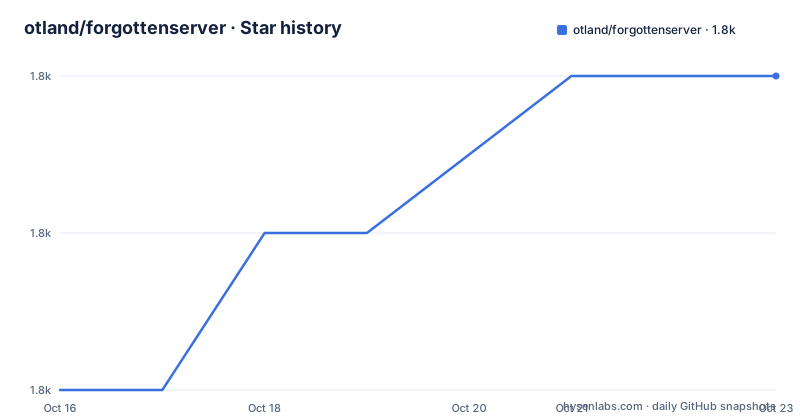
Star history
- otland/forgottenserver1,844 ★ · +2
| Repository | 2026-10-16 | 2026-10-23 |
|---|---|---|
| otland/forgottenserver | 1.8k | 1.8k |
2 Stars in the last 7 days, measured from the daily GitHub snapshot. Compare with other projects
Editorial analysis
What The Forgotten Server Operates
The Forgotten Server solves a specific server-side problem: it provides the executable and scripting environment for an OpenTibia-style MMORPG rather than a complete game package. It is written in C++ and forked from OpenTibia Server, so developers familiar with that lineage have a relevant starting point. The README identifies OTClient as the client that can connect to it. That makes the project most relevant to server operators, C++ contributors, Lua script authors, and people building or modifying a private or community game server.
It is not presented as a general-purpose MMO framework with a separate administration interface. The repository contains `CMakeLists.txt`, `CMakePresets.json`, source code under `src/`, runtime resources under `data/`, Lua-oriented configuration such as `config.lua.dist`, a `schema.sql` database schema, and a `vcpkg/` dependency manifest. Based on that layout, it is a server codebase with deployment artifacts, not a packaged game world. The README does not claim that cloning the repository alone creates a playable MMORPG.
That boundary matters for adoption. A team looking for a conventional web service with an HTTP API, a database migration tool, and a browser administration panel would not find those interfaces described here. A team willing to own protocol compatibility, game scripts, persistence, networking, and client-side coordination has the kind of components suggested by the repository.
C++ Server, Lua Scripts, and MariaDB Data Flow
The repository combines a compiled C++ server with a script layer and relational storage. The C++ implementation lives in `src/`, while `config.lua.dist` indicates that server configuration is represented in Lua. The README links a separate `Script Interface` reference, which implies that gameplay and server behavior can be extended through scripts rather than requiring every change to be compiled into the executable.
The `Dockerfile` makes the native build path more concrete. It installs C++ build tools, Boost development libraries, CMake, `fmt`, LuaJIT, MariaDB Connector C, OpenSSL, pugixml, and Samurai. It then configures CMake with LuaJIT enabled and builds the `RelWithDebInfo` configuration. The resulting executable is copied as `/bin/tfs`.
Database access is represented by two repository artifacts. `.env.example` defines `MYSQL_HOST`, `MYSQL_USER`, `MYSQL_PASSWORD`, `MYSQL_DATABASE`, `MYSQL_SOCK`, and `MYSQL_PORT`. `schema.sql` provides a schema file. The documentation does not explain whether the executable applies this schema automatically, whether MariaDB is bundled by the Docker image, or what exact import command a new operator should use. Those points must be established from the linked Compiling guide or server administration documentation before deployment.
The Docker image reduces packaging work by placing `data/` in `/srv/data/` and exposing ports `7171` and `7172`. The README does not map each port to a protocol or explain the firewall, TLS, or client-side settings required for an Internet-facing deployment. The exposed ports confirm that the container is prepared for network listeners, but they are not sufficient documentation for production exposure.
Compiling the Server from the Repository Build Recipe
The README gives two acquisition routes: follow the linked `Compiling` wiki page or download a release. It does not provide a self-contained installation tutorial in the repository README. The concrete commands visible in the `Dockerfile` are CMake build steps, not a complete host installation procedure. They show the configuration and build sequence used by the official container recipe:
cmake --preset default -DUSE_LUAJIT=ONThis selects the `default` preset and enables LuaJIT. The second command builds the `RelWithDebInfo` configuration through the same preset:
cmake --build --config RelWithDebInfo --preset defaultThese commands should be run in an environment containing the dependencies listed by the `Dockerfile`. The README itself does not state a complete package list for Ubuntu, macOS, Windows, or another native platform. A first-time user following only these commands is likely to encounter missing dependencies or environment-specific errors, so the linked Compiling page is the appropriate source for native prerequisites.
The repository also contains `vcpkg.json`, which indicates dependency management information for the vcpkg-based build route. The workflow badge name, `build-vcpkg.yml`, provides another clue about that build path, but the README does not reproduce the invocation. No version pin should be assumed from the visible files. Release `v1.6`, dated 2024-06-05, is the latest listed release, while the default branch can contain work beyond that release.
Container Startup Needs External Server Configuration
The `Dockerfile` provides a concrete packaging model, but the available documentation does not give a complete image name, a Docker run command, or a verified first-login sequence. The image copies the server executable and resources into `/srv`, exposes `7171` and `7172`, declares `/srv` as a volume, and starts `/bin/tfs` as its entrypoint. That means container configuration must be arranged before the process can serve clients.
The environment template identifies the database variables accepted by the project:
MYSQL_HOST=127.0.0.1
MYSQL_USER=forgottenserver
MYSQL_PASSWORD=
MYSQL_DATABASE=forgottenserver
MYSQL_SOCK=
MYSQL_PORT=
The template contains empty password, socket, and port values. The README does not explain whether those values may remain empty, which combinations are valid, or whether the template is loaded directly by the executable. It also does not show how to import `schema.sql`. A container image that starts `/bin/tfs` is therefore not equivalent to a ready-to-play server: a reachable database and initialized schema are separate requirements.
For a first real use, the supported path is the Compiling wiki followed by the Script Interface reference. The README names OTClient as the connecting client but does not document client installation, address entry, account creation, protocol version, or initial character creation. It would be misleading to invent those steps. Verify them in the project wiki or OTLand support forum before expecting a successful connection.
Operational Limits of the README and OTLand Resources
The largest practical limitation is documentation depth. The README links compilation, scripting, contribution, support, and release resources, but it leaves first-run configuration, database initialization, client compatibility, production networking, and backup procedures to those external pages. That is a poor fit for an operator who needs a single self-contained deployment guide.
The server's C++ core also creates a different adoption cost from a script-only or packaged game server. Native compilation requires a compatible compiler and native dependencies. Docker can containerize the executable, but it does not remove the need to understand the server's configuration and external database. If the project changes a configuration key or expects different data files across branches, an operator must also keep the configuration and runtime resources aligned with that version.
The project names its issue tracker on GitHub and explicitly says it is not a support forum. The README directs users who need help to the OTLand support forum. That separation can keep defect reports focused, but it also means troubleshooting may depend on forum access and documentation maintained outside the repository. The README additionally mentions a premium support forum on OTLand as a way to support the site; this does not change the GPL-2.0 licensing terms.
The GPL-2.0 license is important for redistribution and derivative-work decisions, although this review does not provide legal advice. Operators need to examine the repository `LICENSE` and consider how source-code obligations apply to their intended distribution. The README does not state whether client assets or game data can be bundled under the same terms.
OpenTibia Server Lineage Versus a Packaged MMORPG
The closest documented alternative is OpenTibia Server, because The Forgotten Server is explicitly a fork of that project. The difference is lineage rather than a feature comparison: OpenTibia Server is the upstream project named by the README, while this repository is its C++ successor or derivative with its own `master` branch, release sequence, repository layout, and support links. The available files do not provide enough detail to claim that one release supports more features or handles more traffic than the other.
A more useful comparison is between this repository and a preconfigured commercial or downloadable MMORPG package. The Forgotten Server exposes source, build definitions, scripting references, a database schema, and container packaging. A packaged server may offer a more direct initial setup, but no particular package is documented here, so naming one would add unsupported assumptions. The practical distinction is ownership: adopting this project means building or packaging its C++ server and taking responsibility for Lua configuration, MariaDB setup, client compatibility, and runtime resources.
OpenTibia Server is therefore relevant for lineage and shared domain knowledge, not automatically as a drop-in replacement. Teams must compare the exact branch or release they intend to run. The visible repository does not include a migration guide, compatibility matrix, or rollback procedure.
Maintenance Signals and Upgrade Boundaries
The repository is not archived, and its last push was on 2026-10-12. That is a current maintenance signal under the repository metadata, although it does not by itself promise stable releases or support for every configuration. The listed releases are `v1.6` from 2024-06-05, `v1.4.2` from 2022-06-29, and `v1.4.1` from 2021-12-03. The gap between the latest listed release and the default branch means operators must decide whether they want release artifacts or branch-level development.
Upgrade cost depends on what changes between the selected release and `master`. The repository includes native build definitions, a vcpkg manifest, a Lua configuration template, a database schema, and server data. The README does not document automatic migrations, schema rollback, config migration, or a compatibility policy between releases. None of those upgrade behaviors should be assumed.
Release downloads may reduce compilation work, but they still leave client, database, and content requirements. Branch builds may contain newer fixes, but they also require validation because no stability policy is stated. For licensing and redistribution, `GPL-2.0` and the repository `LICENSE` are the first documents to review.
Editorial conclusion
Adopt The Forgotten Server if you intend to operate an OpenTibia-compatible MMORPG and can work with C++, Lua, MariaDB, and external client or game-data configuration. Do not choose it as a turnkey demonstration server based on the README alone. Verify first whether your required client assets, database schema, configuration files, and platform dependencies are available under compatible terms, then follow the linked Compiling guide before committing to it.
Frequently asked questions
How do I install The Forgotten Server?
The README directs users either to the Compiling wiki page or to the releases page for downloadable builds. The repository also contains a Dockerfile, but the README does not give a complete Docker run command.
Which client can connect to The Forgotten Server?
The README names OTClient as a client that can connect to the server. It does not document client version compatibility, address settings, or account creation steps.
What database configuration does The Forgotten Server use?
The `.env.example` file lists `MYSQL_HOST`, `MYSQL_USER`, `MYSQL_PASSWORD`, `MYSQL_DATABASE`, `MYSQL_SOCK`, and `MYSQL_PORT`, while `schema.sql` provides a database schema file. The README does not explain how to import the schema or connect the server to MariaDB.
Official sources
Add this badge to your README
If you maintain this project, the badge below links readers to this analysis and shows its maintenance status from the daily GitHub snapshot. Paste the markdown into your README; add ?metric=license or ?metric=stars to the image URL for a different field.

[](https://hysenlabs.com/projects/otland-forgottenserver)Star history chart for your README
[](https://hysenlabs.com/projects/otland-forgottenserver)Was this useful?