OWASP Community Pages: a Jekyll site for contributed security content
OWASP Community Pages are a place where OWASP can accept community contributions for security-related content.
At a glance
- What is it?
- OWASP Community Pages is a GitHub-based content repository that publishes community-authored security material through a Jekyll site. It suits contributors with original, vendor-neutral content, but it is not documented as a general-purpose publishing system.
- Who is it for?
- Adopt or contribute to OWASP Community Pages when you have original, vendor-neutral security content and are prepared to work through a fork and pull request. Do not treat it as a general publishing platform, an application-security scanner, or a project with a documented release process.
- Can I use it commercially?
- Not without permission. GitHub finds no licence file in the repository, and without a licence all rights are reserved by default: you may read the code but not reuse it. Check the README, or ask the authors, before using it.
- Is it still maintained?
- Yes. The repository last received commits 3 days ago.
- What is it written in?
- Mainly HTML, according to GitHub's language statistics.
Answers come from the project's GitHub data, last synced on November 6, 2026, and from our analysis. They are not legal advice.
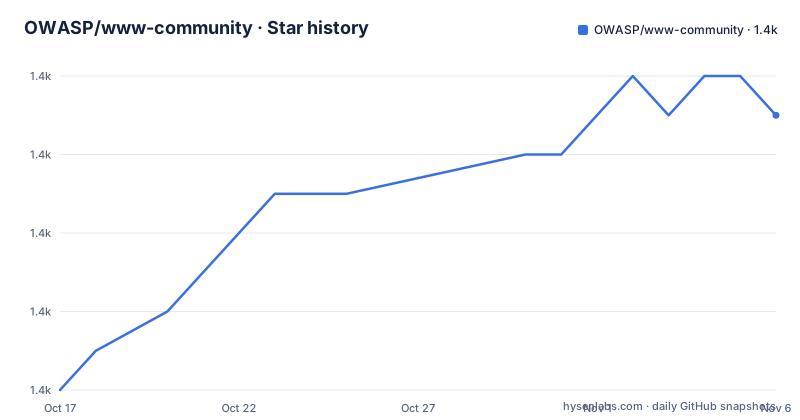
Star history
- OWASP/www-community1,419 ★ · +7
| Repository | 2026-10-17 | 2026-11-06 |
|---|---|---|
| OWASP/www-community | 1.4k | 1.4k |
7 Stars in the last 20 days, measured from the daily GitHub snapshot. Compare with other projects
Editorial analysis
What OWASP Community Pages contributes to the OWASP site
OWASP Community Pages solves a publishing problem for security-related material that the OWASP community wants to contribute. The repository is not presented as a command-line security utility or a tool that scans applications. Its purpose is content production: documents in the repository create the website at `https://owasp.org/www-community/`, while GitHub pull requests provide the contribution path.
The intended contributors are people who can prepare original security content and submit it through GitHub. The repository accepts both new pages and updates to existing ones. That makes it relevant to technical writers, security practitioners, and community members who want their material included in the OWASP community publishing structure. It is less suitable for someone expecting a ready-made content management system, because the documented workflow centers on repository files, page front matter, a Git fork, and review through a pull request.
The repository has no GitHub releases, so it should not be evaluated as a versioned software distribution with published release artifacts. Its primary language is listed as HTML, and the visible repository layout includes Markdown pages, Jekyll configuration, includes, data files, assets, and contribution metadata. That layout describes a static publishing project rather than an application with a runtime API.
The Jekyll page structure behind OWASP Community Pages
The publishing model is visible through the repository layout. Top-level files include `_config.yml`, `_data/`, `_includes/`, `assets/`, `index.md`, `info.md`, and `tab_initiatives.md`. The `pages/` directory contains the main content area, while `_includes/` provides reusable template fragments. The README requires new content files to begin with front matter and an `include` tag.
The documented page template uses `layout: col-sidebar`, which directs Jekyll to use a sidebar-oriented layout. It also defines `title`, `author`, `contributors`, `permalink`, and `tags`. The `{% include writers.html %}` fragment adds writer-related template content to the generated page. The README says that `contributors`, `permalink`, and `tags` are optional and may be left blank when a contributor is uncertain about them.
A permalink determines the page address used by the site, so it affects the published location. Tags such as `attack` and `XSS` appear in the README example, but the document does not prescribe a complete controlled vocabulary or explain validation for every tag. Likewise, the repository contains `tools_schema.json`, but the README does not state that every contributor must edit it or explain its role in page publication. Existing files in `pages/` therefore remain the practical reference for accepted page conventions.
Forking OWASP Community Pages for the first page
There is no separate installation procedure in the README. The documented route is to work with the repository through GitHub. The instructions tell contributors to fork the repository, clone their fork, make changes in `pages/`, push those changes, and open a pull request against the main repository. No exact shell commands, dependency installation steps, Ruby setup, or site-build command are supplied.
For a first page, create a new file inside `pages/` and place the following front matter and include at its beginning. The title and author below retain the values from the README as an example. Replace them with the applicable page information when following the contribution process. The contributor can omit the three fields that the README marks as optional.
---
layout: col-sidebar
title: "My Page"
author: "My Name"
contributors: ["Additional Contributor Names", "If Any"]
permalink: /MyPageTitle
tags: ["attack", "XSS"]
---

{% include writers.html %}
The page body follows the include. After adding the security content, commit and push the change to the personal fork, then open a pull request against `OWASP/www-community`. If the contribution addresses an existing issue, the README asks the contributor to comment on that issue so an assignment can be arranged. This reduces the chance of duplicate work, although the README does not describe the approval sequence or publishing schedule.
Originality and vendor neutrality constraints for contributions
The strongest content constraint is provenance. The contributor rules require original work and prohibit submitting copyrighted material that the contributor does not own. They also require contributions to be vendor and product neutral. These are editorial and licensing conditions. The README does not describe automated checks that enforce either rule.
The originality requirement matters because the repository exists to collect community contributions. A contributor who wants to reproduce a third-party guide, vendor tutorial, or product document cannot assume that publishing it through a pull request makes it acceptable. The repository license is listed as unknown. The README therefore does not establish broad reuse rights beyond the conditions stated in its contributor rules.
Vendor neutrality also constrains subject selection and phrasing. A page about a security issue can still be useful without recommending one vendor or product, but the README does not provide detailed examples of acceptable and rejected wording. Contributors with a strong preference for a particular commercial tool may find the requirement restrictive. The pull request process gives maintainers a place to evaluate that requirement, but the README does not promise an approval turnaround, automated rejection criteria, or a formal review workflow.
Why OWASP Community Pages is not a general publishing tool
OWASP Community Pages has a narrow scope. It does not describe an application-security scanner, penetration-testing framework, credential-handling utility, or deployment service. Calling it an attack tool would be inaccurate. Its tags and security-related subject matter describe the content being published, not an executable capability.
It also differs from a conventional application framework. The repository uses Jekyll-related concepts such as `_config.yml`, `_includes/`, layout front matter, permalinks, and Markdown content. The README does not document supported Ruby versions, local preview commands, generated build output, deployment triggers, or plugin requirements. A contributor who needs a local CMS, authenticated publishing interface, or programmatic content API would find none of those capabilities described in the project documentation.
The absence of GitHub releases further narrows how the project should be used. There is no documented package version or release archive to install. The contribution unit is a repository file submitted through GitHub. That works for a community website, but it means changes depend on repository conventions, pull request review, and subsequent site publication rather than semantic-version upgrades.
Maintenance history, content changes, and repository upgrades
The repository is not archived, and its last push was on 2026-10-15. That is the most recent maintenance date stated by the repository record, but it does not establish a release cadence or guarantee that every page will receive review. The repository has no GitHub releases, so the README provides no release-based upgrade path.
For page maintainers, the relevant upgrade cost is compatibility with repository templates and content structure. The README does not provide migration instructions for renamed layouts, changed includes, altered metadata fields, or site-wide presentation changes. A contributor should inspect existing files and `_includes/` before choosing metadata or page structure.
The README also records a specific repository-history change. In July 2020, the Git history was rewritten to reduce a repository size that had exceeded 5 GB. The instructions say that forks created before that date should be deleted, along with local clones, and then re-forked or re-cloned. That is a concrete maintenance boundary rather than a normal feature upgrade.
License handling requires care. The repository license is listed as unknown, while the contributor rules require original work. Contributors who intend to reuse existing pages or import outside material must establish the relevant rights separately. This article does not give legal advice or infer reuse permissions that the README does not document.
Editorial conclusion
Adopt or contribute to OWASP Community Pages when you have original, vendor-neutral security content and are prepared to work through a fork and pull request. Do not treat it as a general publishing platform, an application-security scanner, or a project with a documented release process. Before contributing, verify that the page fits the `pages/` structure, follows the documented front matter, meets the originality and neutrality rules, and can receive maintenance after publication.
Frequently asked questions
How do I add a new page to OWASP Community Pages?
Fork and clone the repository, create a file in `pages/`, add the documented front matter and `{% include writers.html %}`, then push the change and open a pull request. The README marks `contributors`, `permalink`, and `tags` as optional.
Does OWASP Community Pages provide a local installation command?
No install command is documented in the README. It describes a GitHub fork and pull request workflow but does not provide Ruby dependencies, a site-build command, or local preview instructions.
What content can I contribute to OWASP Community Pages?
The repository accepts new security-related content and updates to current pages. Contributions must be original work and must remain vendor and product neutral.
Does OWASP Community Pages publish GitHub releases?
The repository has no GitHub releases. Its documented delivery model is the website produced by repository documents, with proposed changes handled through pull requests.
Official sources
Add this badge to your README
If you maintain this project, the badge below links readers to this analysis and shows its maintenance status from the daily GitHub snapshot. Paste the markdown into your README; add ?metric=license or ?metric=stars to the image URL for a different field.

[](https://hysenlabs.com/projects/owasp-www-community)Star history chart for your README
[](https://hysenlabs.com/projects/owasp-www-community)Was this useful?