pablo14/funModeling: an R toolbox that grew out of a data science book
R package: funModeling: data cleaning, importance variable analysis and model perfomance
At a glance
- What is it?
- A CRAN package of functions for exploratory data analysis, data preparation and model performance, written to support the examples in an open source data science book. It is aimed at people from business, research and teaching, and the repository is more interesting for its shape than its contents: a rendered README committed alongside its source, a LaTeX leftovers directory, and a personal test folder that does not follow the R convention.
- Who is it for?
- Install this from CRAN if you teach exploratory data analysis in R and want a worked set of functions rather than examples you write yourself, since the package exists to support the topics in a book and that is where its cohesion comes from. Two things to check before you build on it.
- Can I use it commercially?
- Yes. MIT is a permissive licence: you can use, modify and sell software built on it, as long as you keep its copyright and licence notices.
- Is it still maintained?
- Activity is slowing. The repository last received commits 8 months ago.
- What is it written in?
- Mainly HTML, according to GitHub's language statistics.
Answers come from the project's GitHub data, last synced on October 4, 2026, and from our analysis. They are not legal advice.
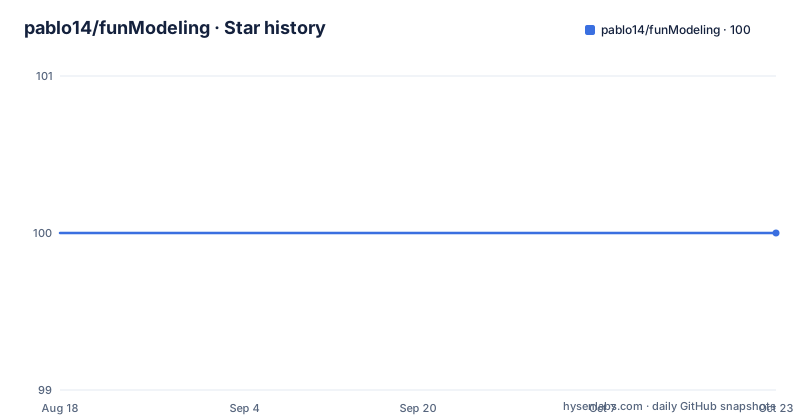
Star history
- pablo14/funModeling100 ★ · +0
| Repository | 2026-08-18 | 2026-10-04 |
|---|---|---|
| pablo14/funModeling | 100 | 100 |
0 Stars in the last 47 days, measured from the daily GitHub snapshot. Compare with other projects
Editorial analysis
The README is rendered from an R Markdown source
The repository root contains three versions of the same document: a Markdown README, an R Markdown file that appears to be its source, and a rendered HTML version. Committing the rendered file alongside the source is why the repository's recorded primary language is HTML rather than R, which is a small but confusing signal if you arrive expecting to read code. Two other entries at the root are build residue rather than source. There is a directory with a name associated with LaTeX auxiliary files, which is what a build of the PDF manual leaves behind, and there is a directory for the author's own tests that does not use the conventional name for a package's test suite. Neither hurts anything, but both suggest the tree was committed without a cleanup pass.
It is a companion to a book, not a standalone tool
The README is explicit that the package is intimately related to an open source data science book published in 2017, and that most of its functionality exists to explain topics addressed by that book. That relationship is the reason to expect a coherent API rather than a grab bag: the functions are grouped by the chapters that needed them. The book exists in English and in a Spanish edition, both linked, and a digital copy in PDF, mobi and epub formats can be bought from the download section at a price you name. The package's audience is stated just as plainly, people coming from business, from research, and from teaching, with professors and students named explicitly. That is a wider audience than a typical modelling package aims at, and it explains the emphasis on preparation and exploration rather than on any one algorithm.
Three problem domains, and the description misspells one
The package is described as containing a set of functions related to three things: exploratory data analysis, data preparation, and model performance. That is the whole scope statement, and it is worth noting what is absent from it, since there is no mention of any particular modelling algorithm or of a pipeline. It is a toolbox for the steps either side of modelling rather than for modelling itself. The repository's own short description lists the same three areas, and spells the third one incorrectly, writing performance with an extra letter. Small thing, but it is the kind of detail that tells you the package description predates a spell check and is not maintained with the same care as the code.
Four blog posts are the closest thing to a feature list
The README does not enumerate functions, which is unusual for a package of this size, and the substitute is a list of four blog posts built on the package. Read as a feature list they cover four distinct capabilities: an introduction to exploratory data analysis in R, automatic checking of data types in predictive models, a fast route through data exploration aimed at predictive modelling, and a new discretisation method described as recursive information gain ratio maximisation. That last one is the only item that names a specific algorithm, and the rest are workflow descriptions. So the honest way to learn the API is to read those posts and the vignette, in that order, rather than to expect a reference card.
CRAN is the distribution channel, GitHub Pages is the manual
The top of the README links to the package page on CRAN, and it does so twice, which is a small sign that the file was assembled over time rather than written in one pass. The documentation itself is split between two systems. There is an official project page hosted as a GitHub Pages site, and a vignette, which in R packages is a long-form example document rather than a manual, hosted under a separate path on that same site. The repository also carries a documentation directory, which is the generated site for the package, and a vignettes directory for the source of any vignettes shipped inside the package. If you are looking for a function reference, you will find it in the rendered documentation rather than in the repository itself.
A Spanish data school sits alongside the package
The final section of the README is addressed to Spanish speakers and points at a data school founded by the same author who wrote the package and the book. That school offers free and paid courses, blog posts, and a video channel, and it teaches both R and Python, which is the one place in this repository where a language other than R appears. For a user outside the Spanish-speaking world the section is skippable, but it tells you something about the project's shape: the package is one artefact in a teaching ecosystem rather than a standalone library, and the audience spans both languages even though the package itself is R only.
There is no version history in the repository
Maintenance information is thin, and it is thin in a specific way. The repository publishes no GitHub releases, so there is no tag history to read and nothing to compare against. For a package distributed through CRAN that is not fatal, since the version is declared in the package's DESCRIPTION file and CRAN keeps the history, but it does mean the GitHub repository cannot tell you what changed when. The last push to master is dated 2026-02-17, and the licence is MIT, recorded in a markdown file at the root rather than as a plain licence text, which is the convention for a package documented on GitHub. Everything else at the root follows the standard R package layout, with a namespace file, an R source directory, a manual directory, a data directory and a build ignore file.
Editorial conclusion
Install this from CRAN if you teach exploratory data analysis in R and want a worked set of functions rather than examples you write yourself, since the package exists to support the topics in a book and that is where its cohesion comes from. Two things to check before you build on it. The function list is not in the README, so you will be reading the vignette and the blog posts to learn what is available, and the repository carries no GitHub releases, so the CRAN version is the only version reference you have. The last push to master is dated 2026-02-17.
Frequently asked questions
What is the funModeling R package for?
It contains a set of functions related to exploratory data analysis, data preparation and model performance, and is used by people coming from business, research and teaching. It is distributed through CRAN under the MIT licence.
How is funModeling connected to the Data Science Live Book?
The README says the package is intimately related to that open source book from 2017, in the sense that most of its functionality is used to explain topics the book addresses. The book exists in English and Spanish, and a digital copy can be bought at a price you name.
Where can I find the funModeling function reference?
Not in the README, which does not enumerate functions. The closest thing to a list is four blog posts built on the package, covering exploratory data analysis, automatic data type checking, fast exploration for predictive modelling, and a recursive information gain ratio discretisation method, plus a vignette hosted on the project's documentation site.
How is the funModeling package maintained?
The repository publishes no GitHub releases and the last push to master is dated 2026-02-17, so the GitHub history does not show what changed when. Version information comes from CRAN and the package's DESCRIPTION file, and the licence is MIT.
Does funModeling support languages other than R?
The package itself is R only. A data school founded by the same author teaches both R and Python, and that school, along with its courses and blog posts, is what the Spanish-language section of the README points at.
Official sources
Add this badge to your README
If you maintain this project, the badge below links readers to this analysis and shows its maintenance status from the daily GitHub snapshot. Paste the markdown into your README; add ?metric=license or ?metric=stars to the image URL for a different field.

[](https://hysenlabs.com/projects/pablo14-funmodeling)Star history chart for your README
[](https://hysenlabs.com/projects/pablo14-funmodeling)