pennylane: two one-line descriptions, no version in the manifest, and four test plugins for flaky runs
PennyLane is an open-source quantum software platform for quantum computing, quantum machine learning, and quantum chemistry. Create meaningful quantum algorithms, from inspiration to implementation.
At a glance
- What is it?
- An open-source quantum software platform whose README and packaging manifest describe it differently, whose simulators are a separate distribution, and whose manifest declares its version as dynamic rather than stating it. Its development groups carry four plugins for managing a suite that is known to be flaky, a documentation-example runner, and a module boundary checker pinned to an exact version.
- Who is it for?
- This is the library to reach for if you want to write quantum circuits the way you would write a neural network and stay ignorant of the simulator underneath, which is a real design decision rather than a convenience. Two things to know before you depend on it.
- Can I use it commercially?
- Yes. Apache-2.0 is a permissive licence: you can use, modify and sell software built on it, as long as you keep its copyright and licence notices.
- Is it still maintained?
- Yes. The repository received new commits within the last day.
- What is it written in?
- Mainly Python, according to GitHub's language statistics.
Answers come from the project's GitHub data, last synced on November 23, 2026, and from our analysis. They are not legal advice.
Star history
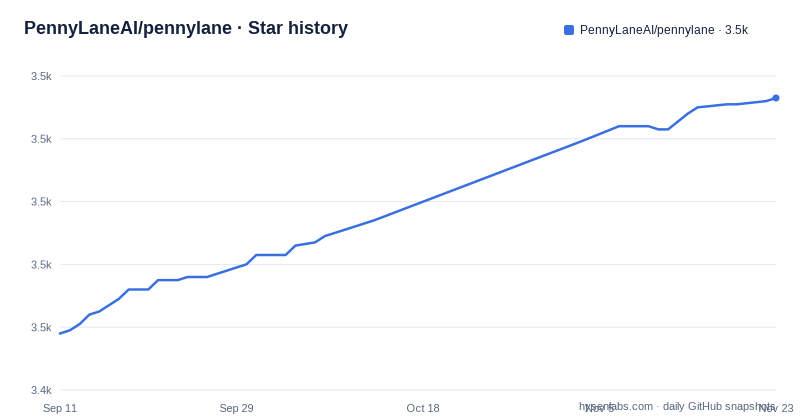
- PennyLaneAI/pennylane3,533 ★ · +75
| Repository | 2026-09-11 | 2026-11-23 |
|---|---|---|
| PennyLaneAI/pennylane | 3.5k | 3.5k |
75 Stars in the last 73 days, measured from the daily GitHub snapshot. Compare with other projects
Editorial analysis
Two one-line descriptions and no version in the manifest
The README opens by calling this an open source quantum software platform for quantum computing, quantum machine learning and quantum chemistry. The packaging manifest calls it a cross platform Python library for the same three fields, and adds the sentence that carries the project's whole argument: train a quantum computer the way you would train a neural network. So the two descriptions differ in kind, one a platform and one a library, and only the second makes the comparison explicit. Installation is a single command, and the floor is high:
python -m pip install pennylaneThe version is the other difference. The manifest declares it dynamic rather than writing a number, so the version lives somewhere else entirely, and the development status classifier still says Beta. The newest release in the record is a beta of the next minor version, so the released line and the in-development line are running in parallel.
The simulators are a separate distribution with a floor, not a ceiling
The dependency list includes a second distribution whose name starts with the platform's own, which is where the simulators live. It is declared with a minimum version rather than a maximum, so a fresh install takes the newest simulator release available and an existing environment keeps whatever it already has. That is a reasonable choice, and it has an obvious consequence: the platform can be upgraded without the simulator moving, and the combination you end up running is one the platform's own test suite may never have seen. The compiler that turns higher level descriptions into circuits is not a dependency at all, it lives in its own repository, and the README links it as a separate project. So a single install gives you the language layer and the simulator, and leaves the compiler as something you add deliberately.
Two dependencies are pinned exactly, one is capped, one is opaque
Most of the runtime list is ranged, and the exceptions are informative. The array library and the automatic differentiation library are each pinned to an exact version, which in a package this old is a deliberate choice about a runtime whose behaviour differences matter. One library is capped below a version, meaning the project has decided that a later major will not work and has not yet removed the old one. A graph library is declared with a floor only, having replaced an earlier one that is still absent from the list. And one entry carries a name that describes no library at all, which makes it the hardest dependency in the file to reason about from the outside. Taken together the list says the project pins what changes behaviour and floats what does not.
Two documentation domains and two names for the package
Point at the documentation and there are two of them. The badge row links a documentation site on the project's own domain, and the getting started section links a different host for the same documentation, one that has not been migrated. The package has two names too: the distribution name in the manifest is the lower case project name, while the index listing and the badge both use a capitalised form of it. Neither is wrong, and both are easy to mistype. The support surface is deliberately split as well, with a forum for questions and an issue tracker for reports, and the README asks you to file bugs in the tracker rather than in the forum.
Four test plugins for a suite that admits to being flaky
The development dependency group is where the engineering shows. It carries a plugin that seeds random number generation so failures reproduce, a plugin that retries flaky tests, one that runs tests in separate processes, and one that splits a suite across shards. That is four tools aimed at one problem, and the build file confirms the problem is real: it passes a flag to the test runner that suppresses the retry plugin's report, which is how you keep a re-run from looking like a pass. There is also a separate target for the device plugin tests, and a documentation example runner, which means the examples in the documentation are executed as part of the suite. For a project with a large test surface and a lot of numerical code, that is the correct set of tools to reach for.
The clean target lists subdirectories by hand
The build file is conventional and then slightly old fashioned. Installation, wheel building and source distribution building all go through the modern Python package tool rather than the legacy invocation, and documentation is delegated to a subdirectory makefile. Formatting is black with a check mode, and linting is a different tool run separately over source files and over test files. Coverage is requested with both a terminal report and an HTML report. The one place it shows its age is the clean target, which removes caches by naming each subdirectory of the package and each test directory individually, including two paths that no longer correspond to the current layout. A new subpackage added tomorrow will simply not be cleaned, which is the kind of bug that costs somebody an afternoon.
Three files about automated tooling sit next to a module boundary file
The root of the repository carries an unusual cluster of governance files. There is an agent instruction file, a second instruction file for a different tool, a policy file written specifically about the use of automated tooling in this project, and a module boundary configuration that declares which parts of the package may import which, enforced by a checker pinned to an exact version in the development group. That last one is the most interesting, because it means the architecture is a checked property rather than a convention, and it is why a project of this size can keep a legacy graph library and a modern replacement from cross-contaminating. Alongside them sit the coverage configuration, a codecov file, a lint configuration, a pre-commit configuration, a root conftest, a manifest file, and a build helper of three lines that delegates to the packaging tool.
Every contributor is listed as an author on the releases
The contribution section is short and contains one unusual promise: all contributors will be listed as authors on the releases. That is a stronger commitment than attribution in a changelog, and it is the sort of policy that shapes who contributes to a project with this many outside users. The mechanics are ordinary in everything else: fork, branch, pull request, with the pull request guide linked, and the development guide sent to you for the details. Bug reports, feature suggestions and even links to projects built on top of it are all invited in the same paragraph, which is an unusual invitation in a paper repository. Support asks you to use the issue tracker and points at a separate forum for discussion, and both a code of conduct and a community statement are linked rather than restated.
Editorial conclusion
This is the library to reach for if you want to write quantum circuits the way you would write a neural network and stay ignorant of the simulator underneath, which is a real design decision rather than a convenience. Two things to know before you depend on it. The simulator is a separate distribution pinned to a floor, so upgrading the platform does not upgrade the thing that actually runs your circuits, and you can end up with a combination the platform's own tests never covered. And the platform is still classified as beta while its manifest carries no version at all, so pin by the released number from the index rather than by the branch you are reading.
Frequently asked questions
what is pennylane
An open-source quantum software platform for quantum computing, quantum machine learning and quantum chemistry. Its packaging manifest describes it as a cross-platform Python library whose aim is to let you train a quantum computer the way you would train a neural network.
How do I install PennyLane?
With pip, from a Python 3.12 or newer environment; the install section is a single pip command. Container images are published on the project's page on Docker Hub, with a separate documentation page for running the simulators in one.
Does PennyLane run on real quantum hardware or only simulators?
Both are described. The README says it integrates with hardware devices across four qubit technologies and provides tools to estimate resources and compile circuits for them, and its own simulators are shipped as a separate distribution that the main package depends on.
What is PennyLane's current version status?
The manifest declares the version dynamic rather than stating it, and the development status classifier says Beta. The newest release in the visible record is a beta of the next minor version, published after the preceding patch release.
How does PennyLane keep its module boundaries?
With a boundary configuration file at the root and a checker pinned to an exact version in the development dependencies, so the package's internal import rules are a checked property rather than a convention.
Official sources
Add this badge to your README
If you maintain this project, the badge below links readers to this analysis and shows its maintenance status from the daily GitHub snapshot. Paste the markdown into your README; add ?metric=license or ?metric=stars to the image URL for a different field.

[](https://hysenlabs.com/projects/pennylaneai-pennylane)Star history chart for your README
[](https://hysenlabs.com/projects/pennylaneai-pennylane)Was this useful?