OpenCat on NyBoard: the legacy quadruped firmware and where it stops
An open source quadruped robot pet framework for developing Boston Dynamics-style four-legged robots that are perfect for STEM, coding & robotics education, IoT robotics applications, AI-enhanced robotics application services, research, and DIY robotics kit development.
At a glance
- What is it?
- Petoi's oldest quadruped repository is still the right home for the original Bittle and Nybble, and the wrong one for anything running an ESP32. It ships as a single Arduino sketch, and its release tags belong to the desktop app rather than the firmware.
- Who is it for?
- OpenCat on NyBoard fits teaching, a weekend build on an original Bittle or Nybble, and anyone who wants gait code on hardware they can hold. It is the wrong starting point for a Bittle X, a Nybble Q, or any ESP32 work, and the ROS pipelines are documented by the community rather than here.
- Can I use it commercially?
- Yes. MIT is a permissive licence: you can use, modify and sell software built on it, as long as you keep its copyright and licence notices.
- Is it still maintained?
- Yes. The repository last received commits 3 days ago.
- What is it written in?
- Mainly C++, according to GitHub's language statistics.
Answers come from the project's GitHub data, last synced on November 15, 2026, and from our analysis. They are not legal advice.
Star history
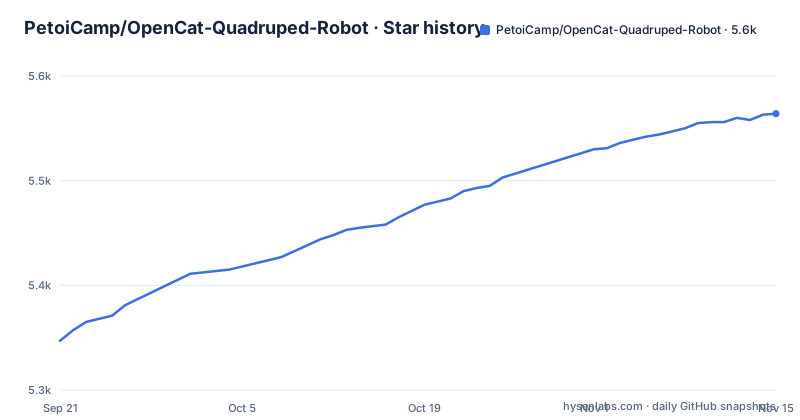
- PetoiCamp/OpenCat-Quadruped-Robot5,564 ★ · +217
| Repository | 2026-09-21 | 2026-11-15 |
|---|---|---|
| PetoiCamp/OpenCat-Quadruped-Robot | 5.3k | 5.6k |
217 Stars in the last 55 days, measured from the daily GitHub snapshot. Compare with other projects
Editorial analysis
The NyBoard split decides which repository you need
Petoi divides its quadruped code by board, and this repository is the older half. The original Bittle and Nybble ran on NyBoard hardware with an ATmega328P. Both products are discontinued, and the README keeps both of them supported by this codebase. Everything newer, Bittle X and Nybble Q, moved to BiBoard with an ESP32, so the opening note in the README sends owners of current-generation hardware somewhere else. Two repositories share the OpenCat name:
https://github.com/PetoiCamp/OpenCat-Quadruped-Robot
https://github.com/PetoiCamp/OpenCatEsp32-Quadruped-Robot
The repository description markets OpenCat for AI-enhanced robotics services and research, yet that description covers both halves of the split while this one only holds the legacy half.
One Arduino sketch, eight directories, no build system
The top level of the repository is one sketch, eight directories and a few files. There is no build system, no package manifest and no dependency lock file. OpenCat.ino is the firmware entry point, and it is a sketch rather than a library: you open it, compile it for the board and flash it, instead of importing a package into a larger program. OpenCatPythonAPI and pyUI point at a Python surface on the host side, and serialMaster points at serial tooling for a board that is already running. That is the practical shape of this project: an Arduino sketch surrounded by directories named for their roles.
There is no install command, so the first run is a board and a cable
The README's opening sections give no install command. The repository's top level shows the layout, which is what a first run actually depends on:
OpenCat.ino
OpenCatPythonAPI/
SkillLibrary/
ModuleTests/
serialMaster/
pyUI/
src/
Log/
Resources/
ChangeLog.md
So the first run is physical. You fetch the repository, open OpenCat.ino in the Arduino IDE, select the target that matches the NyBoard variant in your hands, and upload it the way that board vendor's Arduino target requires. Expect to consult that vendor's documentation for the board selection. If you would rather not touch hardware on day one, the browser simulators linked for Bittle X and Quaddle are the cheaper first check, and they exercise gait ideas on a desktop instead.
Release tags track the desktop app, not the sketch you flash
The repository is not archived, and the last push landed on 2026-09-08, so the tree you fetch now is not the tree of a year ago. The release list is where the upgrade story gets odd. The three most recent tags are 1.2.6beta on 2025-08-05, 1.2.5 on 2025-06-23 and 1.2.4 on 2025-04-08, and every one of them carries the name PetoiDesktopApp. The desktop companion application gets version numbers. The NyBoard sketch in this repository does not. That leaves no tagged firmware to pin a classroom build or a lab rig to, and an upgrade here means pulling main rather than checking out a release. ChangeLog.md is the only history file named at the top level, so it is where you look for what changed in the sketch itself. The licence is the easy part: MIT, and the README promises no vendor lock-in.
ROS, cameras and IMU support all resolve somewhere else
Several of the framework's headline promises do not resolve to files in this repository. ROS compatibility is claimed, and the credit is explicit: SLAM, navigation and perception pipelines are documented by the community rather than here. No ROS package, launch file or message definition sits at the top level, so those pipelines live elsewhere and this tree is not their source. Sensor integration is listed as cameras, touch, IMUs and ultrasonic sensors that clip and go. Sim-to-real and reinforcement learning work is offered as a use of the platform, while the training environment and the policy code are absent from this tree. What you get instead is the layer underneath: gait coordination, servo control and IMU integration on a board you can hold. Write your own ROS nodes and your own sensor bring-up, and treat the community write-ups as starting points.
Quaddle runs four servos and its source is not here yet
The most interesting machine named in this README cannot be cloned from it. Quaddle, a mini desk robot on the same OpenCat lineage, is a Kickstarter launch dated Sept 2, 2026, and the README states plainly that its source code is not yet public, with open sourcing planned before delivery. Two hardware choices make it a different problem rather than a smaller one. It runs a full quadruped on 4 servos instead of the usual 8 to 12, which pushes the work into gait design and leg coordination. Those servos report position instead of only accepting commands, and that feedback is what makes Puppet Mode possible: hand-guide the legs and record the motion directly, with no code written for it. Shells and mounts are 3D printable, the stated plan is that the ESP32-S3 code structure resembles this repository but sits closer to OpenCatESP32, and an online simulator lets you watch it before it ships. None of that is code you can read today.
Editorial conclusion
OpenCat on NyBoard fits teaching, a weekend build on an original Bittle or Nybble, and anyone who wants gait code on hardware they can hold. It is the wrong starting point for a Bittle X, a Nybble Q, or any ESP32 work, and the ROS pipelines are documented by the community rather than here. Before adopting it, confirm which board your robot uses, and if it is NyBoard, read OpenCat.ino and ChangeLog.md directly, because the release tags track the desktop app rather than the firmware you flash.
Frequently asked questions
Is OpenCat-Quadruped-Robot still usable with the original Bittle and Nybble?
Yes. Both products are discontinued, but the README states that this codebase still fully supports the NyBoard and ATmega328P robots, and it is the repository Petoi points legacy owners to.
Which OpenCat repository should I use for a Bittle X or a Nybble Q?
OpenCatESP32, at github.com/PetoiCamp/OpenCatEsp32-Quadruped-Robot. Those two kits run BiBoard with an ESP32, and the README sends current-generation hardware owners there for active development.
How do I install OpenCat on my robot?
There is no package manager step. The repository is an Arduino sketch (OpenCat.ino) with serialMaster, pyUI and OpenCatPythonAPI beside it. Board selection and upload steps come from the board vendor's Arduino target.
Can I download the Quaddle source code?
Not yet. The README states that the Quaddle source code is not yet public and that Petoi plans to open source it before delivery, with the announcement to come on this repo and r/petoi; the Kickstarter launch was Sept 2, 2026.
Official sources
Add this badge to your README
If you maintain this project, the badge below links readers to this analysis and shows its maintenance status from the daily GitHub snapshot. Paste the markdown into your README; add ?metric=license or ?metric=stars to the image URL for a different field.

[](https://hysenlabs.com/projects/petoicamp-opencat-quadruped-robot)Star history chart for your README
[](https://hysenlabs.com/projects/petoicamp-opencat-quadruped-robot)Was this useful?