A ReAct agent that answers vacuum questions and writes the usage report
Built on **Agentic RAG** (Agent-driven Retrieval-Augmented Generation) technology, it not only accurately answers pre-sales and after-sales questions but also generates personalized usage reports and optimization suggestions by deeply analyzing device data.
At a glance
- What is it?
- agent-sweep-engine is a consumer customer service system for robot vacuum owners, built on Agentic RAG so one agent handles pre-sales questions, after-sales troubleshooting and usage reports from device data. The interesting parts are the seams: Tools/ holds exactly two capabilities, and Models/ is a factory so the base model can change without touching business logic.
- Who is it for?
- Adopt agent-sweep-engine if you are building a consumer agent that has to do two jobs with one model, answer questions and turn device data into a report, and if you want the base model behind a factory so Qwen can be swapped for something else later. Do not adopt it expecting a product: the repository ships no licence file and no releases, and the last push was on 2026-07-29.
- Can I use it commercially?
- Not without permission. GitHub finds no licence file in the repository, and without a licence all rights are reserved by default: you may read the code but not reuse it. Check the README, or ask the authors, before using it.
- Is it still maintained?
- Yes. The repository last received commits 110 days ago.
- What is it written in?
- Mainly Python, according to GitHub's language statistics.
Answers come from the project's GitHub data, last synced on November 15, 2026, and from our analysis. They are not legal advice.
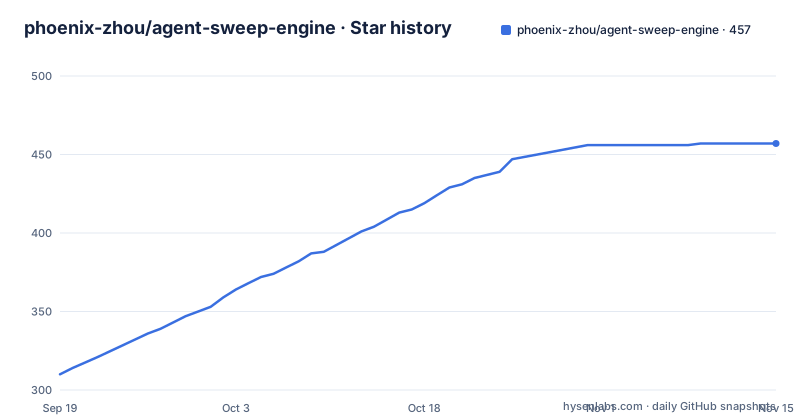
Star history
- phoenix-zhou/agent-sweep-engine457 ★ · +147
| Repository | 2026-09-19 | 2026-11-15 |
|---|---|---|
| phoenix-zhou/agent-sweep-engine | 310 | 457 |
147 Stars in the last 57 days, measured from the daily GitHub snapshot. Compare with other projects
Editorial analysis
One agent, two jobs: answers and the usage report
The target user is a person who owns, or is considering, a robot vacuum. The project splits their questions in two and gives both to a single agent. Pre-sales traffic covers features, price comparison and value analysis. After-sales traffic covers how to operate the machine, troubleshooting and routine maintenance.
The second job is the one that separates this from a FAQ bot. For owners, it analyses usage data from the device, such as cleaning frequency, consumable condition and error logs, and produces a personalized report plus suggestions: adjust the cleaning schedule, replace a part that is wearing out. The README calls the architecture multi-task integration, and the reason it matters is cost and coherence: one agent answering a question and summarising the same machine's week keeps one retrieval path and one conversation history instead of two systems.
Retrieval is what is supposed to keep the answers honest. Facts come out of a knowledge base through RAG rather than from the model's memory, and the stated purpose is to reduce hallucination.
Tools/ has two hands: retrieval and report generation
An agent that can act needs something to act with, and this one has a deliberately small set. The Tools/ directory packages the atomic capabilities, and the README names two: RAG retrieval, which pulls relevant knowledge out of the vector database, and report generation, which analyses device data and produces a structured report.
Everything the agent does therefore routes through one of those two. Questions that need knowledge hit retrieval. Report requests hit the generator. There is no browsing tool, no HTTP fetch tool and no shell tool in the description, which is a sane default for a customer-facing deployment: the blast radius of a wrong tool call stays inside a query.
Above them sits the Agent/ directory, which the README calls the brain and which implements the ReAct pattern, reasoning plus acting. Its stated jobs are understanding intent, planning a task path and deciding when to call an external tool. That last decision is the part that distinguishes this from a plain RAG chain, where retrieval is always in the path.
Models/ is a factory, prompts/ is deliberately not code
Two directories exist to keep changes out of business logic. Models/ uses the factory pattern to load and manage the large language model and the embedding model, so swapping the base model between Qwen, Llama or something else does not require editing the agent. If you deploy on a different provider later, that is the seam you work through.
prompts/ takes the opposite approach to the usual one: instead of prompt strings scattered through handlers, system prompts and per-task prompts are collected in one place so you can debug and tune model instructions without changing code at all. For a system whose quality lives in retrieval and instruction wording, that separation is the point.
The data layer has the same shape in two halves. data/ holds the raw material for building the knowledge base, and Chroma/ holds the vector index produced from it. Worth knowing before you clone: neither Chroma/ nor bert-base-chinese/ appears in the repository's top level, which fits a local storage path that only exists after you index and a model directory you are expected to download yourself.
Three front doors and five test scripts at the root
Interaction is layered by audience. app.py is a Flask backend API service, described as the route for backend integration or for testing requests through Postman. app_web_gradio.py and app_web_streamlit.py are the demo doors, one Gradio and one Streamlit, meant for standing up a front end quickly to show the system working. app_test.py joins them at the root.
The test scripts are named for what they exercise rather than for a framework: testQA.py, testExtractInfo.py, testgenerator.py and testfrom_external_systems.py, the last one covering the path where data arrives from a system outside this repository. There is no pytest suite in the listing, which matches a project assembled around manual verification scripts.
Two root files are worth flagging as smells rather than features. output.txt is a run artifact checked into the repository, and .idea/ is IDE configuration. Neither hurts anything at runtime, and both tell you the project was developed in a single working copy.
evals.py and a BERT model exist to make retrieval quality measurable
Most RAG demos stop at the answer. This one ships the measurement: evals.py is an automated evaluation script, Eval/ holds validation data, and bert-base-chinese/ holds a BERT model used for evaluating results. The stated metrics are accuracy, relevance and recall, and the stated purpose is that system performance should be measurable rather than argued.
The pinned dependencies back that up. rouge_score==0.1.2 and scikit-learn==1.7.2 are scoring tools, langsmith==0.4.8 gives you tracing, and onnxruntime==1.22.1 with transformers==4.55.2 covers the BERT side. jieba==0.42.1 sits alongside stopwords.txt at the root, which is the segmenter and stopword pair a Chinese retrieval pipeline needs.
One catch if you plan to reproduce the numbers: bert-base-chinese/ is not in the repository tree, and the README points at a Baidu Pan download with an extraction code instead. Budget for that before you compare your recall against anything.
The install is a conda environment and a pinned dependency wall
Three commands get you a Python 3.10 environment with everything installed, and the project asks for 3.10 or newer:
conda create -n agent_se python=3.10
conda activate agent_se
pip install -r requirements.txt
What arrives is a heavy, fully pinned set, and the pins are the point rather than an accident. The retrieval and agent core is chromadb==1.0.15 with langchain==0.3.27, langchain-core==0.3.72, langchain-community==0.3.27 and langchain-ollama==0.3.6. Local model management is ollama==0.5.1. The model stack underneath is torch==2.7.0 with torchvision==0.22.0 and transformers==4.55.2, which is what pulls in a multi-gigabyte download before any of your own code runs.
Three web surfaces arrive with it, Flask==3.1.1, gradio==4.44.0 and streamlit==1.51.0, plus fastapi==0.135.1 and uvicorn==0.35.0 for the API path. Nothing here uses caret ranges, so a rebuild six months from now reproduces the same versions or fails loudly.
The stack section then adds a second path: Ollama for local model management, LangChain as the development framework, whose base install is listed separately as pip install openai langchain modelscope, and Alibaba Cloud Bailian as the model service for the Qwen family, which needs an API Key and a Secret Key applied for in advance.
No LICENSE file, no releases, and an inline dependency list that is cut off
Two facts matter before you build on this. There is no LICENSE file at the root of the repository, so there is no stated grant for the code, and the repository publishes no GitHub releases, so there is no tagged version to depend on. The last push was on 2026-07-29, which is recent enough that the work is not abandoned and old enough that you should expect the pins above to need checking against the current releases of LangChain and Chroma.
Documentation exists in two languages, README.md and README_EN.md, and the English one is the one to read if you are not working in Chinese, since most of the prose, the architecture diagram and the reference material point at Chinese-language blog posts.
One documentation flaw to be aware of: the README reproduces requirements.txt inline and that copy stops at a truncated safetens line, while the actual file continues through scikit-learn, torch, transformers, tzdata and uvicorn. Install from requirements.txt, never from the list in the README.
Editorial conclusion
Adopt agent-sweep-engine if you are building a consumer agent that has to do two jobs with one model, answer questions and turn device data into a report, and if you want the base model behind a factory so Qwen can be swapped for something else later. Do not adopt it expecting a product: the repository ships no licence file and no releases, and the last push was on 2026-07-29. Verify first that the two tool capabilities in Tools/ cover your cases, since retrieval and report generation are the only actions the agent can take.
Frequently asked questions
What is agent-sweep-engine?
A consumer customer service system for robot vacuum owners built on Agentic RAG. It handles pre-sales questions about features and price comparison, after-sales questions about operation, troubleshooting and maintenance, and it generates a personalized usage report with suggestions from device data such as cleaning frequency, consumable condition and error logs.
What model does agent-sweep-engine use?
The project is built on LangChain with Qwen as the base model. Ollama manages and deploys models locally, and Alibaba Cloud Bailian is offered as the model service for the Qwen family, requiring an API Key and a Secret Key applied for in advance. The Models/ factory is designed to swap the base model without changing business code.
Can agent-sweep-engine run without a cloud account?
Yes, since Ollama handles local model management and deployment, and both langchain-ollama==0.3.6 and ollama==0.5.1 are pinned in requirements.txt. The documented cloud path is Alibaba Cloud Bailian, which needs credentials issued before you start.
How does agent-sweep-engine measure RAG answer quality?
Through evals.py, using a validation dataset in Eval/ and a dedicated BERT evaluation model in bert-base-chinese/, with accuracy, relevance and recall as the stated metrics. rouge_score and scikit-learn are pinned for scoring, and langsmith is pinned for tracing. The BERT directory is not in the repository and has to be downloaded separately.
Official sources
Add this badge to your README
If you maintain this project, the badge below links readers to this analysis and shows its maintenance status from the daily GitHub snapshot. Paste the markdown into your README; add ?metric=license or ?metric=stars to the image URL for a different field.

[](https://hysenlabs.com/projects/phoenix-zhou-agent-sweep-engine)Star history chart for your README
[](https://hysenlabs.com/projects/phoenix-zhou-agent-sweep-engine)Was this useful?