PikaPython for Microcontrollers: Architecture, Porting, and Constraints
An ultra-lightweight Python interpreter that runs with only 4KB of RAM, zero dependencies. It is ready to use out of the box without any configuration required and easy to extend with C. Similar project: MicroPython, JerryScript.
At a glance
- What is it?
- PikaPython is a lightweight embedded Python interpreter designed for microcontrollers with very limited RAM. Its C implementation, board support packages, native binding tool, and package manager make it suitable for embedded Python workloads, although the README does not document a complete installation command or a general-purpose host build procedure.
- Who is it for?
- Adopt PikaPython when a microcontroller project needs Python-level scripting, limited RAM, and a path from Python declarations to C functions. Do not adopt it when the project requires a documented general-purpose installation path, complete hardware coverage, or clear evidence that a specific board and peripheral combination is supported.
- Can I use it commercially?
- Yes. MIT is a permissive licence: you can use, modify and sell software built on it, as long as you keep its copyright and licence notices.
- Is it still maintained?
- Yes. The repository last received commits 42 days ago.
- What is it written in?
- Mainly C, according to GitHub's language statistics.
Answers come from the project's GitHub data, last synced on October 23, 2026, and from our analysis. They are not legal advice.
Star history
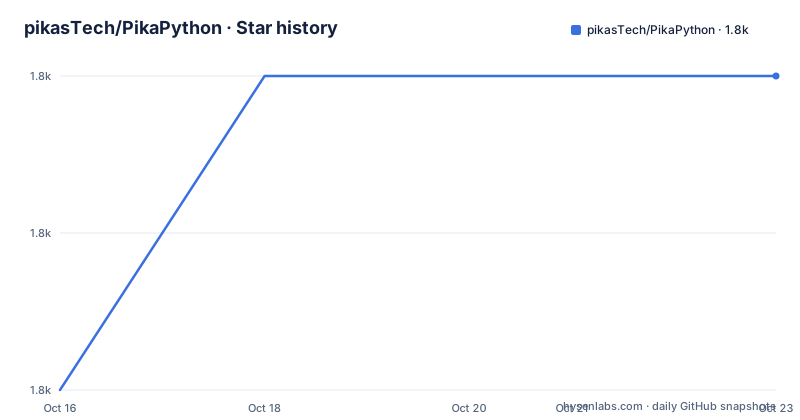
- pikasTech/PikaPython1,761 ★ · +2
| Repository | 2026-10-16 | 2026-10-23 |
|---|---|---|
| pikasTech/PikaPython | 1.8k | 1.8k |
2 Stars in the last 7 days, measured from the daily GitHub snapshot. Compare with other projects
Editorial analysis
PikaPython's target problem and intended users
PikaPython addresses the problem of running Python-style application code on embedded systems where a conventional Python runtime would consume too much memory. The repository describes the interpreter as using only 4 KB of RAM and having zero dependencies. That target is aimed at firmware developers who want a compact scripting layer for microcontrollers rather than developers running Python applications on a desktop or server. The README also positions the project as an alternative to MicroPython and JerryScript.
The repository is primarily written in C, which fits the firmware context and makes native integration part of the design rather than an afterthought. PikaPython is intended for developers working with boards and peripherals such as GPIO, timers, UART, PWM, ADC, and I2C. The platform table lists several STM32 families, including stm32g030c8, stm32g070cB, stm32f103c8, stm32f103rb, stm32f103ze, and stm32f103rc. The table marks support differently for each peripheral, so selecting an MCU name alone does not prove that every listed driver is available.
The documented Pika-Pi Zero board is a useful example of the intended scale. It is based on an STM32G030C8T6 with 64 KB of Flash and 8 KB of RAM, and the README says it can run PikaPython with GPIO, timer, I2C, RGB, key, and LCD support. The board also provides USB-to-serial support through a CH340. This is a concrete hardware example, but it is not evidence that every embedded target has equivalent memory, peripheral coverage, or toolchain support.
The repository layout and C binding mechanism
PikaPython separates the interpreter core, board support, operating-system ports, packages, tools, and examples. The `src` directory contains the core code. `bsp` contains MCU and board support, while `port` contains OS and package-manager integrations. The `examples` directory contains scripts covering devices, callbacks, classes, tasks, threading, AES, Base64, JSON, event loops, flashdb, and other modules. This layout gives a porting project a clear place for hardware code, application scripts, and reusable packages.
The most distinctive extension path is Pika Pre-compiler. The README states that a developer can write the API of a Python module in a `.pyi` file and use Pika Pre-compiler to generate the bindings to C functions. The `tools/pikaCompiler` directory contains the pre-compiler, described as written in Rust. The workflow therefore separates the Python-facing declaration from the C implementation. The declaration describes the module interface, and the generated binding makes that interface available to the interpreter. This is more controlled than making every embedded API follow a Python runtime's object model.
The repository also includes `tools/pikaPackageManager` and a `packages.toml` file, which indicate a package-oriented workflow for reusable modules. The README links to package-manager documentation, but the excerpt does not document a complete command sequence for searching, installing, upgrading, or removing packages. As a result, the package system should be treated as part of the porting surface, not as a fully reproducible host installation procedure.
Starting from the online generator and simulation paths
The README's documented starting point is the Online Project Generator at `http://pikascript.com`. It says this path can generate projects, while Keil projects require the Community Edition license and Keil newer than v5.36. This is a tooling and licensing constraint for that route, not a claim that all PikaPython ports use Keil. The README does not give a shell installation command, a package-manager installation command, or a host compiler sequence for the interpreter itself.
For a first use without target hardware, the README points to a simulation project documented as `Keil 仿真工程`. The expected workflow is therefore to use the generator or simulation project to create an executable environment, then connect Python scripts to the APIs available in that project. The documentation does not provide enough detail in this excerpt to reproduce a complete build and script-upload sequence, so those steps should be taken from the linked documentation rather than inferred.
A hardware-first path is also documented through Pika-Pi Zero. The board's STM32G030C8T6 has 64 KB of Flash and 8 KB of RAM, and the README describes support for GPIO, timer, I2C, RGB, key, and LCD peripherals. Its CH340 provides a USB-to-serial path, and the README states that Python scripts can be downloaded through that connection. The project also offers PikaPython Studio as a serial-terminal, script-download, and package-management tool. The README does not specify Studio's supported operating systems, executable format, or exact menu actions.
Platform support is board-specific, not merely CPU-specific
The platform table is more useful as a starting point for port selection than as a general compatibility guarantee. For the listed STM32 devices, the table separates BSP availability from individual peripheral support. GPIO, timers, UART, PWM, ADC, and I2C appear across the displayed entries, while DAC support is not marked for those rows. This distinction matters for firmware work. An MCU can have a BSP and still lack the particular timer channel, I2C implementation, or board pin mapping required by an application.
The repository also identifies topics and directories associated with RTThread and other embedded environments, but the excerpt does not provide a complete list of supported RTOS versions or porting instructions. Related projects include an LVGL binding and several Blue Pill demos. Those are separate repositories or examples, so they should not be treated as part of the core interpreter's supported surface.
The 4 KB RAM claim describes the interpreter's low-memory objective, not a guarantee that every application fits in 4 KB. Scripts, generated bindings, packages, C buffers, the application itself, and the board's runtime overhead all affect the final memory budget. The README gives the Pika-Pi Zero figures but does not publish a per-feature memory table. Consequently, an engineer must validate the generated firmware for the actual script and peripheral workload.
PikaPython versus MicroPython and JerryScript
The README names MicroPython and JerryScript as similar projects, but it does not provide a detailed feature matrix. The clearest documented distinction is PikaPython's C extension workflow. Its Pika Pre-compiler generates bindings from a Python API declaration written in `.pyi`, while PikaPython itself is implemented primarily in C. This favors teams that already have native firmware modules and want an explicit Python-facing declaration.
The README does not document comparative performance, module compatibility, package formats, supported boards, or migration behavior for this repository. A team should not choose PikaPython merely because its 4 KB RAM statement appears smaller than a competing project's headline. The decision depends on language requirements, native bindings, board support, and the exact scripts that must run.
PikaPython also has a version distinction that matters during adoption. The README says PikaPython V2 is available with a redesigned kernel, a unified project CLI, and Code Agent workflows, and links to the `v2` tree. The recent releases listed for the repository are V2 release candidates, including v2.0.0-rc5 dated 2026-09-02. The README content, however, also describes the V1-oriented online generator and PikaPython Studio. The project therefore needs branch-aware evaluation rather than assuming that every command and document applies to both lines.
Maintenance signals, licensing, and adoption costs
The repository is not archived, and its last push was on 2026-09-11. Recent listed releases include v2.0.0-rc5 on 2026-09-02, v2.0.0-rc4 on 2026-08-30, and v2.0.0-rc3 on 2026-08-07. These dates indicate recent activity around the V2 release-candidate line. They do not establish compatibility between each release candidate, and the README excerpt does not document a stable V2 release.
The repository declares the MIT license. That identifies the project's stated licensing model, but it does not answer questions about bundled packages, board libraries, generated output, or third-party tool licenses. The README separately notes that Keil Community Edition is required for Keil project generation and that Keil must be newer than v5.36. That is a concrete build constraint. The project also uses a Rust pre-compiler, a C interpreter core, and platform-specific support code, so adoption cost includes toolchain setup, board configuration, package selection, and validation of generated bindings.
The documentation does not provide a documented rollback procedure, compatibility policy between `master` and `v2`, or release-candidate migration guide. Those omissions matter for production firmware, where a version change can affect generated interfaces and memory use. The first verification step should be to identify the branch and release line, then inspect the MCU BSP and package set used by the intended project.
Editorial conclusion
Adopt PikaPython when a microcontroller project needs Python-level scripting, limited RAM, and a path from Python declarations to C functions. Do not adopt it when the project requires a documented general-purpose installation path, complete hardware coverage, or clear evidence that a specific board and peripheral combination is supported. Verify the intended branch, the selected MCU BSP, generated C bindings, package dependencies, and the exact RAM and Flash budget before committing the design.
Frequently asked questions
What is PikaPython used for?
PikaPython is an embedded Python interpreter for resource-constrained devices. The README highlights a 4 KB RAM target, C extension support, and microcontroller use cases such as GPIO, timers, UART, PWM, ADC, and I2C.
Does PikaPython support Microcontrollers?
The README lists several STM32 families in its platform support table, including stm32g030c8, stm32g070cB, stm32f103c8, stm32f103rb, stm32f103ze, and stm32f103rc. Peripheral support is listed separately for each MCU, so applications must check the required driver.
How do you extend PikaPython with C?
The documented path is to declare a Python module API in a `.pyi` file and use Pika Pre-compiler to generate bindings to the C functions. The `tools/pikaCompiler` directory contains the pre-compiler described as written in Rust.
Official sources
Add this badge to your README
If you maintain this project, the badge below links readers to this analysis and shows its maintenance status from the daily GitHub snapshot. Paste the markdown into your README; add ?metric=license or ?metric=stars to the image URL for a different field.

[](https://hysenlabs.com/projects/pikastech-pikapython)Star history chart for your README
[](https://hysenlabs.com/projects/pikastech-pikapython)Was this useful?