meta-ads-mcp calls itself an independent open-source project while its manifest is a proprietary source-available licence with a patched floor for a host-header bypass
Meta Ads (Facebook/Instagram) MCP server for Claude, ChatGPT, Perplexity & Cursor — the Meta node of Pipeboard’s 5-platform family (+ Google, TikTok, Snap, Reddit). Hosted remote MCP, badged Meta Business Partner, free plan — no self-hosting required.
At a glance
- What is it?
- meta-ads-mcp is an MCP server that lets an assistant launch and analyse Meta ad campaigns, shipped alongside four sibling servers for other ad platforms and a Go command line client in a separate repository. The hosted path is the recommended one and needs no developer token. The packaging files are where the interesting decisions are, and one of them is a licence that does not match the word open source used twice in the readme.
- Who is it for?
- This is worth reading if you are deciding whether to point an agent at a real advertising account, because the documentation is unusually candid about its own limits and it is worth reading the licensing before the feature list. Two things to decide first.
- Can I use it commercially?
- Check first. The repository uses a licence we do not classify automatically, so read its LICENSE file before any commercial use.
- Is it still maintained?
- Yes. The repository last received commits 26 days ago.
- What is it written in?
- Mainly Python, according to GitHub's language statistics.
Answers come from the project's GitHub data, last synced on November 15, 2026, and from our analysis. They are not legal advice.
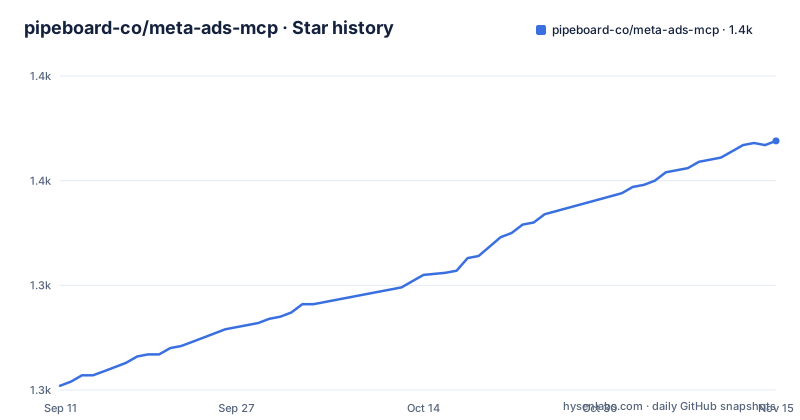
Star history
- pipeboard-co/meta-ads-mcp1,369 ★ · +117
| Repository | 2026-09-11 | 2026-11-15 |
|---|---|---|
| pipeboard-co/meta-ads-mcp | 1.3k | 1.4k |
117 Stars in the last 65 days, measured from the daily GitHub snapshot. Compare with other projects
Editorial analysis
The readme says open source twice and the manifest says proprietary
The first thing to reconcile is the licence. The readme calls this an independent open-source project, and the file list at the top of it includes a licence file as if that settles the matter. The manifest says otherwise. It declares a source-available licence with a commercial-use restriction and classifies the package under other or proprietary licence rather than any of the open-source classifiers. The project metadata carries no licence value at all. Source-available licences with a change clause are a real and deliberate category, and they are not the same thing as an open source grant: the point of an open source licence is that the rights are granted to everyone, while a source-available licence typically reserves some rights and sets conditions on when the terms change. So the two descriptions in the same repository are not reconcilable, and the manifest is the one a package index and a legal review will read. Two more framing details sit alongside this. Self-hosting is labelled as being for technical users only, and the recommended path throughout is a hosted service that needs no developer token.
One dependency has a patched floor because of a host-header authentication bypass
Both dependency files carry the same three-line note about a security advisory, and it is the most valuable thing in the repository. The web framework the MCP SDK pulls in transitively is floored above version 1.0.0 because versions up to and including 1.0.0 are affected by an advisory whose name is given as a host-header problem and whose description is a host-header authentication bypass:
# Pulled in transitively by mcp; pin a patched floor for CVE-2026-48710 (BadHost
# Host-header auth bypass), vulnerable in starlette <= 1.0.0.
starlette>=1.0.1
A host-header authentication bypass is worth understanding rather than noting. If a server trusts a header that a client can set, an attacker who can reach the server can claim to be someone else, which for an OAuth callback is the difference between logging in as yourself and logging in as an account you chose. The MCP SDK itself is pinned to an exact version rather than a floor, which is the right call for a package whose transitive graph carries a vulnerability like this, and the note explains why the floor exists so a future dependency bump does not silently undo it. What the note does not say is whether the pinned SDK version was tested against the patched framework, or whether the hosted deployment is running a patched build at all.
Three build systems, and the test runner is a runtime dependency
One package, three ways to build it. The manifest declares a modern build backend and lists its dependencies. There is a second dependency file, used by the container image. And there is a setup script that calls the older build tool with no arguments at all, which means anyone who builds through that route gets defaults instead of the metadata declared in the manifest. The container does not use the manifest either: its file copies the requirements list, installs a package manager, and installs from that list with a system-wide flag, so the image is built from a dependency list that is not the manifest's. The two lists are not identical. The manifest includes a test runner and its asynchronous plugin as runtime dependencies, and the requirements file does not include them at all. So installing the package from the manifest drags a test framework onto your machine, while building the container, which is the path most people take, installs neither. That is backwards, and it is the kind of thing that is invisible until someone tries to run the container's tests and finds the runner missing.
A standard library module is installed as a package, and two HTTP clients are both present
The dependency list has a few entries that deserve a second look. One of them is the standard library's path-handling module, pinned to a version above 1.0. There is a distribution of that name on the package index that predates the standard library version, and installing a package whose name matches a standard library module is how a working interpreter quietly picks up someone else's module instead. Nothing about this repository suggests the backport is needed; if the code was written against modern Python, the dependency is either vestigial or a mistake. The other entries are more defensible but still worth naming. An imaging library is there for creative uploads, which makes sense. A dotenv loader is there, which means configuration is read from the environment at runtime rather than passed in. And two HTTP clients are both present, one modern and one older, which means one of them is legacy. Three version statements also disagree: the manifest allows a floor, the container pins a specific minor of the same major line, and there is a version-manager file at the root with its own opinion.
Forty-two tools here, two hundred and thirty across five endpoints, one shared rate limit
The family framing is the sales pitch and the arithmetic supports it. The Meta server is described as 42 tools covering campaigns, ad sets, ads, creatives including dynamic creative testing, image upload, insights, and several targeting dimensions plus page management. Four sibling servers are listed with their own endpoints and counts: 59 for one, 59 for another, 37 for one, 33 for the last, which sums to the 230 the readme claims. Each endpoint is a distinct URL and they are presented as interchangeable because they share the same authentication, the same discovery mechanism, the same confirmation model, and the same token. That last point is the one to think hardest about. One token across five ad networks means one revocation point, which is convenient, and one rate-limit ceiling, which means a runaway agent on one platform eats the budget for the other four. The command line client that exposes all of them is a single static binary written in a different language, living in a different repository, installed from a package manager tap, and it exists specifically to avoid a protocol handshake on every call. So the Python server in this repository is one node of a product whose shell lives elsewhere.
The safety claim is universal for confirmations and conditional for paused campaigns
The comparison table in the readme is worth reading on its own terms, because it rates the competition and rates itself lower in one row. On trust, the first-party connector gets the better answer and this project gets a business-partner badge. On price, the first-party connector is described as free in an open beta while this one is a free plan followed by paid tiers. On safety, the first-party connector is described as defined by its owner and this one as explicit confirmation on every write. Then, in the paragraph after the table, the readme says the first-party connector is the safest single-platform option. No vendor writes that sentence unless it is true or unless nobody reads. So the safety model is worth taking at face value in the part that matters. Writes are explicit and confirmed. New campaigns start paused. And that second guarantee is conditioned: the surrounding text says campaigns start paused where the platform supports it. Which platforms support it is not itemised, so the strongest part of the safety story has a platform-dependent escape hatch that a reader has to check for their own network.
The end-to-end tests are excluded from the default run
The test configuration is explicit about what it will not run. There is a marker for end-to-end tests whose own description says they require a running MCP server, and the default invocation deselects them with a marker expression while running in strict mode so an unregistered marker is an error rather than a skip. Asynchronous mode is on by default, so the asynchronous tests run without decoration. What that means in practice is that a default test run proves the pure logic and the request-shaping, and proves nothing about the server. For a package whose entire value is a protocol server talking to a live advertising API, the tests that would catch a broken handshake or a mis-shaped tool response are the ones you have to ask for explicitly. Combined with the earlier observation about the test runner living in the manifest rather than in the file the container installs, the testing story is thin in a specific way rather than in a general one. The repository does have an examples directory with an HTTP client and its own readme, which is the more useful smoke test.
An allowlist file at the root and a getting-started section that stops mid-word
Three root entries describe the shape of the service rather than the code. There is an email allowlist file, which in a public repository suggests some part of the hosted service is gated by address rather than open to anyone with a link. There are two registration manifests, one for a tool directory and one for the protocol's own server metadata, both of which are how a hosted server gets discovered by clients that are not configured by hand. And there are three focused documents: notes on the Meta API, a guide to setting up the streamable HTTP transport, and a file of planned improvements. That last group is where the boundary of the open repository sits. The getting-started section is the recommended path and it describes the hosted service using a streamable HTTP transport for what it calls reliable, scalable access, and the sentence ends partway through that word. So the document that is supposed to get you running ends mid-sentence, while the platform notes and the transport guide live in separate files. Nothing here is a secret, but the part that explains how the transport is actually configured is not the part most readers are sent to.
Editorial conclusion
This is worth reading if you are deciding whether to point an agent at a real advertising account, because the documentation is unusually candid about its own limits and it is worth reading the licensing before the feature list. Two things to decide first. Whether the licence works for you, since the manifest names a source-available terms with a commercial-use restriction and the classifier calls it proprietary, while the readme describes the project as independent and open source twice. And whether the hosted route is acceptable, since it is the recommended path, it holds your advertising OAuth on someone else's servers, and all five platforms share one token and one rate-limit ceiling, which means one noisy agent consumes your budget everywhere at once. Before you connect anything, check three things. What the safety model actually guarantees, since the confirmation on writes is universal but the paused-by-default campaign behaviour is conditioned on the platform supporting it. Where your credentials go, since one token covers five ad networks and one revocation point. And what a passing test run means here, because the end-to-end tests are excluded from the default invocation and the tests that do run do not need a server.
Frequently asked questions
What does the meta-ads-mcp server do?
It is a Model Context Protocol server that lets an assistant run Meta ad operations in natural conversation across Facebook and Instagram surfaces, described as 42 tools covering campaigns, ad sets, ads, creatives including dynamic creative testing, image upload, insights, targeting dimensions, and page management. It runs as a hosted remote server or locally as a Python package.
Is meta-ads-mcp open source?
The readme calls it an independent open-source project twice, but the manifest declares a source-available licence with a commercial-use restriction and classifies the package as proprietary, and the licence field in the project metadata is empty. The manifest is what a package index reads, so treat the licence as source-available rather than open source.
Why is meta-ads-mcp pinned to a newer starlette version?
Both dependency files carry a note saying the web framework is pulled in transitively by the MCP SDK and that versions up to 1.0.0 are affected by an advisory described as a host-header authentication bypass, so the dependency is floored above that. The MCP SDK itself is pinned to an exact version rather than a floor.
What does Pipeboard's MCP family include?
Five remote servers with their own endpoints and tool counts, which sum to more than 230: this one for Meta at 42, and siblings for Google, TikTok, Snap, and Reddit. They share one authentication, one discovery mechanism, one write-confirmation model, and one API token, so an agent that learns one learns the rest.
Does meta-ads-mcp confirm before changing campaigns?
The stated model is an explicit confirmation prompt on every write, and the comparison table gives this project credit for it. The paused-by-default behaviour for new campaigns is conditional, though, since the surrounding text says it applies where the platform supports it and does not itemise which platforms do.
How are the meta-ads-mcp tests configured?
The default invocation runs in strict marker mode and explicitly deselects the tests marked as end-to-end, whose own description says they need a running MCP server. Asynchronous mode is on by default. Separately, the test runner is a runtime dependency in the manifest but is absent from the requirements file the container image installs from.
Official sources
Add this badge to your README
If you maintain this project, the badge below links readers to this analysis and shows its maintenance status from the daily GitHub snapshot. Paste the markdown into your README; add ?metric=license or ?metric=stars to the image URL for a different field.

[](https://hysenlabs.com/projects/pipeboard-co-meta-ads-mcp)Star history chart for your README
[](https://hysenlabs.com/projects/pipeboard-co-meta-ads-mcp)Was this useful?