ux-ui-agent-skills: 44 gates, a Python test chain, and two descriptions that disagree
Turn Claude into a Senior Design Architect — DTCG design tokens, 42 components, WCAG 2.2 accessibility, any-framework code, 138 design systems, and runnable skills.
At a glance
- What is it?
- A JavaScript kit of design tokens, instructions and example pages for Claude Code, with no runtime and no dependencies. Its own numbers do not all line up: the component count differs between the repository description and the package description, the test script is half Python, and the gate documentation uses three different totals.
- Who is it for?
- Judge this as documentation with a test harness attached, not as a library, because that is what it ships: tokens, rules, example HTML and a gate suite, with package version 2.8.0 matching the newest release tag and the last commit one day behind it. The weak points are all in the numbers rather than the rules.
- Can I use it commercially?
- Yes. MIT is a permissive licence: you can use, modify and sell software built on it, as long as you keep its copyright and licence notices.
- Is it still maintained?
- Yes. The repository last received commits 5 days ago.
- What is it written in?
- Mainly JavaScript, according to GitHub's language statistics.
Answers come from the project's GitHub data, last synced on November 22, 2026, and from our analysis. They are not legal advice.
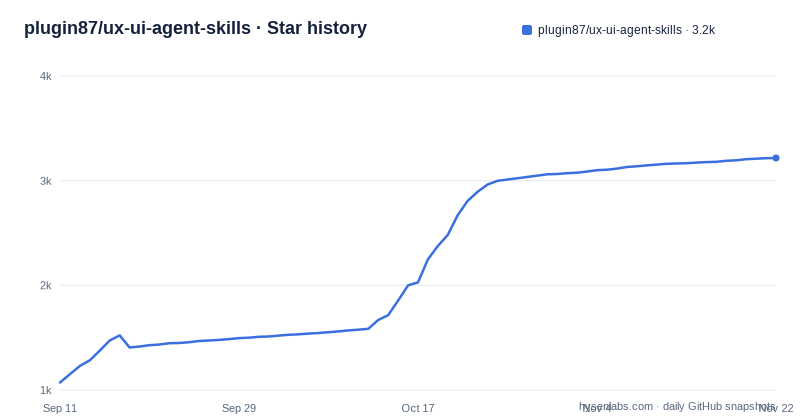
Star history
- plugin87/ux-ui-agent-skills3,217 ★ · +2,145
| Repository | 2026-09-11 | 2026-11-22 |
|---|---|---|
| plugin87/ux-ui-agent-skills | 1.1k | 3.2k |
2,145 Stars in the last 72 days, measured from the daily GitHub snapshot. Compare with other projects
Editorial analysis
The repository description and the package description count components differently
The repository description promises 42 components and WCAG 2.2 accessibility. The description field in `package.json`, the one npm and anyone reading the manifest sees, says 50 components, WCAG 2.2 AA to AAA, plus i18n and RTL accessibility, and 19 runnable skills. The count that matters most for planning is the component count, because the two numbers cannot both be right and nothing in the repository says which one is current. The other fields agree: both descriptions say 138 design systems and both claim any-framework output. The version lines agree too, with `package.json` at 2.8.0 and the newest release tag v2.8.0 published on 2026-09-15, the last commit landing on 2026-09-16. So the versioning is disciplined and one headline number is not, which is a useful thing to know before you plan a component migration around either figure.
The test chain is half Python on a project with no dependencies
The claim at the top is that there are no build tools, no dependencies and no runtime, a pure instruction and knowledge layer. The `test` script contradicts the spirit of that while being perfectly normal for a lint suite. It is eight commands chained with `&&`, and six of them are `python3` invocations:
node bin/cli.js list >/dev/null && python3 scripts/validate_tokens.py && python3 scripts/validate_contrast.py`validate_tokens.py`, `validate_contrast.py`, `validate_component_spec.py`, `validate_theme_refs.py`, `check_no_emoji.py` and `check_links.py` all require a Python 3 interpreter on the path, in a repository whose primary language is JavaScript. `lint_hardcodes.py` runs against `examples/golden` and nothing else, so the hardcode check covers one example directory rather than the pages it publishes. The `test:render` script shows which files the measurement pass reads:
node scripts/measure_render.mjs examples/apple-demo/index.html examples/sample-app/preview.html && node scripts/measure_render.mjs --dark examples/sample-app/preview.htmlOnly two of the twenty-nine root directories hold JavaScript tooling, and the rest of the checks live in Python or in Node test files under `tests/`.
Three gate counts circulate and none of them is labelled
A reader trying to reproduce a claim from this repository has to guess which number belongs to which command. The opening says the screenshots were taken from the same HTML that the 44 gates measure. The comparison table shows ten gates rejecting a deliberately bad fixture and says the good page passes all 44. The cold-start section then reports a score of 14/14 on an independent run of `evals/run.mjs`, and describes two pages that pass all fourteen gates. Three totals, two of them on the same page, and no sentence says whether 44 and 14 count the same things at different scopes or measure different things entirely. The one thing that does hold the documentation in place is `tests/meta/browser-gates.test.mjs`, which the README says pins every claim in that verdict table so it cannot rot, and the `test:gates` script that runs the files under `tests/meta/` together with the unit and CLI tests.
Two of the gates are known to look away, and both cases are documented
The verdict table records the limits as plainly as the failures. On white text over a gradient the contrast gate reports `x <h1> "Analytics Dashboard" 1.00:1 (need 3)` with the explanation that a gradient has no measurable background, so the worst case is reported as the literal worst case rather than as an inconclusive result. The state-aware check catches something the first one cannot, reporting `x default "Save Changes" 1.00:1 (need 4.5) [rgb(255,255,255) on rgb(255,255,255)]`, white on white in the default state of a control, with six states below AA. The second documented blind spot came from the cold-start run: a reduced-motion policy living in an external stylesheet read as no policy at all, because Chromium treats a file URL linked sheet as cross-origin. That is the condition a locally opened example page is always in, so a reduced-motion rule can pass the gate on a developer machine while being invisible to it. The rule lives in `CLAUDE.md` and `.claude/rules/`, and the checking script is `scripts/verify_reduced_motion.mjs`.
The terminal screen claims ten chart types and then names eleven
The density test is one screen with ten chart types on it: candlestick, volume, moving average, depth, order book, tape, sparklines, stacked area, waterfall, bubble and a correlation matrix. That is eleven named artifacts against a stated ten, and the correlation matrix is the one that does not fit a single chart type description, so either the count or the list needs a correction. The published site has 49 live pages described as twenty whole-product screens, every component harness, and both reference screens. If every component really has a harness, the arithmetic leaves 27 harnesses for the component count, which matches neither the 42 in the repository description nor the 50 in the package description. Either some components have no harness, or the page count is stale. It is a small discrepancy, and it is the kind that tells you the component list and the published pages are maintained by different hands.
Cold start found seven defects that warm runs never hit
The strongest evidence in the repository is an experiment it ran against itself. Two subagents were given a brief and a project scaffolded by `ux-ui-skills new`, which installs the kit and ships no example screens, plus nothing else: no hints, no warning that anything would be scored, no access to the conversation that built the kit. Both scored 14/14 on an independent run of `evals/run.mjs`, and the README attributes that transfer to the rules rather than to familiarity. What the two runs cost is the more useful number, seven defects that four in-session runs never produced. A secondary button landed at 1.13:1 dark on dark because the component tier never followed the dark map. The reduced-motion stylesheet case above was one of them. Also on the list: a missing scrim token, a theme that emitted colours and no spacing, and an intent gate that did not know cancelling a subscription is a destructive action. The explanation offered is that a familiar run reaches for a finished demo theme instead of the template a real new user receives, so the template itself had been hiding defects.
The critique pass rejected two pages that pass every gate
After the scoring, the outputs went to a `/critique` step that renders the work and argues for rejection. Its verdict on two pages that pass all fourteen gates was rework, with eight findings, five of them Major, and not one of them measurable by a gate. An empty state that reads as a page which failed to load. A theme toggle that communicates nothing about its own state. A toast claiming a draft project was created over a list that never changed. A loading state wearing the disabled dimming, so it reads as a control you cannot use. These are the failure modes a machine check cannot see, and the README treats them as the reason the 44 gates are not sufficient on their own. The blind outputs were never edited, and they stay in `evals/out/` as the record, with patching described as editing the experiment. That is the part of the setup worth copying: the failure record is a first-class artifact in the repository rather than something discarded after the announcement.
A gate that encodes a dislike of indigo and a hue range for danger
Some of these checks are taste with a numeric threshold attached, which is the honest way to say so. The slop-tell pass flags a hardcoded indigo to purple gradient, a single radius, one flat shadow and `#000` on `#fff`, and the taste audit reports the biggest heading at 24 pixels against a 14 pixel body as a 1.7x ratio rather than a display scale. The token-by-intent check reports `x "Delete Account" is destructive but filled with rgb(99, 102, 241) (hue 239deg, not a danger colour)`, so a destructive control has to fall inside a hue range the script defines. That rule has history on the page: `lint_intent` used to resolve primary and danger from a page's own CSS variables, so a page with no tokens resolved neither and got skipped entirely, reporting zero intent-bearing controls. The fix inverts the behaviour, because an untokenised page is exactly where intent gets picked by convenience. The stated cost of the change was checked against every example in both themes afterwards, with no false positives reported.
Editorial conclusion
Judge this as documentation with a test harness attached, not as a library, because that is what it ships: tokens, rules, example HTML and a gate suite, with package version 2.8.0 matching the newest release tag and the last commit one day behind it. The weak points are all in the numbers rather than the rules. Two descriptions disagree on how many components exist, three gate totals circulate with no label saying which script owns which, the main test chain needs a Python interpreter on a project that claims no dependencies, and the contrast checker has two documented blind spots on gradients and on linked stylesheets opened over file URLs. Before depending on a passing gate run, check which command produced the number you are quoting, and reproduce the render checks with the same serving method the project used.
Frequently asked questions
What is ux-ui-agent-skills?
It is a JavaScript kit of design tokens, instruction files, example pages and design systems, published on npm as `ux-ui-agent-skills` at version 2.8.0 under the MIT license. The package claims no build tools, no dependencies and no runtime, and installs either as a Claude Code plugin or through npx.
How many components does ux-ui-agent-skills ship?
Two published numbers disagree. The repository description says 42 components while the description field in `package.json` says 50 components and 19 runnable skills, so the current count has to be checked against one of those two sources rather than assumed.
What do the gates in ux-ui-agent-skills check?
The documented set covers WCAG contrast on rendered pages and across control states, target size under WCAG 2.5.8, responsive overflow at 280px, axe-core findings, slop tells, a taste audit, token usage by intent, emoji detection and hardcoded values. A deliberately bad fixture at `tests/fixtures/bad/slop-screen.html` is rejected by ten of them with 63 hardcoded values reported.
Does running the ux-ui-agent-skills tests need Python?
Yes. The `test` script chains seven Python scripts, among them `scripts/validate_tokens.py`, `scripts/validate_contrast.py` and `scripts/check_no_emoji.py`, alongside Node commands. The package itself declares no dependencies, so a Python 3 interpreter has to be present on the machine running the checks.
What are Agent skills in Claude and what do they do?
In this repository they are instruction and knowledge files plus a CLI, with the rules carried in `CLAUDE.md` and `.claude/rules/` and an `.mcp.example.json` config template at the root. `ux-ui-skills new` scaffolds a project from the kit and ships no example screens, which is why the cold-start runs in this repository started from rules alone.
How does ux-ui-agent-skills test a design system for accessibility?
The kit scores rendered pages rather than source files. A table of gate verdicts against a bad fixture reports a heading at 1.00:1 on a gradient, a default-state button white on white at 1.00:1 where 4.5 is needed, an icon button at 15.3x16 against a 24x24 minimum, and a SERIOUS axe-core target-size finding, with the claims pinned by `tests/meta/browser-gates.test.mjs`.
Official sources
Add this badge to your README
If you maintain this project, the badge below links readers to this analysis and shows its maintenance status from the daily GitHub snapshot. Paste the markdown into your README; add ?metric=license or ?metric=stars to the image URL for a different field.

[](https://hysenlabs.com/projects/plugin87-ux-ui-agent-skills)Star history chart for your README
[](https://hysenlabs.com/projects/plugin87-ux-ui-agent-skills)Was this useful?