alist-tvbox: a Java proxy that republishes an AList instance as a TvBox subscription, with admin/admin in the readme
AList proxy server for TvBox, support playlist and search.
At a glance
- What is it?
- power721's alist-tvbox turns an AList instance into a TvBox config and subscription endpoint on port 4567. The build is one Maven command, the container is one docker run, and the security surface is printed in the same short document: default admin credentials, a plain http config URL, and an install line that pipes a remote script into a root shell.
- Who is it for?
- Read it as an integration server and check the terms of every upstream before pointing it anywhere: it sits in front of cloud drives and media libraries you are expected to have credentials for, and it republishes them through a subscription URL. If you deploy it, change the admin credential first, keep port 4567 off the public internet or put a reverse proxy with TLS in front of it, and read the one-line install script before letting it run as root.
- Can I use it commercially?
- Not without permission. GitHub finds no licence file in the repository, and without a licence all rights are reserved by default: you may read the code but not reuse it. Check the README, or ask the authors, before using it.
- Is it still maintained?
- Yes. The repository last received commits 2 days ago.
- What is it written in?
- Mainly Java, according to GitHub's language statistics.
Answers come from the project's GitHub data, last synced on November 15, 2026, and from our analysis. They are not legal advice.
Star history
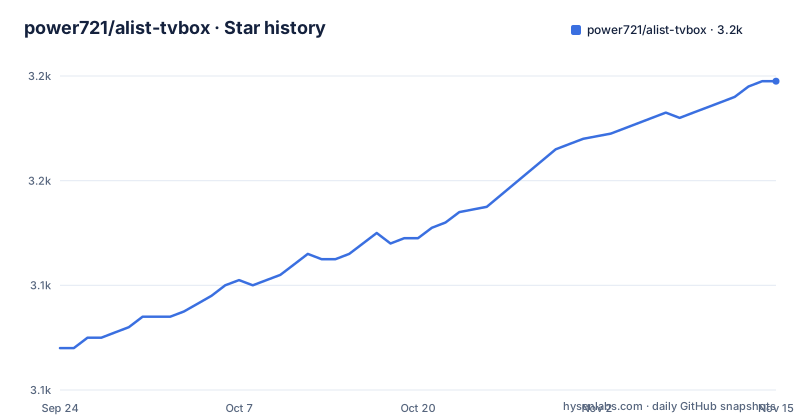
- power721/alist-tvbox3,179 ★ · +51
| Repository | 2026-09-24 | 2026-11-15 |
|---|---|---|
| power721/alist-tvbox | 3.1k | 3.2k |
51 Stars in the last 52 days, measured from the daily GitHub snapshot. Compare with other projects
Editorial analysis
The whole product is one config URL on port 4567
The project is described in a single line: an AList proxy server for TvBox that supports playlist and search. Everything else in the document is downstream of that.
What the user actually configures is one URL, http://ip:4567/sub/0, handed to a TvBox client as its configuration address. There is no account, no key, and no token in that URL, which means the endpoint is protected by whatever the server binds to rather than by anything in the address itself.
The feature list sets the scope: a web management UI for the server, TvBox subscriptions and aggregated configurations, and sources covering AList, Emby, Jellyfin, Feiniu, BiliBili, YouTube, and live streams. Cloud drive accounts and shares are listed for Aliyun, Baidu, Quark, UC, 115, 123, Tianyi, 139, Thunder, PikPak, and GuangYa. The readme also points at OpenList and at a Chinese-language document as related projects.
Four run routes, and one of them pipes a script into a root shell
Build and run from source is two commands:
mvn clean package
java -jar target/alist-tvbox-1.0.jar
Docker is documented three ways: a local build followed by a run, a container from Docker Hub named haroldli/alist-tvbox, and a second image named haroldli/xiaoya-tvbox that also maps a second port and mounts a data directory.
docker run -d -p 4567:4567 --restart=always --name=alist-tvbox alist-tvbox
docker run -d -p 4567:4567 -p 5344:80 -e ALIST_PORT=5344 -v /opt/alist-tvbox:/data --restart=always --name=xiaoya-tvbox haroldli/xiaoya-tvbox:latest
Then there is the fourth route, a single line:
sudo bash -c "$(curl -fsSL https://d.har01d.cn/update_xiaoya.sh)"That one fetches a script over https and executes it as root with no checksum, no review step, and no reference to what it changes. The hostname is a bare domain unrelated to the Docker Hub namespace used two paragraphs earlier, so nothing in the document connects the two. Read that script before running it, or build the container instead.
The default credential and both published ports are in the readme
The security surface of this project fits in four lines of its own documentation.
username: admin

password: admin
Those two values appear immediately after the docker run command, with no instruction to change them and no separate first-run step that forces a password. So a deployment that follows the readme literally is reachable with a two-character guess.
The ports make it worse in a specific way. The first run publishes 4567 on the host and sets --restart=always, so the service returns after a reboot with the default credential intact. The second publishes a second port, 5344 mapped to 80 inside the container and driven by the ALIST_PORT variable, and mounts /opt/alist-tvbox as /data so configuration survives a container replacement. Finally, the config URL itself is plain http, so the subscription payload a client fetches, including whatever site and blacklist configuration it carries, crosses the network unencrypted.
Change the credential, then decide what may reach the port.
The Docker section runs build.sh, and the root holds nine other build scripts
The container instructions begin with:
./build.shThere is no build.sh at the root of this repository. What the root does contain is nine scripts with more specific names: build-app.sh, build-base.sh, build-docker.sh, build-hostmode.sh, build-java.sh, build-musl.sh, build-native.sh, build-service.sh, and build-xiaoya.sh, alongside a mybuild.sh, the Maven wrapper mvnw with its mvnw.cmd companion, and pom.xml.
That naming is itself information. Nine variants imply nine distinct build targets, from a native binary and a musl build through host mode, a service image, and the xiaoya image the second docker run pulls, but the readme explains none of them and names a file that is not among them.
So the one command a self-hosting user is told to run first will fail, and the actual choice between nine real build paths has to be made by reading the scripts.
The jar name says 1.0 and the release numbers are already at 1.109
The run command hard-codes a version:
java -jar target/alist-tvbox-1.0.jarThe release record has moved a long way from that. The three newest tags are 1.107.0, 1.108.0, and 1.109.0, and all three were published on the same day, 2026-10-03, within roughly seven and a half hours of each other. The most recent push is dated the same day.
A Maven build produces whatever artifact name the version in pom.xml dictates, so a checkout at a 1.10x tag does not produce the file the readme tells you to run. Either the instruction is a leftover from the 1.0 era, or the jar is renamed by hand somewhere in one of the nine build scripts, and the document does not say which.
The density of the release numbers is worth noting separately. Three versions in one day is a versioning cadence where the number carries little information, so pinning by version is less meaningful here than pinning by commit.
Site ordering uses three number ranges, and the example sits outside all of them
Order is set with an order field, lower value first, and three defaults are defined around it: built-in sources and plugins start from 1000, subscription sources start from 2000, and a site with no order field defaults to 9000.
The example shows two sites with values below all three ranges:
{
  "sites": [
    {
      "key": "豆瓣",
      "order": 100
    },
    {
      "key": "YouTube",
      "order": 500
    }
  ]
}
An order of 100 and an order of 500 are lower than 1000, so they sort ahead of every built-in source and every plugin, whatever those are. That may be exactly the intent for a site you want pinned to the top, but the readme never says that the ranges describe where those groups start rather than bounds a custom value may cross.
The other customization example is thinner than its prose. The text says it disables two sites by key, changes one site name by key, and adds a new site; the snippet shows a rename and a new site with type 3, an api pointing at a templated drpy script address, searchable 2, quickSearch 0, and filterable 1, plus a blacklist naming two Bilibili spider keys and one parse. No disabled entry appears anywhere in it.
Python plugins travel as one base64 blob inside the subscription
Spider plugins written in Python are not loaded from a directory. They are reached through a site entry whose api is csp_PyProxy and whose jar points at a bundled spring.jar, with the original Python entry and ext wrapped into a base64 string:
"ext": "base64({\"loader\":\"ATV_ADDRESS/Atvp.py\",\"api\":\"ATV_ADDRESS\",\"source\":\"...\",\"token\":\"...\",\"local_proxy_config\":{\"ALI\":{\"enabled\":true,\"concurrency\":20,\"chunk_size\":1024}}})"Everything the Python side needs is encoded into that one field: the loader path, the API base, the source, a token, and the local proxy configuration. Acceleration is off unless local_proxy_config is populated, and the example populates it for one provider with a concurrency of 20 and a chunk size of 1024.
The practical consequence is that the subscription payload a client downloads carries a token and a loader address inside an opaque base64 field, and the readme says nothing about how that blob is validated or which side performs the check.
Three instruction files, two documentation directories, and no licence
The root is busier than a small Java server needs to be. There are three files aimed at contributors and tooling, AGENTS.md, CLAUDE.md, and CONTEXT.md, plus RELEASE_NOTES.md and an api.md. There are two documentation directories, doc/ and docs/, and the doc/ one is where the Chinese-language readme linked from the top of the English one lives.
There are also directories for configuration and data, config/ and data/, a docker/ directory, a scripts/ directory, an atv-cli/ directory, and a web-ui/ directory next to src/, alongside a .zcode/ directory with a .zcodeignore beside it.
The gap worth flagging is licensing. No licence is recorded for the project, and no LICENSE file sits at the root next to the source. For a server that republishes other people's cloud accounts and media libraries through a subscription feed, anyone embedding it has to settle reuse terms separately, and nothing in the tree helps them do that.
Editorial conclusion
Read it as an integration server and check the terms of every upstream before pointing it anywhere: it sits in front of cloud drives and media libraries you are expected to have credentials for, and it republishes them through a subscription URL. If you deploy it, change the admin credential first, keep port 4567 off the public internet or put a reverse proxy with TLS in front of it, and read the one-line install script before letting it run as root. Expect to adapt the build: the readme names a build script and a jar version the repository does not contain.
Frequently asked questions
What is power721 alist-tvbox?
It is a Java proxy server that republishes an AList instance as a TvBox configuration and subscription, served at http://ip:4567/sub/0, with a web management UI. It also aggregates other sources, including Emby, Jellyfin, Feiniu, BiliBili, YouTube, and live streams, and manages cloud drive accounts and shares for eleven named providers.
What are the default credentials for alist-tvbox?
The readme prints username: admin and password: admin directly after the docker run command, with no instruction to change them and no first-run step that forces a new password. The same command publishes port 4567 on the host and passes --restart=always, so the default survives a reboot.
How do I install alist-tvbox?
From source it is mvn clean package followed by java -jar target/alist-tvbox-1.0.jar. For containers the readme shows a local ./build.sh step, an image named haroldli/alist-tvbox, and an image named haroldli/xiaoya-tvbox that maps a second port and mounts a data directory. A separate one-line option fetches a script over https and runs it under sudo, which is worth reading before you run it.
Which cloud drives and media sources does alist-tvbox support?
The feature list names Aliyun, Baidu, Quark, UC, 115, 123, Tianyi, 139, Thunder, PikPak, and GuangYa for accounts and shares, and AList, Emby, Jellyfin, Feiniu, BiliBili, YouTube, and live streams as sources. Offline download is listed for 115, GuangYa, and Thunder, and Python spider plugin management, plugin filters, and local proxy acceleration are part of the same list.
Is a TV Box illegal?
That question is about consumer TV boxes, and this repository is a server-side proxy that republishes an AList instance through a TvBox subscription URL, so it has no answer about consumer hardware. What it does state is which upstream services it can sit in front of, and the terms of those services are the part a user has to check.
Official sources
Add this badge to your README
If you maintain this project, the badge below links readers to this analysis and shows its maintenance status from the daily GitHub snapshot. Paste the markdown into your README; add ?metric=license or ?metric=stars to the image URL for a different field.

[](https://hysenlabs.com/projects/power721-alist-tvbox)Star history chart for your README
[](https://hysenlabs.com/projects/power721-alist-tvbox)Was this useful?