paper2code describes its own output directory three different ways
Agent skill to turn any arxiv paper into a working implementation
At a glance
- What is it?
- paper2code is an agent skill that turns an arXiv URL into a citation-anchored implementation. Its substance is an audit convention, and the interesting reading is where the convention and the documentation disagree with each other.
- Who is it for?
- The idea is worth having, and it is packaged as instructions rather than as software, which makes its own documentation the weakest part of it. The claim that any decision can be checked against the paper rests on a classification scheme with three states and six tags, on a delivery tree that disagrees with itself three times, and on a notebook that runs on toy dimensions instead of on the architecture.
- Can I use it commercially?
- Yes. MIT is a permissive licence: you can use, modify and sell software built on it, as long as you keep its copyright and licence notices.
- Is it still maintained?
- Yes. The repository last received commits 13 days ago.
- What is it written in?
- Mainly Python, according to GitHub's language statistics.
Answers come from the project's GitHub data, last synced on November 22, 2026, and from our analysis. They are not legal advice.
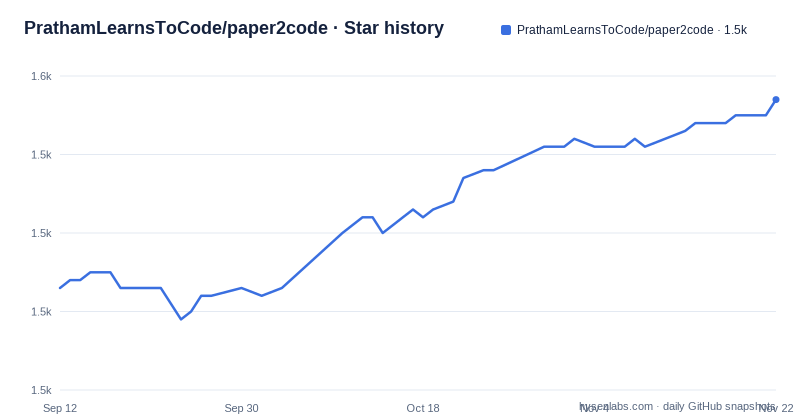
Star history
- PrathamLearnsToCode/paper2code1,547 ★ · +24
| Repository | 2026-09-12 | 2026-11-22 |
|---|---|---|
| PrathamLearnsToCode/paper2code | 1.5k | 1.5k |
24 Stars in the last 71 days, measured from the daily GitHub snapshot. Compare with other projects
Editorial analysis
Three entries at the root, and the install command points inside skills
The repository holds `LICENSE`, `README.md`, and `skills/`. That is the whole tree. There is no package manifest, no `pyproject.toml`, no test directory, no CI workflow, and no GitHub releases, even though the recorded primary language is Python. The Python in question is the illustrative code inside the skill's own documentation, not an importable package.
Installation confirms the shape. It goes through a Node tool, aimed at one subdirectory rather than the repository root:
npx skills add PrathamLearnsToCode/paper2code/skills/paper2codeYou are then asked which coding agents to use it with, such as Claude Code, whether to install it globally or per project, and whether to symlink or copy. Global and symlink are both marked recommended. After that, the documented step is to open the agent and run the skill, with `claude` given as the example and any preferred agent named as an alternative.
So there is no version to pin. The last commit is dated 2026-04-03, and with nothing tagged, every install takes whatever sits on the default branch at that moment.
The hero diagram stops mid box and the GIF is still a placeholder
The first thing a reader meets is an ASCII illustration of the pipeline, and it does not close. The left column ends at `model.py # §3.2 cited` with its right border cut short, the frame underneath stops before reaching the far edge, and the box that would have shown `loss.py` and the rest is not there. The URL on the left is `https://arxiv.org/abs/1706.03762`, and the right side lists four paths: `README.md`, `REPRODUCTION_NOTES.md`, `requirements.txt`, and `src/`.
Underneath it sits a line of italic text that is a production note rather than prose: a placeholder for an animated GIF describing paper fetch, parsing, ambiguity audit, code generation, and walkthrough notebook. The placeholder is still in place.
That carries more weight than a broken diagram normally would, because those five stages are the entire claim of the project. A frame that stops after `model.py` and a GIF slot that was never filled are the only two pieces of evidence a reader gets for how the stages connect to one another.
The output directory is enumerated three times and the lists disagree
Three separate places list what a run produces, and no two of them match.
The hero diagram shows four entries. The delivery tree shows eight: `README.md`, `REPRODUCTION_NOTES.md`, `requirements.txt`, then `src/` holding `model.py`, `loss.py`, `data.py`, `train.py` marked if in scope, and `evaluate.py`. The table of key files then names `model.py` and `REPRODUCTION_NOTES.md` alongside two files that appear in neither list above it: `base.yaml`, called the single source of truth for all hyperparameters, and `walkthrough.ipynb`, called runnable on CPU with toy dimensions.
That second one is the load-bearing mismatch. A notebook running on CPU with toy dimensions exercises shapes rather than the architecture everything else is cited to, so the only artifact guaranteed to execute is the one that never touches the paper. And `base.yaml` claims sole ownership of the hyperparameters while the same tree pins dependencies separately in `requirements.txt` and annotates still more of them inline in `model.py`.
The pipeline classifies choices three ways and the tag table lists six
The stated method is that before a single line of code is written, every implementation choice is classified as `SPECIFIED`, `PARTIALLY_SPECIFIED`, or `UNSPECIFIED`. The tag table then defines a different set of six: `§X.Y` for something directly specified in a section, `§X.Y, Eq. N` for an equation, `[UNSPECIFIED]` for a paper that does not state something, with alternatives listed, `[PARTIALLY_SPECIFIED]` for an ambiguous mention with the quote included, `[ASSUMPTION]` for a reasonable inference with reasoning explained, and `[FROM_OFFICIAL_CODE]` for something taken from the authors' own implementation.
Neither list contains the other. `SPECIFIED` is one of the three states but never appears as a tag, because the table uses `§X.Y` in its place. `[ASSUMPTION]` and `[FROM_OFFICIAL_CODE]` are tags with no state behind them, and both record a provenance the three-way classification has no slot for.
The worked example shows the gap directly:
# [ASSUMPTION] Using pre-norm based on "we found pre-norm more stable" in §4.1
# The paper uses post-norm in Figure 1 but pre-norm in experiments — ambiguous
That is a paper contradicting itself, which the three states treat as `PARTIALLY_SPECIFIED` and the tag records as `[ASSUMPTION]`.
Full mode advertises a data pipeline the skill declines to build
The usage section offers a bare arXiv identifier, a full abs URL, `--framework jax` to pin the framework, `--mode full` for a run that includes the training loop and the data pipeline, and `--mode educational` for extra comments and a pedagogical notebook.
The refusal list then rules the data pipeline out. It will not download datasets, it will not set up training infrastructure with no distributed training, no experiment tracking, and no checkpointing beyond what the paper's contribution requires, and it will not implement baselines. The delivery tree agrees with the refusals: `data.py` is a Dataset class skeleton with preprocessing TODOs and instructions on where to get the data, and `train.py` is annotated as present only if in scope.
So `--mode full` names a stage whose output is a list of TODOs. What full mode can add over the default is the loop and the wiring, not a working data path, and the usage section does not draw that line anywhere.
The flagship UNSPECIFIED example departs from the framework default
The flag system gets its demonstration on LayerNorm epsilon:
# [UNSPECIFIED] Paper does not state epsilon for LayerNorm — using 1e-6 (common default)
# Alternatives: 1e-5 (PyTorch default), 1e-8 (some implementations)
self.norm = nn.LayerNorm(d_model, eps=1e-6)
Annotated as a common default, `1e-6` is a decade below the PyTorch default of `1e-5`, which the same comment lists as an alternative. So the one hyperparameter chosen to show honest flagging yields a layer that differs from the framework default on every generated run. That may be the right call for the paper, which is the entire purpose of the flag, but a reader diffing generated code against hand written code will hit a discrepancy that looks like a mistake and is not.
The companion example shows the anchoring side, citing a section and an equation on the line itself:
# §3.2 — "We apply layer normalization before each sub-layer" (Pre-LN variant)
class TransformerBlock(nn.Module):
    def forward(self, x):
        # §3.2, Eq. 2 — attention_weights = softmax(QK^T / sqrt(d_k))
        attn_out = self.attention(self.norm1(x))  # (batch, seq_len, d_model)
        x = x + attn_out  # §3.2 — residual connection
Worked examples carry the trust, and the review checklist ends mid item
The contributing guide calls worked examples the most trust building part of the project, then specifies how to add one: pick a well known paper whose output people can verify, run the skill, save the full output under `skills/paper2code/worked/{paper_slug}/`, and write a `review.md` that honestly evaluates what the skill got right, what it correctly flagged as unspecified, and any mistakes it made.
The last bullet of that list ends after the words `Any edge`, so the criteria for the final category are never stated, and those saved outputs are what the repository's `skills/` directory would contain alongside the skill itself.
Scope is narrowed in three other places that matter for expectations. It will not guarantee correctness, on the stated grounds that a wrong paper produces wrong code. It will not reimplement standard components, so a paper saying standard transformer encoder yields an import rather than a fresh attention implementation. And only the core contribution gets implemented, never the baselines it is measured against.
Editorial conclusion
The idea is worth having, and it is packaged as instructions rather than as software, which makes its own documentation the weakest part of it. The claim that any decision can be checked against the paper rests on a classification scheme with three states and six tags, on a delivery tree that disagrees with itself three times, and on a notebook that runs on toy dimensions instead of on the architecture. Install from the default branch since there is no version to pin, read the generated `[UNSPECIFIED]` comments instead of trusting the file list, and expect to build the data path yourself.
Frequently asked questions
How do you install the paper2code skill?
With `npx skills add PrathamLearnsToCode/paper2code/skills/paper2code`, which installs into a subdirectory rather than the repository root. You then pick agents such as Claude Code, choose global or project-level scope, and choose symlink or copy, with global and symlink marked recommended.
What files does paper2code produce?
The delivery tree shows README.md, REPRODUCTION_NOTES.md, requirements.txt, and a src directory with model.py, loss.py, data.py, train.py when in scope, and evaluate.py. The key files table also names base.yaml and walkthrough.ipynb, which appear in neither tree.
Does paper2code download datasets?
No. The data module is delivered as a Dataset class skeleton with preprocessing TODOs plus instructions on where to get the data and how to preprocess it. It also skips distributed training, experiment tracking, and checkpointing beyond the paper's contribution.
How does paper2code mark details the paper never states?
Every implementation choice is classified before any code is written, as SPECIFIED, PARTIALLY_SPECIFIED, or UNSPECIFIED, and unspecified choices get an `[UNSPECIFIED]` comment at the exact line where the choice is made, with the common alternatives listed.
What invocation modes does paper2code accept?
A bare arXiv identifier or a full abs URL, plus `--framework jax` to pin the framework, `--mode full` for the training loop and data pipeline, and `--mode educational` for extra comments and a pedagogical notebook.
Official sources
Add this badge to your README
If you maintain this project, the badge below links readers to this analysis and shows its maintenance status from the daily GitHub snapshot. Paste the markdown into your README; add ?metric=license or ?metric=stars to the image URL for a different field.

[](https://hysenlabs.com/projects/prathamlearnstocode-paper2code)Star history chart for your README
[](https://hysenlabs.com/projects/prathamlearnstocode-paper2code)Was this useful?